
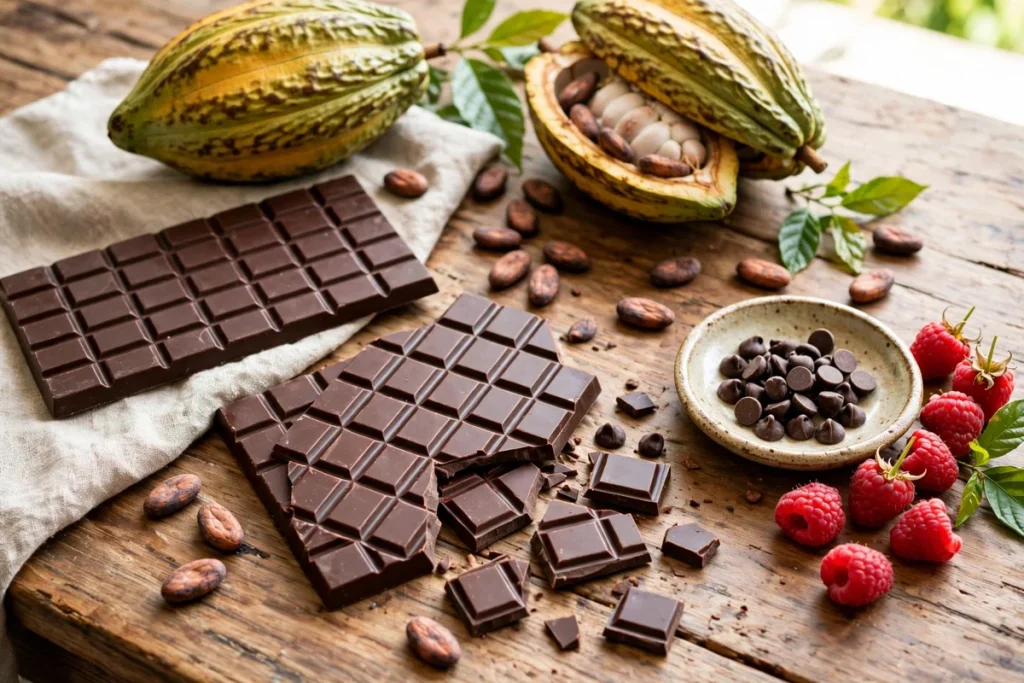

Low calorie chocolate bars sound like a contradiction, and in a way they are. Most chocolate is calorie-dense — roughly 150 calories per ounce — so a bar that genuinely counts as low calorie is usually one of three things: a small, portion-controlled piece; a high-cocoa dark chocolate eaten by the square; or a sugar-free or fibre-rich bar built to cut sugar. A true low-calorie whole bar lands around 60 to 160 calories, and every pick below stays inside that range.
A quick honesty note before the list: per 100 g, most chocolate is still around 500 calories or more. The low numbers below come from the portion, not from chocolate suddenly becoming a health food. Figures are label values for the stated portion. The Lindt Excellence 85% figures were read from Lindt’s official US shop on 27 October 2026, and the rest are widely documented label values — always check the pack, because recipes change.
8 Low Calorie Chocolate Bars Worth Trying
1. Hershey’s Special Dark Miniature — 45 calories
Portion: 1 miniature piece (9 g). Calories: about 45. Sugar: 4 g. Fibre: 0 g. Protein: 1 g. Per 100 g: about 500 calories. This is the lowest-calorie pick on the list, and the reason is simple: it is tiny. One miniature gives you a real hit of dark chocolate flavour for 45 calories. The catch is that the bag invites a second, third and fourth — but even three miniatures is only 135 calories, still less than most full-size bars.
2. Lindt Excellence 85% Cocoa — 1 square, about 57 calories
Portion: 1 square (10 g). Calories: about 57. Sugar: about 1 g. Fibre: about 1 g. Protein: about 1 g. Per 100 g: about 567 calories. Lindt’s official label lists a serving as 3 squares (30 g) at 170 calories, 4 g sugar, 4 g fibre and 4 g protein — divide by 3 and you get roughly 57 calories per square. This is the dark chocolate sweet spot: high enough cocoa that the sugar is low, but not so bitter that most people cannot enjoy it.
3. Lindt Excellence 70% Cocoa — 2 squares, about 110 calories
Portion: 2 squares (20 g). Calories: about 110. Sugar: about 5 g. Fibre: about 2 g. Protein: about 2 g. Per 100 g: about 550 calories. If 85% tastes too intense for you, the 70% bar is the friendlier middle ground — still dark chocolate, still portionable by the square, with a little more sugar and a milder taste.
4. Gatsby Milk Chocolate Style Bar — 60 calories
Portion: 1 bar (28 g). Calories: 60. Sugar: 0 g. Fibre: 7 g. Protein: 2 g. Per 100 g: about 214 calories. Gatsby bars are the lowest-calorie whole bars on this list. They are sugar-free, sweetened with allulose and stevia, and the high fibre is what keeps the calories down — the fibre replaces much of the sugar. For more sugar-free shopping ideas, see our sugar-free grocery list.
5. Gatsby Sea Salt Extra Dark Bar — 70 calories
Portion: 1 bar (28 g). Calories: 70. Sugar: 0 g. Fibre: 7 g. Protein: 2 g. Per 100 g: about 250 calories. Same idea as the milk chocolate version, but with a darker, salted flavour — and still only 70 calories for a whole bar. The sea salt makes a small bar taste bigger, which helps if you are trying to stop at one.
6. Built Bar Puff, Brownie Batter — 140 calories
Portion: 1 bar (51 g). Calories: 140. Sugar: 5 g. Fibre: 1 g. Protein: 17 g. Per 100 g: about 275 calories. This is the protein pick: a marshmallow-textured, chocolate-coated bar with 17 g of protein, which makes it the most filling option here. It is the only pick that works as a genuine snack rather than just a chocolate fix. If you like sweet treats that pull their weight on protein, our protein dessert recipes use the same idea with Greek yogurt, cottage cheese and protein powder.
7. Quest Mini Protein Bar — 90 calories
Portion: 1 mini bar (23 g). Calories: 90. Sugar: 1 g. Fibre: 4 g. Protein: 8 g. Per 100 g: about 391 calories. The mini size is the point: a full-size Quest bar runs about 200 calories, but the mini gives you the same chocolatey, high-protein idea at 90. It is a good middle ground between a pure chocolate pick and a full protein bar.
8. Lindt Excellence 90% Cocoa — 2 squares, about 110 calories
Portion: 2 squares (20 g). Calories: about 110. Sugar: about 2 g. Fibre: about 3 g. Protein: about 2 g. Per 100 g: about 550 calories. For serious dark chocolate fans, the 90% bar has even less sugar than the 85% — about 1 g per square — and two squares is a satisfying, slow-to-eat portion. If you find it too bitter, eat it with a few raspberries; the fruit’s sweetness does the work sugar used to do.
Low Calorie Chocolate Bars at a Glance
| Pick | Portion | Calories | Sugar | Fibre | Protein |
|---|---|---|---|---|---|
| Hershey’s Special Dark miniature | 1 piece (9 g) | 45 | 4 g | 0 g | 1 g |
| Lindt Excellence 85% | 1 square (10 g) | ~57 | ~1 g | ~1 g | ~1 g |
| Lindt Excellence 70% | 2 squares (20 g) | ~110 | ~5 g | ~2 g | ~2 g |
| Gatsby Milk Chocolate Style | 1 bar (28 g) | 60 | 0 g | 7 g | 2 g |
| Gatsby Sea Salt Extra Dark | 1 bar (28 g) | 70 | 0 g | 7 g | 2 g |
| Built Bar Puff, Brownie Batter | 1 bar (51 g) | 140 | 5 g | 1 g | 17 g |
| Quest Mini | 1 mini bar (23 g) | 90 | 1 g | 4 g | 8 g |
| Lindt Excellence 90% | 2 squares (20 g) | ~110 | ~2 g | ~3 g | ~2 g |
Why Dark Chocolate Wins (When You Eat It by the Square)
Cocoa percentage up means sugar down — that is the whole trick with dark chocolate. A milk chocolate bar might be 50% sugar; an 85% bar is about 13% sugar (4 g per 30 g serving on Lindt’s label). The fat and calories per gram stay similar, but because the sugar drops, the flavour gets intense — and intense flavour is easier to stop eating.
The per-square maths makes portioning easy. Lindt Excellence 85% is 170 calories for 3 squares, so 170 ÷ 3 = about 57 calories per square. You can do the same with any bar: take the calories per serving, divide by the number of squares in that serving, and you know what one square costs. Two squares of 85% is about 113 calories — still a low-calorie chocolate fix.
If you want to understand why the protein picks keep you fuller for longer, our calories in protein guide explains protein’s role in satiety and weight loss.
Watch-Outs Before You Stock Up
- Sugar alcohols: sugar-free bars (like Gatsby) use sugar alcohols such as maltitol or allulose. In small amounts they are fine, but eating several bars at once can cause bloating, gas or stomach upset. One bar, not three.
- The low-calorie halo: a 60-calorie bar is only low calorie if you eat one. Two Gatsby bars are 120 calories and two Built bars are 280 — the halo disappears fast when the portion doubles.
- Per-100 g reality: most chocolate on this list is still around 500–570 calories per 100 g. The exceptions (Gatsby, Built) get their low per-100 g numbers from fibre, sugar alcohols or protein replacing sugar and fat. A low-calorie bar is a portioning win, not a different food group.
Frequently Asked Questions
What chocolate bar has the least calories?
The lowest-calorie portion on this list is a Hershey’s Special Dark miniature, at about 45 calories per 9 g piece. If you want a whole bar rather than a miniature, Gatsby’s Milk Chocolate Style bar is 60 calories. In both cases the trick is the small portion — the chocolate itself is not magically low calorie.
Is dark chocolate low calorie?
Not per 100 g — most dark chocolate is 550 calories or more per 100 g, about the same as milk chocolate. Dark chocolate only becomes low calorie when you eat it by the square: one 10 g square of an 85% bar is about 57 calories, and its low sugar (about 1 g) makes it easier to stop at one.
How many calories are in a square of dark chocolate?
About 55–60 calories for a standard 10 g square. Lindt Excellence 85% is 170 calories for 3 squares, so 170 ÷ 3 = about 57 calories per square. For any bar, divide the calories per serving by the number of squares in that serving to get your per-square figure.
Are sugar-free chocolate bars good for weight loss?
They can help, because they cut sugar and usually calories — Gatsby’s bars are 60–70 calories for a whole bar. But sugar-free bars are sweetened with sugar alcohols, and eating a lot of them can cause bloating or stomach upset. They work best as an occasional one-bar treat, not a multi-bar habit.
Can I eat chocolate every day and lose weight?
Yes, if it fits your calorie budget. A daily 45–90 calorie portion — a miniature, a square or two of dark chocolate, or a mini protein bar — is easy to fit into most plans. What breaks the budget is a full 200–250 calorie bar eaten as an extra, every single day, on top of everything else.



Pingback: Clif Bar Chocolate Chip: Calories, Nutrition & Is It Healthy?