
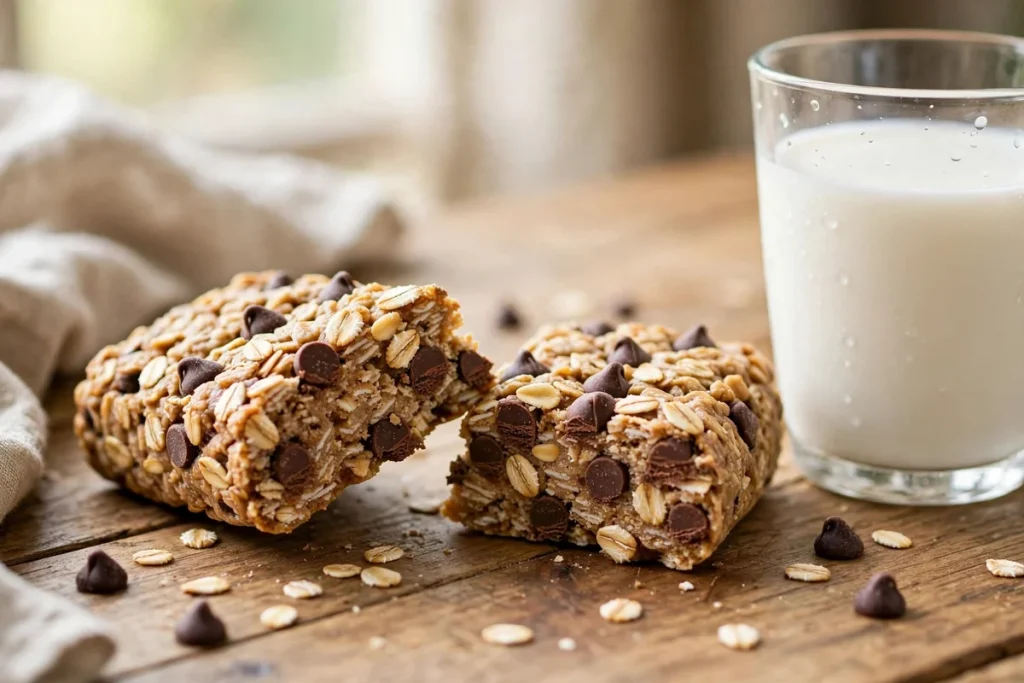

If you want the headline facts on a clif bar chocolate chip up front, here they are: one full bar weighs 68 g (2.40 oz) and contains 250 calories and 10 g of protein, according to the official CLIF BAR product page on clifbar.com, read October 27, 2026. The number that matters most after that is the sugar: 17 g of total sugars, including 16 g of added sugars — a full quarter of the bar’s weight is sugar.
That combination is the whole story of this bar. It is an energy bar built for endurance exercise, made with organic rolled oats and soy protein, and it does its job during a long hike or a bike ride. As an everyday desk snack, though, the sugar load makes it a poor choice for weight loss. This post gives you the official numbers, the honest read, and the half-bar maths for when one whole bar is more than you need.
Clif Bar Chocolate Chip nutrition facts (official values)
Every figure below is taken from the Nutrition Facts panel on the official CLIF BAR Chocolate Chip product page. Serving size is 1 bar (68 g).
| Nutrient | Per full bar (68 g) | % daily value |
|---|---|---|
| Calories | 250 | — |
| Total fat | 6 g | 8% |
| Saturated fat | 2 g | 9% |
| Trans fat | 0 g | — |
| Cholesterol | 0 mg | 0% |
| Sodium | 130 mg | 6% |
| Total carbohydrate | 43 g | 16% |
| Dietary fibre | 5 g | 19% |
| Total sugars | 17 g | — |
| Added sugars | 16 g | 32% |
| Protein | 10 g | 19% |
The honest read: an energy bar, not a health snack
CLIF’s own positioning says it plainly: the CLIF BAR range is for use “Before + During Exercise”, with “Sustained Energy to Support Performance”. That is the context this bar makes sense in. During a long run, hike or bike ride, your body wants quick carbohydrate, and 43 g of carbs with 250 calories is a useful fuel top-up. At a desk, the same bar is mostly a sweet snack with a protein halo.
The sugar is the headline caveat. At 17 g of sugars — 16 g added — this bar carries roughly the sugar of four teaspoons, and added sugars alone make up 32% of the recommended daily value in a single bar. The protein helps: 10 g is respectable for a bar this size, and the 5 g of fibre (partly from chicory fiber) slows things down a little. But the balance is still carb-and-sugar heavy: for every gram of protein you get 4.3 g of carbohydrate and 1.7 g of sugar.
Put another way, per 100 g the bar works out at about 368 calories, 14.7 g of protein, 63 g of carbohydrate and 25 g of sugars (calculated from the official per-bar values and the 68 g weight: 250 ÷ 68 × 100 ≈ 368, and so on). That is energy-dense food — useful when you are burning energy, easy to overdo when you are not.
Half a bar: the portion that makes sense off the trail
If you like the taste but do not need 250 calories of fuel, half a bar is the obvious move. Every official figure halved, rounded sensibly:
| Per half bar (34 g) | Amount |
|---|---|
| Calories | 125 |
| Total fat | 3 g |
| Saturated fat | 1 g |
| Sodium | 65 mg |
| Total carbohydrate | 21.5 g |
| Dietary fibre | 2.5 g |
| Total sugars | 8.5 g |
| Added sugars | 8 g |
| Protein | 5 g |
What’s actually inside
The ingredient list starts well: organic rolled oats, then soy rice crisps (soy protein isolate, rice flour, barley malt extract) and organic roasted soybeans supply the protein. But three of the next ingredients are syrups — organic brown rice syrup, organic tapioca syrup and organic cane syrup — which is where most of the 16 g of added sugars comes from. Unsweetened chocolate and organic cinnamon give it the chocolate-chip flavour, and chicory fiber adds to the fibre total. The bar contains soy, and may contain peanuts, tree nuts, milk, sesame and wheat, so it is not a safe pick for people with those allergies.
Who it suits — and who should skip it
Good fit: endurance athletes and long-distance hikers who need portable carbohydrate during exercise; anyone who needs a quick 250-calorie fuel stop mid-activity and cannot carry real food.
Skip it, or halve it: desk snacking, where the sugar does nothing for you; everyday weight loss, where 250 calories of a sweet bar rarely keeps you full; and low-sugar diets, where 16 g of added sugars in one bar eats most of the day’s budget. If you have diabetes or another condition that makes sugar intake a medical question, talk to your doctor or dietitian before making bars like this a habit — this post is nutrition information, not medical advice.
If you want the sweet fix with less sugar
You do not have to give up sweet snacks to do better than this bar. Our low calorie chocolate bars list has chocolate options under 160 calories, and our protein dessert recipes turn Greek yogurt, cottage cheese and protein powder into sweet treats with 15–30 g of protein. And if protein is the real goal, a scoop of protein powder typically gives 20–27 g of protein for about 110–130 calories — roughly double this bar’s protein for half its calories.
How many calories are in a Clif Bar Chocolate Chip?
One full 68 g bar contains 250 calories, according to the official CLIF BAR product page. Half a bar is 125 calories.
How much sugar is in a Clif Bar Chocolate Chip?
17 g of total sugars per bar, including 16 g of added sugars. That means about a quarter of the bar’s weight is sugar.
Is a Clif Bar Chocolate Chip healthy?
It is an energy bar, not a health food. It has real oats and 10 g of protein, but 16 g of added sugars, so it suits long exercise far better than everyday desk snacking.
Is a Clif Bar good for weight loss?
Not an ideal everyday choice: 250 calories and 17 g of sugars is a lot for a snack, and it is easy to eat without feeling full. Half a bar (125 calories) is the smarter portion if you like the taste.
How much protein is in a Clif Bar Chocolate Chip?
10 g of protein per 68 g bar, from soy protein and oats. That is less than a scoop of protein powder, which typically gives 20-27 g.



Pingback: Are Nature Valley Bars Healthy? Calories, Sugar & Protein Compared