
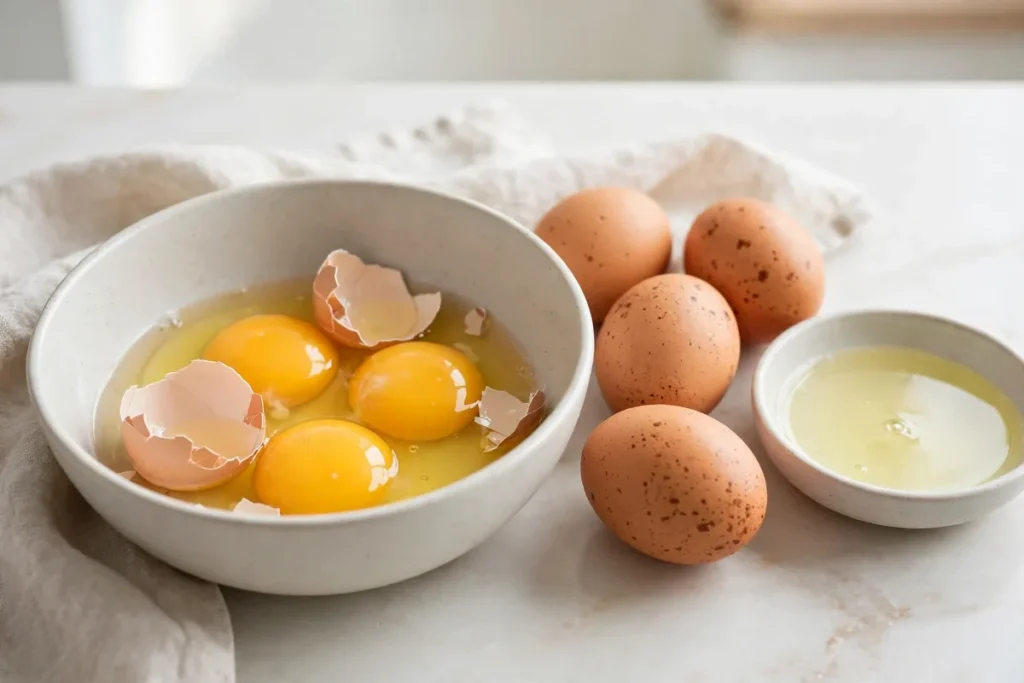

If you’re counting protein, eggs are probably already on your radar — they’re cheap, they cook in minutes, and they show up in everything from breakfast scrambles to post-workout shakes. But “an egg has about six grams of protein” is only the start of the story. The exact number depends on the size of your eggs, how many you eat, and whether you keep the yolk.
This guide breaks down egg protein every way people actually eat it: by count, by size, and split between the white and the yolk. You’ll also see how egg protein stacks up for muscle-building, and how many eggs you realistically need to hit your daily target.
Quick answer: two large eggs give you about 13 g of protein (12.6 g exactly). One large egg has 6.3 g, split between the white (3.6 g) and the yolk (2.7 g). If you only remember one number, make it this: 2 eggs ≈ 13 g.
Protein in Eggs by Count
Eggs are wonderfully predictable: because each egg is its own portion, the protein simply multiplies. Here are the counts for large eggs (50 g each):
| Count | Protein | In round numbers |
|---|---|---|
| 1 egg | 6.3 g | ~6 g |
| 2 eggs | 12.6 g | ~13 g |
| 3 eggs | 18.9 g | ~19 g |
| 4 eggs | 25.2 g | ~25 g |
| 6 eggs | 37.8 g | ~38 g |
Two eggs is the classic breakfast portion — and the most-searched number on this page. At 12.6 g, it covers a solid chunk of the minimum daily protein for an average adult before you’ve added toast, milk, or anything else. Four eggs (25.2 g) is about what you’d get from a scoop of whey or a small chicken breast portion. Six eggs (~38 g) is serious-athlete territory — doable, but most people are better off spreading that protein across the day.
A practical way to think about it: one egg ≈ a “unit” of about 6 g. Need 20 g at breakfast? That’s three eggs (18.9 g) plus a glass of milk. Tracking apps make this easy, but after a week of counting you’ll be doing the multiples of 6.3 without thinking.
Where do eggs fit in a day’s protein? Most active adults do well spreading protein fairly evenly across meals — roughly 25-40 g per meal. Two eggs get breakfast about a third of the way there; three eggs get it halfway. That’s exactly why eggs pair so well with Greek yogurt, cottage cheese, or a glass of milk in the morning: the eggs bring the quality, the dairy brings the volume, and together they clear 25 g without any cooking beyond the eggs themselves.
White vs Yolk: Where the Protein Lives
The egg splits its protein almost evenly — but not its calories. Here’s the breakdown for one large egg:
| Part | Protein | Calories |
|---|---|---|
| Egg white | 3.6 g | 17 |
| Egg yolk | 2.7 g | 55 |
| Whole egg | 6.3 g | 72 |
The white is the leaner protein source: slightly more protein than the yolk (3.6 g vs 2.7 g) with almost no calories, no fat, and no cholesterol. That’s why egg whites are a bodybuilding staple — and why a cup of egg whites (about 7-8 whites) delivers roughly 26 g of protein for just ~126 calories.
But don’t write off the yolk. It holds nearly half the egg’s protein — and almost all of its vitamins, including A, D, and B12, plus choline and healthy fats. Tossing every yolk means tossing half your nutrients to save 55 calories. The honest take: whole eggs are the better food; whites-only is a useful lower-calorie tool when you’re chasing a high protein target on a tight calorie budget. Plenty of people land in the middle — two whole eggs plus extra whites.
Cooking with whites is easy, too: carton egg whites measure like water (about 3 tablespoons equals one white), so you can add two whites to a two-egg scramble and jump from 12.6 g to roughly 20 g of protein for only 34 extra calories. It’s one of the cheapest protein upgrades in the kitchen.
One more way to see the trade-off: protein per calorie. The white delivers about 21 g of protein per 100 calories; the whole egg delivers about 9 g per 100 calories. On pure protein efficiency, whites win easily. But efficiency isn’t the only goal — the yolk’s 55 calories also carry vitamin D, B12, choline, and the fat that helps you absorb fat-soluble vitamins. Unless calories are genuinely tight, the whole egg is the smarter default.
Protein by Egg Size
Just like calories, protein follows weight. Egg size grades are based on the weight of the egg, so a bigger egg simply has more of everything:
| Size | Weight | Protein |
|---|---|---|
| Medium | 44 g | 5.5 g |
| Large | 50 g | 6.3 g |
| Extra-large | 56 g | 7.0 g |
| Jumbo | 63 g | 7.9 g |
Most recipes and nutrition labels assume large eggs, which is why 6.3 g is the standard figure. If your carton is medium, two eggs give you about 11 g rather than 12.6 g — a small gap, but one that adds up if eggs are your main breakfast protein. Jumbo eggs are the quiet overachievers: two of them deliver nearly 16 g, almost as much as three medium eggs.
How Good Is Egg Protein?
Very good — eggs sit close to the reference standard for protein quality. They’re a complete protein, meaning they contain all nine essential amino acids your body can’t make on its own, in proportions your body can actually use. Eggs also rank among the highest-rated protein sources for digestibility, which is why nutrition scientists have used egg protein as a benchmark for decades.
For muscle specifically, the amino acid that matters most is leucine — the trigger for muscle protein synthesis. Each large egg provides about 0.5 g of leucine. Two eggs give you roughly 1 g; pairing them with other protein foods across the meal (Greek yogurt, cheese, meat) easily brings that meal into the 2-3 g leucine range most lifters aim for.
Against plant proteins, eggs have a clear edge in completeness — most plant sources run low in at least one essential amino acid, while eggs have all nine in useful amounts. And how do eggs compare with chicken? A cooked chicken breast has about 31 g of protein per 100 g — far more protein per bite than an egg’s 6.3 g. Eggs win on convenience, price, and nutrients per bite; chicken wins on protein per calorie when you need a lot of protein at once. The smart move isn’t picking a winner — it’s using both.
There’s also the question of timing. Research on muscle protein synthesis suggests spreading protein across the day — roughly 20-40 g per meal — beats loading it all into dinner. Eggs are almost purpose-built for this: they’re one of the few high-quality proteins people happily eat at breakfast, which is the meal most likely to be protein-poor. Two or three eggs in the morning quietly fix the weakest meal of the day.
How Many Eggs for Your Protein Goal?
How much protein you need depends on you. The general RDA is 0.8 g per kilogram of body weight — treat that as a floor, not a target for active people. If you train regularly or you’re building muscle, intakes of 1.2-2.0 g/kg are the common recommendation.
Worked example one: a 70 kg (154 lb) active person aiming for about 110-130 g of protein a day. Adding two eggs at breakfast contributes 13 g — roughly 10% of the goal before 9 a.m. Three eggs pushes that to ~19 g. Stack eggs on top of a chicken or fish lunch (~35-40 g), a Greek yogurt snack (~15 g), and a normal dinner, and the target is comfortably in reach without a single protein shake.
Worked example two: a 60 kg (132 lb) person dieting at 1.6 g/kg — about 96 g a day. Two eggs at breakfast (13 g) plus two extra whites in the scramble (~7 g more) covers a fifth of the day for under 200 calories, leaving plenty of room for lunch and dinner. The pattern is the same at any size: eggs front-load the day with protein while the calorie cost is still low.
Can you eat eggs every day? For most healthy people, yes — egg protein is egg protein whether it shows up on Monday or Friday. Variety still matters for the rest of your diet (fiber, micronutrients, and plain enjoyment), so rotate eggs with other protein sources across the week rather than forcing a carton a day. And if a clinician has given you personal guidance on eggs or cholesterol, that guidance wins over any general article — including this one.
The takeaway: eggs work best as one building block among several meals, not the whole wall. To find your own target based on your weight and activity level, run your numbers through our Protein Calculator — it takes about ten seconds.
Eggs and Calories
Protein never travels alone: each large egg also brings 72 calories and 5 g of fat alongside its 6.3 g of protein — a solid protein-per-calorie ratio for a whole food. Cooking changes the calories (boiling adds nothing; frying adds the fat in the pan) but barely touches the protein. For the full breakdown by cooking method and count, see our egg calories guide.
Boiled and poached eggs keep the full 6.3 g of protein at the lowest calorie cost; scrambled and fried eggs keep the protein too — the extra calories are purely the cooking fat. In other words, you never have to trade protein away to save calories with eggs; you only choose how much fat rides along.
One caution on cooking: extreme heat and very long cooking can slightly reduce protein digestibility, but for normal home cooking — boiling, scrambling, frying — the difference is negligible. What you see in the tables above is what you get, whichever method you choose. If anything, gentle cooking makes egg protein easier to digest than raw egg, which is one more reason to skip the raw-egg shake.
The short version: one large egg = 6.3 g of protein, two eggs ≈ 13 g, and the white and yolk split it almost evenly at 3.6 g and 2.7 g. Eat the whole egg when you can, add whites when you need more protein than calories, and let eggs do what they do best — make hitting your daily protein target a little easier.
Frequently Asked Questions
How much protein in 2 eggs?
About 13 g – exactly 12.6 g for two large eggs.
How many grams of protein in an egg white?
3.6 g, with only 17 kcal.
Do egg yolks have protein?
Yes – 2.7 g per yolk, nearly half the egg’s protein, plus most of its vitamins.
How many eggs do I need for 30 g of protein?
About 5 large eggs (31.5 g) – or 2 eggs plus other protein foods across the meal.
Is egg protein good for building muscle?
Yes: complete amino-acid profile and high digestibility. Total daily protein matters more than any single food.


Pingback: Egg White Nutrition: 1 Cup = 126 Calories & 26 g Protein (½ Cup Too)
Pingback: Protein Powder Guide: Calories and Protein per Scoop, by Type
Pingback: Is Quiche Healthy? Calories in Classic, Veggie and Crustless Quiche