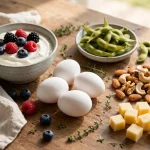
One scoop of protein powder typically has about 110-130 kcal and 20-27 g of protein — roughly the protein of a chicken breast or four eggs, in a glass that takes thirty seconds to finish. It is not a supplement in any magical sense: it is food, dried and powdered, and that is exactly how to think about it.
Protein powder has one job: helping you hit a daily protein target on the days when food alone falls short. It is never a requirement — every gram it provides exists in ordinary food — but as insurance on busy, low-appetite or high-target days, nothing else is as cheap, fast or shelf-stable.
How this guide handles numbers: everything is presented as “about”, because labels differ by brand and flavor — a chocolate version of the same powder often carries 10-20 kcal more than the unflavored one. Ranges are honest here; fake precision is not.
Who this guide is for: anyone standing in the supplement aisle wondering whether the tub justifies its price — lifters chasing a high target, dieters protecting muscle, and the protein-curious who simply keep missing their number by dinner. The short verdict is the same for all three: helpful tool, optional tool.
Calories and Protein per Scoop, by Type
The seven products below cover nearly everything on the shelf. All values are per standard scoop or serving, from typical labels — your tub’s own label is the final word, because serving sizes wander between brands:
| Type | Protein per scoop (about) | Calories (about) | Note |
|---|---|---|---|
| Whey concentrate | About 24 g | 120-130 kcal | The budget standard; contains some lactose |
| Whey isolate | About 25-27 g | About 110 kcal | Most protein per calorie; very low lactose |
| Casein | About 24 g | 110-120 kcal | Slow-digesting; makes thick, pudding-like shakes |
| Egg white protein | About 24 g | About 110 kcal | Dairy-free |
| Soy protein isolate | About 25 g | 110-120 kcal | A complete plant protein |
| Pea/rice blend | About 20-24 g | 120-140 kcal | Vegan; the blend covers amino acids better than either source alone |
| Collagen peptides | About 18 g per 20 g serving | About 70 kcal | Incomplete protein — no tryptophan; a skin-and-joint supplement, not a muscle staple |
One warning before the table becomes a shopping list: mass gainers are a different product wearing similar packaging. A gainer serving runs 500-1,250 kcal — mostly added carbohydrates — and exists for people who struggle to gain weight. If your goal is fat loss or maintenance, a tub with “mass” or “gainer” on the label is the opposite of what you want.
Also note the quiet trick of the scoop itself: there is no standard scoop. Servings run from 20 g (collagen) to 35 g or more, and some brands count two scoops as one serving. The honest comparisons are protein per 100 kcal, or protein per dollar — the choosing section below does that math.
Whey concentrate versus isolate is the comparison shoppers actually face. Isolate is whey filtered further, removing most of the lactose and a little fat — which is why it packs more protein into fewer calories, and why it costs more. If lactose does not bother you, concentrate’s extra 10-20 kcal buys the same muscle-relevant protein for less money.
Plant powders deserve one clarification: a single-source pea protein runs low in one essential amino acid (methionine), and rice protein runs low in another (lysine) — which is exactly why the blends pair them. Soy needs no partner; it is complete on its own, which quietly makes soy isolate the most underrated row in the table.
Do You Actually Need Protein Powder?
For most people, honestly, no — and this guide will keep saying so. A scoop of whey delivers about the protein in four whole eggs or a modest chicken breast, neither of which needs a shaker bottle. Our breakdown of how much protein in an egg shows how quickly ordinary food adds up when meals are built with protein in mind.
Powder earns its place in specific situations. Appetite: some people cannot face another chicken breast at 9 p.m. but can drink a shake. Time: a shake survives in a gym bag or desk drawer; a salmon fillet does not. Very high targets: a large, hard-training person aiming for 180-200 g a day finds food-only routes expensive and exhausting. And budget per gram: plain whey concentrate is, gram for gram, among the cheapest protein sources in the supermarket.
Vegetarians and vegans land in a middle position: food alone absolutely works, but the margin is thinner — the highest-protein plant foods (lentils, tofu, tempeh, soy yogurts) take planning at every single meal. A plant-blend scoop is often the pressure valve that makes the target boringly achievable, especially when traveling or eating out.
The right order of operations is target first, powder second. Work out your daily grams with our protein calculator, eat normally for a few days, and see where you actually land. If you are consistently 20-30 g short, one scoop closes the gap neatly. If you are already there, a tub buys you nothing but flavored milk.
When and How to Use It
Timing is the most overargued topic in protein. The famous 30-minute post-workout window is, for most people, a myth-sized exaggeration: your daily total matters far more than the minute hand. A shake after training is a fine habit — mostly because it is a reliable moment in the day, not because muscles keep a stopwatch. Before bed, between meals, with breakfast: all fine, provided the day’s total lands right.
The shake is just the default. The same scoop disappears happily into half the kitchen:
- Shaken with water: the leanest option, at the table values above.
- Shaken with milk: add about 8 g of protein and 100-150 kcal, and a much better texture.
- Stirred into oats: cook the oats first, then stir the powder in off the heat so it stays smooth.
- Stirred into Greek yogurt: turns a snack into a 35-40 g protein bowl — see our high-protein snacks list for the full snack drawer.
- Blended into smoothies: with frozen fruit, the powder vanishes entirely.
- Baking swaps: replace a small part of the flour in pancakes or muffins — expect a denser crumb, and do not overbake.
Casein deserves its own sentence: it mixes thick, almost like pudding, and digests slowly — which is why it is the classic pre-sleep shake, and the best of the powders for yogurt bowls you plan to eat an hour later.
One small craft note: powder mixes smoothest a little at a time — shake or blend rather than stirring it into hot drinks, where whey can clump and turn grainy. For coffee, let the cup cool for a minute and stir the powder in like a creamer; in oats it goes in off the heat for the same reason.
How much per serving? One scoop is the standard unit for a reason — it lands in the 20-30 g range that well-built meals aim for anyway. Doubling up in a single shake is not harmful for most people, but spreading protein across the day is the pattern linked with better muscle outcomes, and it is simply easier on the stomach.
How to Choose a Good One
Read the label like a skeptic. First line: protein per serving of 20 g or more — anything under that is mostly flavoring and fillers. Second: the ingredient list should be short enough to read at arm’s length — the protein source first, then a sweetener, a flavoring and maybe a thickener. A paragraph of proprietary blends hides how little of the named ingredient you are actually getting.
Then do the only math that matters: protein per dollar. Take the tub’s price and divide by its total protein grams (servings × grams per serving). A $40 tub with 30 servings of 24 g holds 720 g of protein — about 5.6 cents per gram. Compare any two tubs on that number and the marketing falls away: fancy labels routinely cost double per gram for the same protein.
If you compete in tested sport — or simply want the label checked by someone other than the manufacturer — look for third-party seals such as NSF Certified for Sport or Informed Sport, which test for banned substances and label accuracy. Everyone else can treat the seals as a welcome bonus rather than a requirement.
Two practical filters to finish: if dairy bothers you, whey isolate (very low lactose) or a plant blend is the comfortable route; and whatever you choose, buy the small bag first. The best protein powder is the one you will still be drinking in month three, and flavor fatigue is real.
Sweeteners are the last label decision, and mostly a taste one. Sucralose and stevia dominate the shelf; neither changes the protein math. If artificial sweeteners bother your stomach or your palate, unflavored versions of every type exist — they disappear into smoothies and oats and ask nothing of your taste buds.
Myths and Cautions
The kidney question deserves a straight answer: in healthy people, higher protein intakes — powder included — have not been shown to damage kidneys. People who already have kidney disease are a different case, and should follow their clinician’s protein guidance, which is individual. General information here, not medical advice, as always.
Powder is also a poor meal replacement, whatever the tub implies. A shake carries almost no fiber, few micronutrients, and very little of the chewing-and-volume satisfaction that keeps hunger quiet. One shake a day alongside real meals is a tool; three shakes replacing them is a diet quietly going wrong.
Which leads to the rule of thumb: if you regularly need more than about two scoops a day, the food side of your diet needs the work, not the supplement shelf. Fix breakfast first — it is where most protein shortfalls begin.
And finally, permission to buy the boring one: a plain store-brand concentrate or isolate, with a short label and a good per-gram price, beats a celebrity blend for almost everyone. The extras in premium tubs — digestive enzymes, greens blends, exotic sweeteners — are mostly decoration on the same 24 grams.
One more caution that sits between myth and fact: powder quality varies by market. In the US, supplements are not pre-approved the way drugs are, which is precisely why the third-party seals above matter for daily users — and why buying from the brand’s own store, rather than a marketplace reseller, is the safer habit.
Frequently Asked Questions
How many calories are in a scoop of protein powder?
About 110-130 kcal for standard powders. Whey isolate is the leanest at around 110; mass gainers are a different product entirely at 500 kcal and up per serving.
How much protein is in one scoop?
Typically 20-27 g, depending on the type: whey isolate sits at the top, plant blends a little lower. Check the label serving size, because scoops are not standardized.
Is protein powder good for weight loss?
It can help: hitting your protein target inside a calorie deficit protects muscle and keeps hunger quieter. The deficit itself does the losing — the powder just makes the protein part easier.
Whey or plant protein — which is better?
Whey is slightly richer in leucine per gram and usually cheapest per gram of protein. Good soy or pea/rice blends come close. The one you will actually drink every day is the one that wins.
Can I take protein powder without working out?
Yes — it is food, not a drug. But without training, extra protein has little to build, so a food-first approach is the smarter default for most people.