
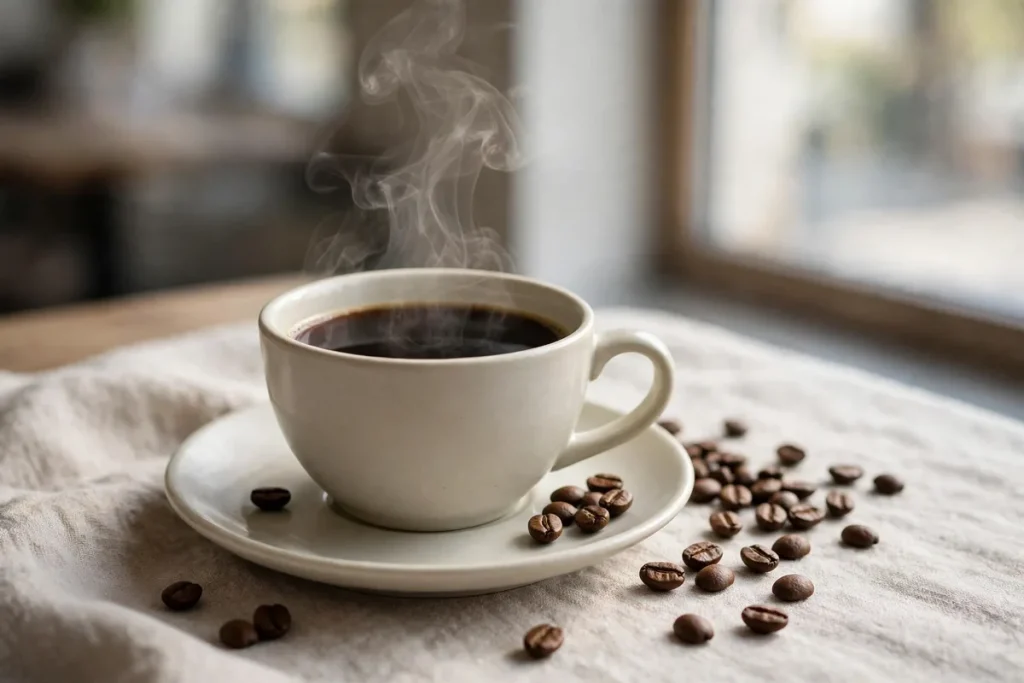

Quick answer: Yes, black coffee does have calories — about 2 per cup. It’s technically not zero, but it’s so close to nothing that it will never be the reason a diet stalls. Here’s the part that actually matters: the coffee itself is almost innocent. Everything you add to it — milk, sugar, syrups, creamers — is where coffee calories really come from, and this guide counts all of them.
Black Coffee Calories by Size
Plain black coffee is about as close to a zero-calorie drink as you can get while still, technically, having calories. USDA figures put brewed coffee at roughly 2 calories for an 8 oz cup, and the count barely creeps up as the cup gets bigger — because the extra volume is mostly extra water.
| Coffee | Calories |
|---|---|
| Black coffee, 8 oz | ~2 |
| Black coffee, 12 oz | ~3 |
| Black coffee, 16 oz | ~5 |
| Decaf coffee, 8 oz | ~2 |
| Cold brew, black, 16 oz | ~5 |
Decaf makes no difference: decaffeination removes caffeine, not calories, and there were barely any calories to begin with. Cold brew lands in the same place, too. It’s steeped stronger than drip coffee, but once it’s diluted and served black over ice, a 16 oz glass is still only around 5 calories. Instant coffee and French press coffee come out essentially identical — the brewing method changes the flavor far more than the calorie count.
One more thing worth knowing: brew strength barely moves the number. A very strong cup might carry an extra calorie or two of dissolved solids compared with a weak one, but you’re arguing over pocket change. Drink three large black coffees a day and your total is still only about 15 calories — less than a single teaspoon of sugar stirred into just one of them.
Why Is Coffee So Low in Calories?
Brewing is an extraction, but a very selective one. Hot water pulls flavor compounds, aromatic oils in trace amounts, acids and caffeine out of the grounds — while almost all of the bean’s fat, sugar and protein stay behind in the filter. What’s left in your cup is essentially flavored water with a tiny amount of dissolved solids, worth a couple of calories at most. The beans themselves contain plenty of calories; they just mostly don’t make it into the mug.
Espresso: The Smallest Cup of All
Espresso is coffee in its most concentrated form. Per ounce it’s more intense than brewed coffee — about 2–3 calories in a single 1 oz shot, and roughly 5 calories in a double shot. But nobody drinks espresso by the pint. The serving is so small that the total is trivial either way.
The caffeine comparison flips in an interesting way. A single shot of espresso contains about 63 mg of caffeine, while a regular 8 oz cup of brewed coffee contains around 95 mg. Espresso wins per sip; the mug of drip coffee wins per serving. Either way, both are effectively calorie-free until you start adding things to them.
One order worth knowing: an Americano — espresso lengthened with hot water — keeps the total at around 5 calories for a full cup. If you like the deeper flavor of espresso, it’s one of the best low-calorie orders in any cafe.
Cafe Latte Calories (And Why Milk Decides)
A cafe latte is mostly steamed milk with a shot or two of espresso poured in — which means the espresso contributes almost nothing and the milk decides everything. Whole milk makes a latte rich and higher in calories. Skim milk cuts the count dramatically. And size matters just as much, because a bigger latte is mostly just more milk.
| Cafe Latte | Calories |
|---|---|
| 12 oz, whole milk | ~150 |
| 16 oz, whole milk | ~190–220 |
| 16 oz, 2% milk | ~190 |
| 16 oz, skim milk | ~130–140 |
| 16 oz, oat milk | ~190 (close to 2%, unless sweetened) |
Oat milk lattes usually land close to 2% milk unless the cafe uses a sweetened barista blend — in which case the count climbs. Nut milks vary a lot by brand and by whether they’re sweetened, so if you’re counting carefully, the carton (or the cafe’s nutrition page) is the only honest source.
Two close relatives: a cappuccino uses the same ingredients with more foam and less liquid milk, so a 12 oz cappuccino with whole milk runs a little lighter at about 120 calories. A flat white — a double shot under a thin layer of velvety steamed milk — is closest to a small latte, so expect roughly the 12 oz latte numbers.
The Add-Ins Table
This is where black coffee quietly stops being a 2-calorie drink. None of these add-ins is dramatic on its own — the problem is that they stack, and most people add two or three of them on autopilot, several times a day.
| Add-In | Amount | Calories |
|---|---|---|
| Sugar | 1 teaspoon | 16 |
| Honey | 1 teaspoon | ~21 |
| Whole milk | 1 tablespoon | ~9 |
| Half-and-half | 1 tablespoon | ~20 |
| Sweetened liquid creamer | 1 tablespoon | ~35 |
| Flavored syrup | 1 pump | ~20 |
| Whipped cream topping | A dollop on top | ~50–100 |
Here’s the worked example that surprises people. Start with a black coffee: 2 calories. Stir in two teaspoons of sugar: that’s another 32. Add a typical pour of sweetened creamer — about a tablespoon and a half: roughly 52 more. Your “just a coffee” is now around 90 calories. Have that same cup three times a day and you’ve quietly added a small meal’s worth of calories without eating a single thing.
The milk pour deserves special attention, because it’s the least measured ingredient in home coffee. A true tablespoon of whole milk is only about 9 calories, but a free-poured “splash” straight from the bottle is often three or four tablespoons. And a homemade cup that’s a quarter milk — as many quietly are — can carry 70 calories or more of milk alone. If your home coffee tastes suspiciously like a latte, it probably is one, calorie-wise.
The flip side is good news: the swaps are painless. Sugar-free sweeteners add effectively zero calories, a splash of milk costs you less than 10, and cutting one sugar from each cup saves about 50 calories a day if you drink three cups — small numbers that genuinely add up over months.
The Hidden-Calorie Coffee Drinks
Some coffee drinks aren’t really coffee with extras — they’re desserts in a cup. That’s completely fine when you know it. It only becomes a problem when a 400-calorie drink gets filed in your head under “coffee: basically zero.”
| Drink | Calories |
|---|---|
| Mocha, 12 oz | ~290–370 |
| Blended frozen coffee drinks | ~300–500 |
| Bulletproof coffee (butter + MCT oil) | ~250–450 |
| Bottled sweetened coffee drinks | ~100–300 per bottle |
A mocha stacks chocolate syrup on top of a latte and often finishes it with whipped cream, which is how it reaches milkshake territory. Blended frozen coffee drinks go further — they’re built on sweetened bases and syrups, and the large sizes are honest desserts. Bulletproof coffee is the sneaky one: it sounds like a health drink, but blending a tablespoon or two of butter and MCT oil into coffee adds pure fat, and fat is the most calorie-dense thing you can eat. Zero carbs is not the same as zero calories.
With bottled sweetened coffees, the only rule is to check the label — some bottles hold two servings, and the range across brands runs from about 100 to 300 calories for what looks like one drink. Again: none of these drinks is “bad.” A mocha is a lovely thing. Just count it as what it is — a treat in the same mental category as a milkshake or a slice of cake, not in the same category as a black coffee.
Coffee and Weight Loss: What It Can and Can’t Do
Coffee has a genuinely decent case here — as long as it’s an honest one. Caffeine slightly raises the rate at which you burn energy, and it can blunt appetite for a short window after you drink it. Both effects are modest rather than magical, and your body adapts to caffeine over time, which softens them further. Helpful? Yes. A weight-loss strategy on its own? No.
There’s also the simple habit effect. A coffee break is a pause — something warm in your hands and a reason to step away from the desk or the kitchen. For a lot of people, that ritual replaces a snack rather than accompanying one. Rituals are powerful precisely because they don’t feel like discipline, and a 2-calorie ritual is about as sustainable as diet changes get.
Where black coffee really earns its place is as a swap. If your usual drink is a soda, a juice or a sweetened bottled coffee, switching to black coffee removes a few hundred calories a day while keeping the ritual — the warm cup, the break, the moment to yourself. Among drinks that feel like a treat, it’s one of the very few that costs almost nothing, in the same rare company as water itself (we ran the numbers on that in our article Does Water Have Calories?).
Ordering out is where the surprises hide, because a “coffee” at a chain can mean anything from 5 calories to 500. If you buy coffee regularly, it’s worth running your usual order through our Dunkin’ calorie calculator once — most people find at least one surprise in their regular order.
What coffee can’t do is melt fat. It doesn’t cancel out a calorie surplus, and no amount of caffeine outruns eating more than you burn. There’s also a backfire risk worth respecting: caffeine late in the day wrecks sleep, and poor sleep is strongly linked with a bigger appetite and harder weight control the following day. Keep the coffee, keep it earlier in the day, and keep it black or lightly doctored.
Finally, context beats any single drink. Two calories is nothing against anyone’s daily budget — and even a 200-calorie latte can fit comfortably if the rest of the day balances out. To judge your coffee against the right number, work out your daily target with our Maintenance Calories Calculator and compare your latte with that, not with zero.
Frequently Asked Questions
Does black coffee have calories?
Yes — about 2 calories in an 8 oz cup. It’s technically not zero, but it’s so close that it won’t move your day’s calorie budget in any meaningful way.
How many calories in a shot of espresso?
About 2–3 calories per 1 oz shot. A double shot is roughly 5 calories.
How many calories in a cafe latte?
About 150 calories for a 12 oz latte with whole milk, and 190–220 for a 16 oz. Switching to skim milk brings a 16 oz latte down to about 130–140 calories.
Does black coffee break a fast?
At roughly 2–5 calories, most fasting approaches treat black coffee as fine during a fast. It’s the milk and sugar that actually break it.
What is the lowest-calorie coffee order?
Black coffee, espresso, an Americano or unsweetened cold brew — all come in under about 5 calories before add-ins.


Pingback: How Many Calories in a Teaspoon of Sugar? (Tbsp, Cube & Cup Too)
Pingback: Half and Half Calories per Tablespoon and in Coffee