
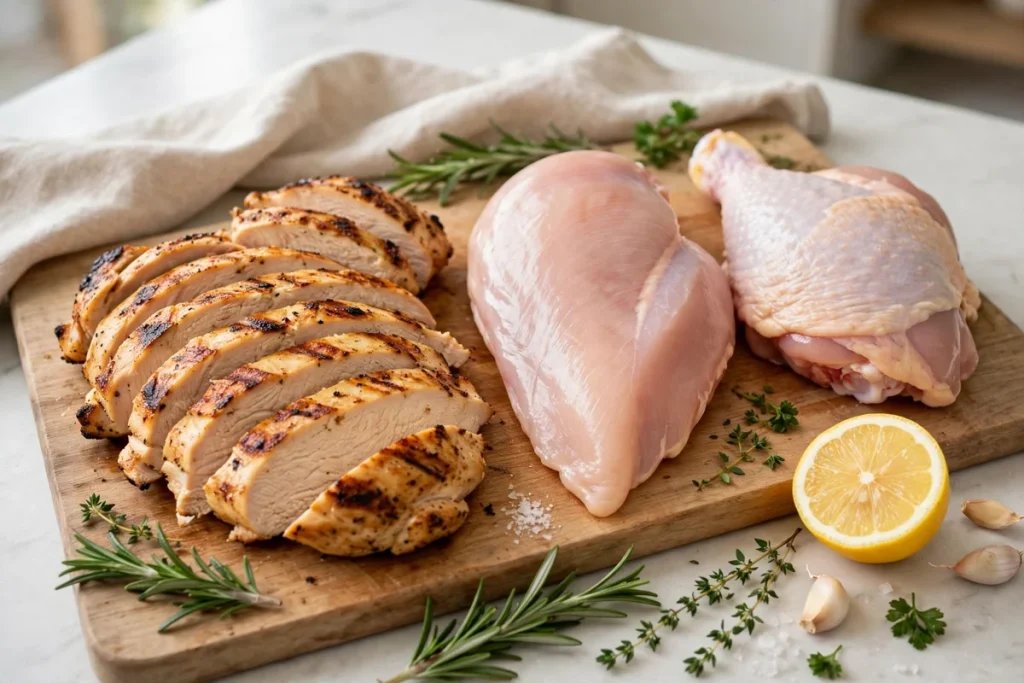

White meat chicken is the breast and the wings — pale, lean meat from muscles the chicken barely uses. Thighs and drumsticks are dark meat. That simple split explains most of what you see on the plate: white meat looks light and cooks up lean, while dark meat looks pinker, tastes richer, and stays juicier.
This guide sorts every common cut into white or dark, gives standard cooked values per 100 grams, and explains why the colour differs, why white meat dries out faster, and when dark meat is still a good choice. All values below are for cooked, skinless chicken, so you can compare cuts fairly.
Which Parts of Chicken Are White Meat?
The breast is the classic white meat, and the tenderloin — the small strip that sits under the breast — counts as white meat too. Wings are also white meat, even though they can taste a little richer than breast, because they are still light-coloured, fast-twitch muscle. By contrast, the thigh and the drumstick, which make up the leg, are dark meat.
| Cut | White or dark | Calories per 100 g cooked skinless | Protein (g) | Fat (g) |
|---|---|---|---|---|
| Breast | White | 165 | 31 | 3.6 |
| Tenderloin | White | 166 | 31 | 3.5 |
| Wing | White | 203 | 30 | 8.1 |
| Thigh | Dark | 209 | 26 | 10.9 |
| Drumstick | Dark | 172 | 28 | 5.7 |
Read the table in pairs and the pattern is clear. Breast and tenderloin give the most protein for the fewest calories, at about 165 calories and 31 grams of protein per 100 grams for breast. Thigh, at about 209 calories and 26 grams of protein per 100 grams, is the heaviest cut in the table, with more than three times the fat of breast. Drumstick sits in between on calories, at 172, but it is still dark meat, so it is juicier and a little richer than breast. Wing is the exception to a tidy white-versus-dark rule: it is white meat, yet at 203 calories and 8.1 grams of fat per 100 grams it is closer to thigh than to breast, largely because wings are small, bony, and often eaten with skin and sauces.
For serving-size detail on the most popular white cut, see our guide to chicken breast calories, which breaks breast down by ounces and by cup. The table here is deliberately different: it is a cut-by-cut comparison, not a serving-size table.
Why White Meat and Dark Meat Look Different
The colour comes mainly from myoglobin, a protein that stores oxygen in muscle. Muscles that work hard all day need more oxygen, so they contain more myoglobin and look darker. A chicken walks, stands, and scratches all day, so its legs work constantly. Its breast muscles, by contrast, are used only in short bursts, because domestic chickens rarely fly. Less work means less myoglobin, less fat around the fibres, and a paler colour.
That is also why white meat is leaner. Breast muscle is built for quick, light work, not for endurance, so it stores little fat. Dark meat is built for steady work, so it carries more fat, more connective tissue, and more flavour. Neither is wrong; they are simply built for different jobs.
Why White Meat Dries Out — and How to Keep Breast Juicy
White meat dries faster for the same reason it is lean: there is little fat to keep it moist, and its fibres tighten quickly when overheated. A few degrees past done is enough to turn a tender breast dry and chalky, while a thigh, protected by its extra fat, forgives the same mistake.
- Use a thermometer and pull breast at 165°F (74°C) in the thickest part, then rest it for 5 to 10 minutes before slicing so the juices settle instead of running out onto the board.
- Cook it gently and evenly: pound thick breasts to an even thickness, or slice them into cutlets, so the thin end does not dry out while the thick end finishes.
- Do not slice straight from the pan, and do not overcook to be safe — 165°F is the safe target, and resting will carry the temperature a little higher without drying the meat.
White Meat vs Dark Meat: Taste, Texture, and Which to Choose
On taste and texture, dark meat is richer, softer, and more forgiving. It shreds well, stays moist in stews and slow cooking, and holds up to bold sauces. White meat is milder, firmer, and cleaner-tasting, which makes it a better blank canvas for salads, sandwiches, wraps, and grilled dishes where you want the seasoning, not the fat, to lead.
For honest balance, dark meat is not simply worse. It is slightly higher in iron and zinc than white meat, and many people find it more satisfying. The trade-off is calories: because protein provides 4 calories per gram, the extra fat in dark meat, at 9 calories per gram, is what pushes its total up. Our guide to calories in protein explains that maths in full, and it is the reason breast wins on protein per calorie even though thigh wins on juiciness.
For weight loss, choose white meat most of the time, especially breast or tenderloin. At 165 calories and 31 grams of protein per 100 grams, breast gives you more protein per calorie than thigh at 209 calories and 26 grams of protein. That higher protein per calorie helps you stay full on fewer calories. If you are working out your overall daily target, our Maintenance Calories Calculator gives a useful starting point, and then white meat makes that budget easier to hit. Keep dark meat for meals where flavour and moisture matter most, and watch the portion and the sauce rather than avoiding it altogether.
Is Turkey Breast White Meat Too?
Yes. Turkey breast is white meat for the same reason chicken breast is: it is pale, lean breast muscle that the bird barely uses for sustained work. Turkey legs, like chicken legs, are dark meat. So the rule carries across both birds — breast and wings are white, legs are dark.
What About “The Other White Meat”?
Pork was famously marketed as “the other white meat,” but that was a slogan, not a classification. Nutritionally, pork is classed as red meat, even though some lean pork cuts look pale when cooked. Do not use the slogan to group pork with chicken breast: white meat chicken means chicken breast and wings, and pork sits in a different category.
Frequently Asked Questions
What parts of chicken are white meat?
The breast, the tenderloin, and the wings are white meat chicken. Thighs and drumsticks are dark meat.
Is white meat chicken healthier than dark meat?
For weight loss, white meat chicken is usually the better choice because breast gives more protein per calorie, at 165 calories and 31 grams of protein per 100 grams, compared with thigh at 209 calories and 26 grams of protein. Dark meat is still nutritious and is slightly higher in iron and zinc.
How many calories in white meat chicken?
Cooked, skinless white meat chicken ranges from about 165 calories per 100 grams for breast to about 203 calories per 100 grams for wing. Tenderloin is close to breast, at about 166 calories per 100 grams.
Is chicken breast the only white meat?
No. Chicken breast is the best-known white meat, but tenderloin and wings are also white meat. The breast is simply the leanest and most popular white cut.
Is turkey white meat?
Yes, turkey breast is white meat, just like chicken breast. Turkey legs are dark meat, following the same breast-and-wings versus legs rule.
The bottom line is simple: if you want lean, high-protein chicken, pick white meat chicken — breast first, tenderloin close behind — and cook it gently to 165°F, then rest it before slicing.



Pingback: How Many Calories Are in a Leg of Chicken? Drumstick, Thigh & Whole Leg