

Protein has 4 calories per gram. That one number answers the question behind this whole article: when you see 25 grams of protein on a label, that protein alone accounts for 100 calories, and when you see 100 grams of protein, that is 400 calories from protein before anything else in the food is counted.
But that is only half the story. Two foods can both give you 20 grams of protein and still land very differently on your daily total, because protein never travels alone. It comes packaged with fat, carbohydrate and water, and those travelling companions decide whether your 20 grams of protein costs you about 100 calories or about 300. This guide gives you the quick answer, the simple maths, and a food-by-food table so you can see exactly which protein sources give you the most protein for the fewest calories.
Calories in Protein: The Quick Answer
Protein provides 4 kilocalories (kcal) per gram. This value comes from the Atwater system, the standard method used on food labels to convert grams of each macronutrient into calories. Here is how protein compares with the other energy sources in food:
| Nutrient | Calories per gram |
|---|---|
| Protein | 4 kcal |
| Carbohydrate | 4 kcal |
| Fat | 9 kcal |
| Alcohol | 7 kcal |
So protein and carbohydrate are equal calorie-for-calorie, fat packs in more than twice as much energy per gram, and alcohol sits in between. Remember 4, 4, 9 and 7, and you can decode almost any food label in your head.
Worked Examples: Turning Protein Grams Into Calories
The formula is simple: protein grams × 4 = calories from protein. Here it is at the amounts you will actually see:
- 10 g of protein = 40 calories from protein
- 25 g of protein = 100 calories from protein
- 50 g of protein = 200 calories from protein
- 100 g of protein = 400 calories from protein
So if your daily target is 120 grams of protein, that protein alone accounts for 480 calories of your day — before you count a single gram of carbohydrate or fat.
How to Calculate the Protein Calories in Any Food From Its Label
Take a protein bar whose label reads 20 g protein, 15 g carbohydrate and 8 g fat. Work through it step by step:
- Protein: 20 × 4 = 80 calories
- Carbohydrate: 15 × 4 = 60 calories
- Fat: 8 × 9 = 72 calories
- Total: 80 + 60 + 72 = 212 calories
If the label prints 210 calories, it matches: labels round grams and totals, so being within a few calories is normal. The useful part is the split. In this bar, protein supplies 80 of the 210 calories — a little over a third — while fat supplies 72. That split tells you far more than the headline number alone.
Try the same check on a plain food. A 100 g chicken breast has about 31 g of protein, so 31 × 4 = 124 calories from protein. Yet the whole breast is about 165 calories. The extra 41 calories come mostly from fat, with a trace of carbohydrate. Protein calories are a floor, not the total: the total is always the protein calories plus whatever fat and carbohydrate travel with them.
Calories in Protein Foods: The Full Table
Here is the comparison that matters most: common protein foods side by side, with the “cost” of their protein worked out for you. The last column answers the question “how many total calories do I spend to get 10 grams of protein from this food?” It is calculated as total calories ÷ protein grams × 10, so a lower number means cheaper protein. All values are typical USDA-style figures for the serving shown, rounded to whole numbers.
| Food | Typical serving | Protein (g) | Total calories | Calories per 10 g of protein |
|---|---|---|---|---|
| Protein powder | 1 scoop (30 g) | 24 | 120 | 50 |
| Canned tuna in water | 100 g | 26 | 132 | 51 |
| Chicken breast, cooked | 100 g | 31 | 165 | 53 |
| Greek yogurt, nonfat | 170 g | 17 | 100 | 59 |
| Tofu, firm | 100 g | 10 | 76 | 76 |
| Cottage cheese, low-fat | 100 g | 12 | 98 | 82 |
| Salmon, cooked | 100 g | 25 | 208 | 83 |
| Tempeh | 100 g | 20 | 193 | 97 |
| Eggs | 2 large (100 g) | 13 | 155 | 119 |
| Milk, semi-skimmed | 250 ml | 9 | 115 | 128 |
| Lentils, cooked | 100 g | 9 | 116 | 129 |
| Peanut butter | 2 tablespoons (32 g) | 7 | 190 | 271 |
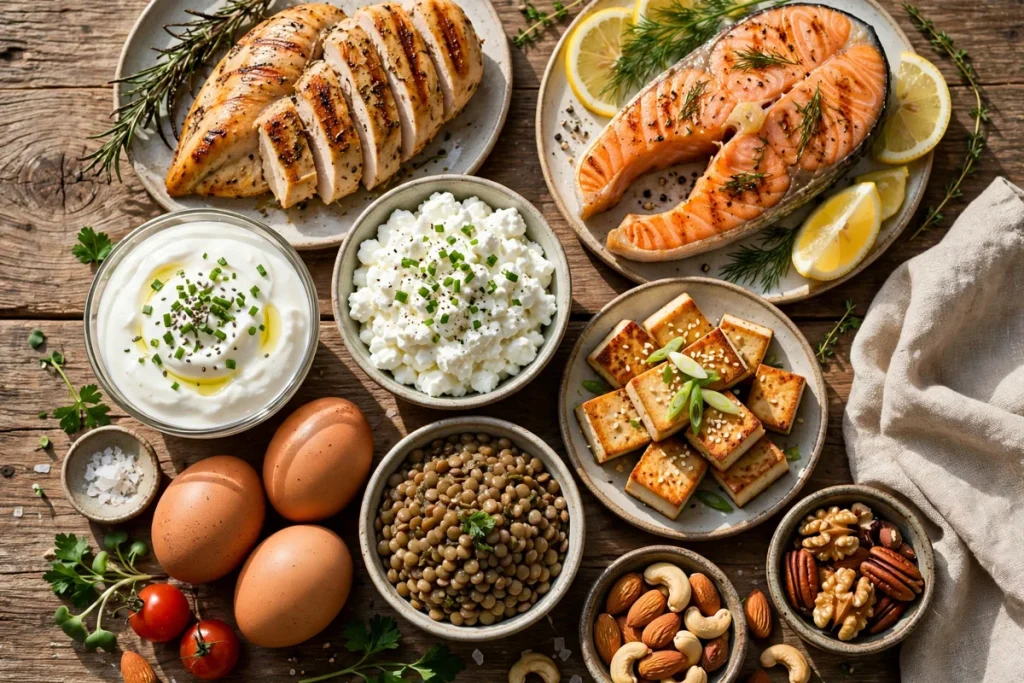
Read the table from the bottom up and the story is clear. The cheapest protein per calorie is lean and watery: protein powder, canned tuna, chicken breast and nonfat Greek yogurt all deliver 10 grams of protein for roughly 50–60 calories. Salmon and tempeh sit in the middle, because their healthy fats and dense texture add calories alongside the protein. And peanut butter is honestly an expensive protein source: at 271 calories per 10 grams of protein, it costs about five times as much energy as chicken breast for the same protein, because most of its calories come from fat. Peanut butter is a fine food — it is just a fat first and a protein second.
Two rows deserve a quick check, since the maths is the point of this article. Chicken breast: 165 total calories ÷ 31 g protein × 10 = 53 calories per 10 g of protein. Peanut butter: 190 total calories ÷ 7 g protein × 10 = 271 calories per 10 g of protein. Same formula, very different answer — and that difference is entirely the fat travelling with the protein.
Why Total Calories Differ If Protein Is Always 4 Per Gram
Because the 4 calories per gram is only the protein part of the bill. Everything else in the food adds its own line. Fat is the biggest swing factor at 9 calories per gram: it is why salmon (208 calories for 25 g of protein) costs more energy than canned tuna (132 calories for 26 g of protein), and why peanut butter is so expensive as a protein source. Carbohydrate is the second factor: lentils carry about 20 g of carbohydrate per 100 g cooked, which is why their protein costs 129 calories per 10 grams despite being low in fat. Water is the quiet third factor: foods like tofu, Greek yogurt and cottage cheese are bulky and watery, so a satisfying serving holds fewer calories for the protein it delivers.
This is also why cooking method matters. The same chicken breast grilled plain and the same breast breaded and fried can differ by well over 100 calories, while the protein grams barely move. The protein did not change — the fat it picked up did. When you compare two protein sources, compare the whole food, not just the protein line.
Protein Calories and Weight Loss
Protein calories still count toward your daily total — there is no free protein. But protein earns its reputation as the weight-loss macro for two real reasons. First, it is the most filling macronutrient: meals built around protein tend to keep you full longer than equal-calorie meals built around refined carbohydrate. Second, protein has the highest thermic effect of food: your body uses roughly 20–30% of protein’s calories just digesting and processing it, compared with roughly 5–10% for carbohydrate and roughly 0–3% for fat. Those figures are approximate, but the direction is consistent — a calorie of protein costs your body more to handle than a calorie of fat.
Put together, that gives a simple strategy. First, find your daily calorie target — our Maintenance Calories Calculator gives you a starting point, and our guide to how many calories you should eat to lose weight explains how to set a deficit from it. Then fill that target with protein from the cheap end of the table above: chicken breast, tuna, Greek yogurt and eggs cost the fewest calories per gram of protein, while fattier options like salmon still earn their place for their other nutrients. If you struggle to hit your protein target from food alone, our protein powder guide breaks down the calories per scoop by type. And if you want a plant-based comparison, our tempeh vs tofu guide puts two of the table’s entries head to head.
The Bottom Line
Protein has 4 calories per gram — always. Multiply the protein grams by 4 and you know the protein calories in any food. But the number that matters for your weight is the total, and the total depends on the fat and carbohydrate travelling with the protein. Choose lean, watery protein sources when calories are tight, treat peanut butter as a fat rather than a protein, and use the table above whenever a label leaves you guessing. That is the whole system: 4 calories per gram, plus the company it keeps.
How many calories are in 1 gram of protein?
4 calories. One gram of protein provides 4 kilocalories, the same as one gram of carbohydrate, less than alcohol at 7 calories per gram, and less than half of fat at 9 calories per gram.
How many calories in 50 grams of protein?
200 calories from protein alone. Multiply 50 grams by 4 calories per gram to get 200.
Do protein calories count toward my daily total?
Yes, fully. Protein calories count toward your daily total just like calories from carbohydrate and fat. There is no free protein.
Is protein powder high in calories?
No, not usually. A typical scoop is about 120 calories for 24 grams of protein, so it is one of the cheapest protein sources in the table at about 50 calories per 10 grams of protein.
Which food gives the most protein for the fewest calories?
Protein powder, canned tuna in water and chicken breast. In the table they cost about 50, 51 and 53 calories per 10 grams of protein.



Pingback: Pad See Ew Calories: Restaurant vs Homemade (Full Breakdown)
Pingback: White Meat Chicken: Which Parts Count, Calories & Protein
Pingback: 2000 Calorie Meal Plan: A Full Day of Eating (With Macros)
Pingback: Are Quest Chips Healthy? Protein, Ingredients & Honest Verdict
Pingback: Carb Counter Tortillas: Net Carbs, Calories & Best Options
Pingback: What to Cook With Ground Turkey: 9 Easy, Healthy Meals