Cottage cheese low fat has about 72 calories and 12 g of protein per 100 g, and a full cup lands at about 163 calories with roughly 28 g of protein. That ratio is why it has quietly become the protein-per-calorie star of the cheese world: it eats like a creamy, satisfying food while costing about as much as a small snack.
If you have ever stood in the dairy aisle wondering whether the tub labeled 1% is meaningfully different from the 2% or the full-fat version, this guide answers it with USDA standard values, a clear comparison table, and an honest note on the one real catch: sodium.
All of the values in this article are USDA standard values for cottage cheese. Brands vary a little, especially on sodium, so treat the numbers as typical values and check your own tub’s label when it matters.
Low-Fat Cottage Cheese Nutrition
The 1% low-fat version is the one most people mean when they talk about low-fat cottage cheese, and its numbers are genuinely impressive. Here is the full picture for the 1% type, with cup figures scaled from the per-100 g values.
| Amount (1% low-fat) | Calories | Protein | Carbs | Fat | Sodium |
|---|---|---|---|---|---|
| Per 100 g | About 72 | 12 g | 3 g | 1 g | About 350-400 mg |
| Per cup (226 g) | About 163 | About 28 g | About 7 g | About 2 g | About 790-900 mg |
| Per half cup (about 113 g) | About 81 | About 14 g | About 2 g | About 1 g | About 175-200 mg |
Two things stand out in that table. First, the protein density: with 12 g of protein in just 72 calories, about two-thirds of the calories in low-fat cottage cheese come from protein itself. That is a ratio most cheeses cannot touch, and it is the whole reason this food shows up in so many weight-loss plans.
Second, the serving size is generous. A cup of cottage cheese is a genuinely big portion — a full bowl, not a garnish — and it still costs only about 163 calories. Compare that with a cup of shredded cheddar, which runs well over 400 calories, and the appeal becomes obvious.
The carbs stay low as well, at just 3 g per 100 g, with only a small amount of natural milk sugar. That makes low-fat cottage cheese an easy fit for lower-carb eating patterns, though it is not a zero-carb food, and people counting carbs closely should still count those 3 g.
1% vs 2% vs Regular Cottage Cheese
Cottage cheese comes in four fat levels, and the label number tells you exactly how much milkfat is in it. Here is how they compare per 100 g.
| Type | Calories per 100 g | Fat per 100 g |
|---|---|---|
| Nonfat | About 65-70 | About 0 g |
| 1% low-fat | 72 | 1 g |
| 2% reduced-fat | About 90 | 2 g |
| Regular (4%) | About 98 | 4 g |
The headline here is how little changes. Moving from 1% to regular adds only about 26 calories per 100 g, and the protein barely moves at all — it stays in the same ballpark of roughly 11-12 g per 100 g whichever tub you pick. The fat changes; the protein does not. That is the opposite of most cheese choices, where a richer version usually means a very different food.
Over a full cup, though, the gap is worth noticing: a cup of regular cottage cheese runs about 222 calories against about 163 for the 1% version, a difference of roughly 60 calories for the same bowl. If you eat cottage cheese daily, that adds up to a real weekly saving for no loss of protein.
Which should you buy? For a calorie budget, 1% is the sweet spot: nearly as light as nonfat with a noticeably creamier texture. The 2% version suits people who want a little more richness for about 18 extra calories per 100 g. Nonfat saves only a few calories over 1% and tastes thinner, while regular is the right pick when richness matters more than calories, such as in a cooked dish where the cheese is a small part of the whole.
Why the Protein Matters
About 28 g of protein in a cup for 163 calories is the number that explains cottage cheese’s reputation. Protein is the most filling of the three macronutrients, and a breakfast built around a cup of cottage cheese tends to keep hunger quiet far longer than a breakfast of the same calories built on toast or cereal alone.
That staying power is also why cottage cheese is a staple of high-protein diets. When you are eating in a calorie deficit, protein does two jobs at once: it keeps you full, and it helps protect muscle while the fat comes off. A food that delivers nearly 30 g of protein for under 170 calories is doing both jobs at a bargain price.
There is a second, quieter advantage. Cottage cheese protein is mostly casein, which digests slowly, so the fullness it gives does not fade in an hour the way a sugary snack’s energy does. It sits comfortably alongside other lean protein staples — see our guide to egg white nutrition for a similar high-protein, low-fat option — and it works at any meal, not just breakfast.
Cottage Cheese Among Cheeses
Put low-fat cottage cheese next to the rest of the cheese counter and the gap is startling. Most cheeses run 350-400 calories per 100 g, because they are concentrated milk fat and protein with most of the water removed. Low-fat cottage cheese, at 72 calories per 100 g, sits in a different league entirely — roughly a fifth of the calories of a hard cheese, weight for weight.
That is not a trick of water content alone, though water helps: cottage cheese keeps much of the whey and moisture that other cheeses press out, so each spoonful carries more volume and less fat. The practical result is that you can eat a genuinely satisfying portion — a full cup — for fewer calories than a small handful of grated cheddar sprinkled over pasta.
None of this makes other cheeses bad foods; a little aged cheddar brings flavor that cottage cheese never will. But if cheese is a daily habit rather than an occasional accent, swapping the everyday portion to low-fat cottage cheese is one of the biggest calorie savings available in the dairy aisle. For the wider picture, our low-fat cheese guide compares the lighter end of the cheese counter.
The Sodium Note
Every honest cottage cheese guide has to mention the one catch: sodium. Low-fat cottage cheese carries about 350-400 mg of sodium per 100 g, which means a full cup lands at roughly 790-900 mg — about a third of the commonly cited 2,300 mg daily limit in a single bowl. The salt is part of how cottage cheese is made, added to the curds for flavor and keeping quality, so it is not something you can wash off.
Whether that matters depends on the rest of your day. If the rest of your meals are built on fresh, lightly salted foods, a cup of cottage cheese fits comfortably. If you are already eating salty breads, cured meats and sauces, the sodium stacks up fast — and that is where the low-sodium versions on the shelf earn their place. They exist in most supermarkets now, so if sodium is something you watch, check the label and pick the lower-sodium tub; the calories and protein are essentially the same.
One more practical tip: what you pair cottage cheese with matters for sodium too. Fresh fruit, cucumber and herbs add almost none, while salty crackers and cured meats add plenty. The cheese itself is only part of the plate’s sodium story.
Easy Ways to Eat It
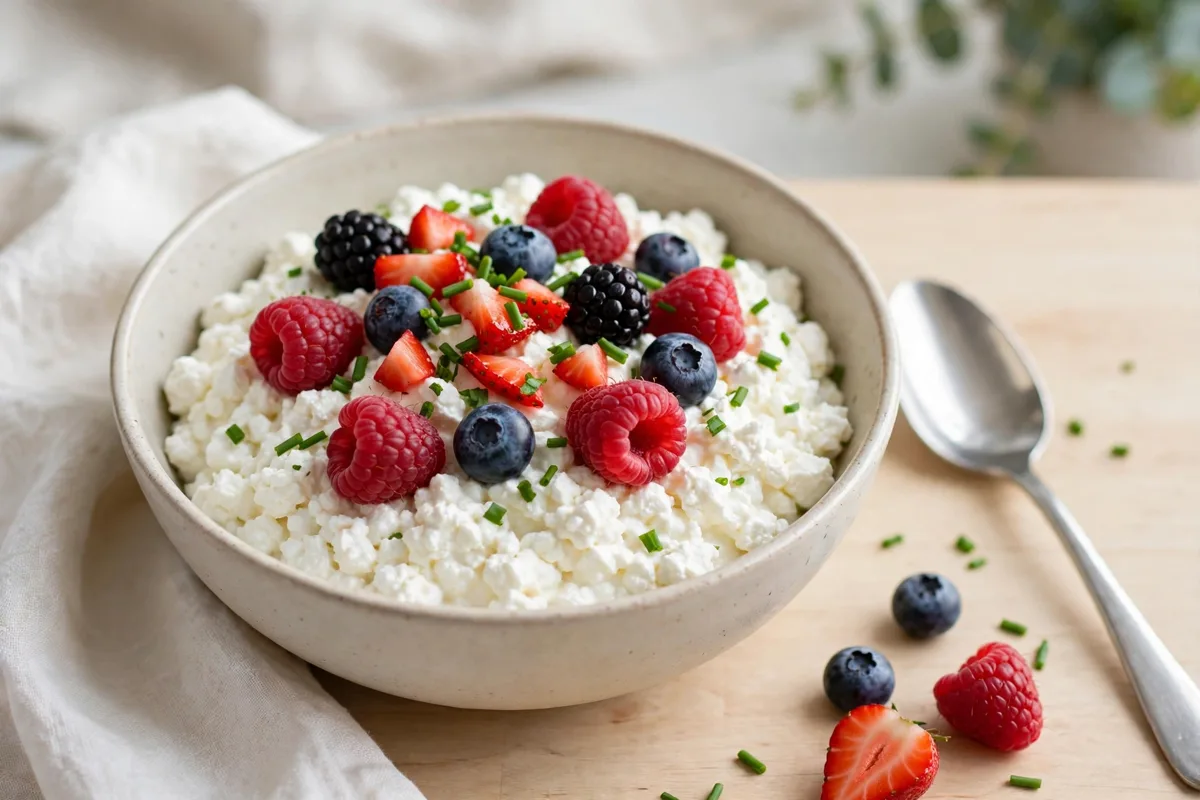
Cottage cheese earns its place in the fridge by being useful at every meal. On toast, it replaces butter or cream cheese with a protein-rich spread — add sliced tomato, chives and cracked pepper and you have a breakfast that actually holds you. With fruit, the salty tang plays beautifully against berries, peach slices or pineapple chunks, and the combination makes a light dessert that still delivers real protein.
Blended into eggs, a few spoonfuls disappear into scrambled eggs and make them fluffier while quietly raising the protein. In a smoothie, it blends smooth and thick without the tang of yogurt, and it gives the drink a protein backbone that fruit alone cannot. And as a dip base, cottage cheese blended with herbs, lemon and garlic makes a creamy dip for vegetables or crackers that costs a fraction of the calories of a sour-cream dip.
Frequently Asked Questions
How many calories in low-fat cottage cheese?
About 72 calories per 100 g for the 1% version, and about 163 calories for a full cup.
How much protein is in low-fat cottage cheese?
About 12 g of protein per 100 g, and about 28 g in a full cup.
Is cottage cheese good for weight loss?
Yes. It is high in protein and low in calories, and protein keeps you full, which makes smaller portions easier to stick with. Just watch the sodium.
Low-fat vs regular cottage cheese – is there a big difference?
Not a huge one: 72 calories per 100 g for 1% against about 98 for regular, and the protein is nearly the same. Over a full cup, though, the gap is about 60 calories.
Is cottage cheese healthier than other cheese?
By the numbers, yes for everyday eating: far fewer calories than hard cheeses at 350-400 per 100 g, with plenty of protein. The watch-out is sodium, at about 350-400 mg per 100 g.
Low-fat cottage cheese earns its reputation honestly: about 72 calories and 12 g of protein per 100 g is a combination almost no other cheese can offer. Pick the 1% tub, keep an eye on the sodium, and let it do the quiet work of keeping you full.