
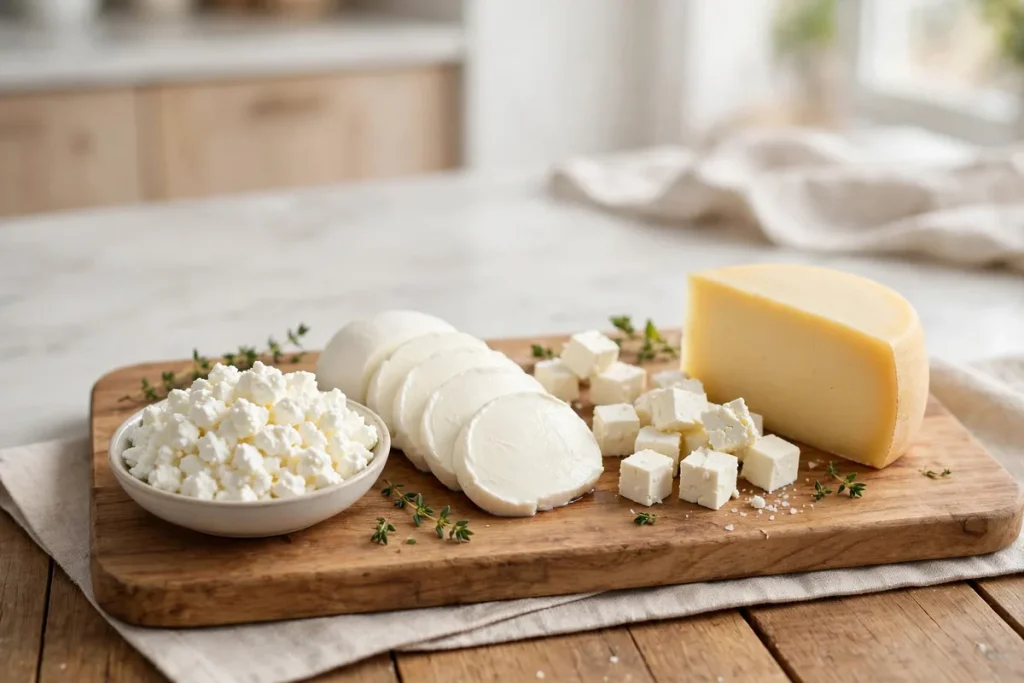

Cheese has an image problem. It is the first thing many people cut when they start watching calories, usually with real regret, and usually unnecessarily. The truth is that “cheese” covers everything from an 84-calorie cottage cheese to a 431-calorie parmesan, and treating them as one food makes no sense. Ranked properly, plenty of cheeses fit a calorie budget beautifully. You just have to know which ones, and how much of them.
Quick Answer: Cheese is not off-limits. The lowest-calorie cheeses are cottage cheese (about 84 kcal per 100 g for the 2% kind), part-skim ricotta (138 kcal) and low-fat mozzarella (about 170-180 kcal), all with real protein behind them. The trick is to pick the cheese by the job it has to do, enjoy the strong-flavoured cheeses like feta and parmesan in small amounts, and keep an honest eye on portions. This guide ranks the main options per 100 g so you can compare them fairly.
What “Low Fat” Actually Means
On a US food label, “low fat” is a regulated claim: it means the food contains 3 grams of fat or less per serving. That sounds strict, but servings of cheese are small (usually one ounce, 28 g), so a cheese can carry the low-fat label and still add up quickly if you eat several servings. It is a useful signal, not a free pass.
For this guide we use a more practical yardstick, based on the full 100 g so every cheese is compared on equal terms. Around 200 kcal or less per 100 g, with real protein to show for it, counts as genuinely light. Between about 250 and 300 kcal per 100 g is moderate, fine in measured amounts. And 400 kcal or more per 100 g is full-fat territory, where a little has to go a long way.
One more thing the label games hide: claims like “50% less fat” are always relative to the regular version of the same cheese. Reduced-fat cheddar is a big improvement on regular cheddar, but at roughly 260-280 kcal per 100 g it is still not a light cheese next to cottage cheese. Comparisons only help if you compare across cheeses, not just within one brand’s range.
Also worth knowing: the percentage on some packages, like “made with 2% milk”, describes the milk the cheese started from, not the finished cheese. Cheese concentrates milk, so the finished fat share is always higher than the milk’s was. That is why this guide sticks to calories and grams per 100 g of the cheese itself: those numbers cannot be dressed up.
The Big Cheese Table
Here is the full ranking, lowest to highest calories, all per 100 g so the comparison is honest. Rows marked as full-fat references are there to show what you are saving against the originals.
| Cheese | Calories (per 100 g) | Fat | Protein |
|---|---|---|---|
| Cottage cheese, fat-free | ~72 kcal | ~0 g | 11 g |
| Cottage cheese, 2% | 84 kcal | 2.3 g | 11 g |
| Ricotta, part-skim | 138 kcal | 8 g | 11 g |
| Mozzarella, low-fat versions | ~170-180 kcal | – | – |
| Ricotta, whole-milk (full-fat reference) | 174 kcal | – | – |
| Neufchâtel | ~253 kcal | – | – |
| Mozzarella, part-skim | 254 kcal | 16 g | 22 g |
| Cheddar, reduced-fat | ~260-280 kcal | ~16 g | ~25 g |
| Feta | 264 kcal | 21 g | 14 g |
| Soft goat cheese | ~264 kcal | 21 g | 18 g |
| Mozzarella, fresh whole-milk (full-fat reference) | ~280-300 kcal | – | – |
| Cream cheese, regular (full-fat reference) | ~342 kcal | – | – |
| Cheddar, regular (full-fat reference) | ~402-416 kcal | 33 g | 25 g |
| Parmesan, grated (full-fat reference) | ~431 kcal | – | – |
A few patterns jump out of the ranking. Fresh, soft, high-moisture cheeses sit at the light end, because water takes up weight that fat would otherwise fill. Hard, aged cheeses cluster at the top for the opposite reason. And the light version of a rich cheese, like Neufchâtel at about 253 kcal against regular cream cheese at about 342, lands mid-table: better, but not in cottage cheese’s league. Two portion-sized favourites do not fit a per-100 g table neatly: a part-skim mozzarella string cheese stick (28 g) runs about 70-85 kcal with 6-7 g of protein, and light cheese-spread wedges are about 25-35 kcal each.
The single biggest saving in the table is the cheddar swap. Trading regular cheddar (about 402-416 kcal per 100 g) for reduced-fat cheddar (about 260-280) saves roughly 140 kcal per 100 g, and the protein, about 25 g, does not move at all. The quiet runner-up is ricotta for cream cheese in cooking: 138 against about 342 kcal per 100 g is a saving most recipes will never notice.
The Best Low-Fat Cheese for Every Job
The smartest way to use this list is not to crown one winner, but to match the cheese to the job it has to do:
Melting and pizza: part-skim mozzarella. It is the one low-fat cheese that behaves like its full-fat version in the oven: it melts, stretches and browns properly at 254 kcal per 100 g, and low-fat mozzarella versions go lower still, around 170-180. This is the easiest swap in the whole article.
Salads: feta and cottage cheese. Feta (264 kcal per 100 g) earns its place through flavour: it is salty and sharp, so a crumbled tablespoon or two seasons an entire bowl. Cottage cheese does the opposite job, adding creamy bulk and 11 g of protein per 100 g for just 84 kcal.
Sandwiches: reduced-fat cheddar or Swiss-style slices. Reduced-fat cheddar keeps the familiar sharpness at roughly 260-280 kcal per 100 g with about 25 g of protein, and pre-sliced formats quietly solve the portion problem before it starts.
Snacking: string cheese. A part-skim mozzarella stick is about 70-85 kcal with 6-7 g of protein, it comes with built-in portion control, and it survives a bag or a desk drawer. Light spreadable wedges, at 25-35 kcal each, are the other genuinely snackable option.
Cooking swap: part-skim ricotta. Where a recipe leans on cream cheese or mascarpone for body, in spreads, stuffed pasta or creamy bakes, part-skim ricotta (138 kcal per 100 g) brings a similar softness for a fraction of the calories, and its mild flavour disappears into the dish.
Notice what is not on this list: a single “best cheese overall”. Cottage cheese wins on numbers and loses on a pizza; mozzarella wins on a pizza and is unremarkable on a cracker. Matching the cheese to the job is the whole strategy, and it is why a fridge with two or three of these in it beats a fridge with one virtuous tub you dread opening.
Low-Fat vs Full-Fat: The Honest Trade-Offs
Let us be honest about what you give up. Fat carries flavour and controls texture, so most low-fat cheeses taste a little milder and feel a little firmer than the originals. In cold uses, in salads, sandwiches and snacks, most people barely notice. Melted is where the gap shows.
Low-fat cheddar is the famous example: heated hard, it can turn rubbery and leak oil instead of going silky. The fix is simple. Add it at the end of cooking, off high heat, use gentle warmth, and let the dish’s residual heat melt it. Low-fat mozzarella does not have this problem, which is why it is the default choice for anything cooked.
Watch the sodium, too. When manufacturers take fat out, some add salt to keep the flavour up, so one brand’s reduced-fat cheese can be noticeably saltier than another’s. A ten-second label comparison between two brands is worth more than any rule of thumb here.
And a gentle warning about fat-free cheese slices: many are mostly additives and starch at about 30-40 kcal a slice. They are fine occasionally, and they certainly fit a budget, but file them under “useful product”, not “health food”. The reassuring news is what survives every fat cut: the protein and calcium stay. Removing fat does not remove them, so you are trading calories, not nutrition.
One honest caveat cuts the other way: a small amount of a full-fat cheese you love can be the smarter choice than a large amount of a low-fat cheese you merely tolerate. Twenty grams of real parmesan or a sharp aged cheddar delivers more satisfaction than 60 g of a bland light cheese, often for the same calories. The goal is not the lowest number on the label; it is the best flavour per calorie in the portion you actually eat.
Portion Reality Check
However light the cheese, portions decide the outcome. One ounce (28 g) is about the size of your thumb, or a small matchbox, and it is shockingly easy to slice double that when you are guessing. Pre-sliced cheese and string cheese beat guessing precisely because they remove the guesswork.
The parmesan trick shows the other side of portion thinking. Per 100 g, parmesan is the most calorie-dense cheese on this page at about 431 kcal. But nobody eats 100 g of parmesan: a tablespoon of grated parmesan is only about 5 g, which works out to roughly 22 kcal for a serious hit of savoury flavour over pasta, eggs or vegetables. Strong cheeses, small doses.
A practical habit that works: portion cheese when you unpack the shopping, not when you are hungry. Cut a block into ounce-sized pieces and wrap them, and the decision gets made on a full stomach instead of at the fridge door at 9 pm. It sounds trivial, but in practice it is the difference between cheese as an ingredient and cheese as an incident.
If you are building a lighter dairy habit generally, the same compare-before-you-pour logic applies to milk: our whole milk nutrition guide shows how whole, 2% and skim milk stack up, and the pattern is identical. The protein and calcium stay while the fat and calories change.
Finally, put your cheese in the context of the whole day. A measured 30 g piece of reduced-fat cheddar is about 80 kcal, a rounding error in most budgets. Two unmeasured handfuls while cooking can be 300. Our maintenance calories calculator will show you the daily budget you are working with, so you can see exactly how much room your favourite cheese gets.
Frequently Asked Questions
Which cheese has the lowest calories?
Cottage cheese, comfortably. The 2% version has about 84 kcal per 100 g, the fat-free version about 72 kcal, and both give you around 11 g of protein per 100 g. Nothing else common comes close.
Is low-fat cheese healthy?
Generally, yes. The protein and calcium stay while the fat and calories drop, which is a good trade for most people. Check the label for sodium, which some brands raise when they cut fat, and for long additive lists, especially in fat-free slices.
Does low-fat cheese melt well?
Mozzarella does: it is made for melting, and part-skim mozzarella behaves almost identically to the full-fat version. Low-fat cheddar is the tricky one, since it can go rubbery over high heat, so add it late and melt it gently.
Is feta a low-fat cheese?
Not strictly: at 264 kcal per 100 g it sits in the mid-range. But feta’s flavour is so strong and salty that a tablespoon or two flavours an entire salad, so the portion you actually eat is small.
Can I eat cheese while losing weight?
Yes. Pick from the light end of the table, weigh your portions for a week until you can recognise what an ounce looks like, and count the cheese in your day like anything else. Cheese itself does not stall weight loss; unmeasured portions do.


Pingback: Grilled Cheese Sandwich Calories: Classic ~330, Light ~270, Restaurant 450+
Pingback: Bagel with Cream Cheese Calories: Classic ~377 (Full Schmear Scale)
Pingback: Provolone Cheese Calories: 98 per Slice (Deli Slice 74) — Full Comparison
Pingback: Cheese Quesadilla Calories: ~475 Homemade (Small Build 260, Corn 220)
Pingback: Ham and Cheese Croissant Calories: ~460 Café (Starbucks 320)
Pingback: Foods High in Saturated Fat: The List + Daily Limit Explained