
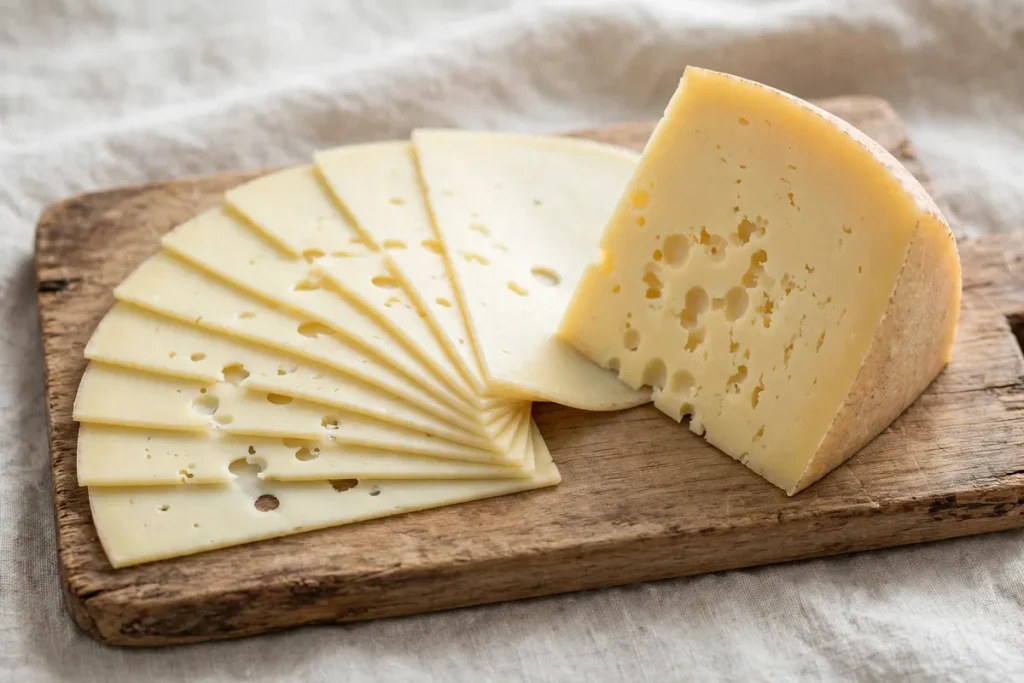

Quick Answer: Provolone cheese calories come to 98 per standard slice (1 oz / 28 g) — right in the middle of the cheese pack. That slice brings 7 g of protein and about 214 mg of calcium, and provolone’s flavor is strong enough that one slice usually does the job a milder cheese needs two for. A thin deli slice (21 g) is only about 74 calories, and even two full slices total just 196. Here is provolone by amount, against its rivals, and in the meals it is actually famous for.
Calories by Amount
Provolone is sold in more formats than most cheeses — pre-packed standard slices, thin deli slices cut to order at the counter, and wedges you slice yourself — so here is the count for each way it actually lands on a sandwich:
| Amount | Weight | Calories |
|---|---|---|
| Thin deli slice | 21 g | ~74 kcal |
| Standard slice (1 oz) | 28 g | 98 kcal |
| 2 slices | 56 g | 196 kcal |
| Per 100 g | 100 g | 351 kcal |
The math underneath is simple: provolone runs 351 calories per 100 g, so every gram is worth about 3.5 calories. That is why the thin deli slice saves real money — at 21 g instead of 28 g, it is the same cheese doing the same job for roughly 24 fewer calories. If your deli lets you choose, thin-sliced is the easiest provolone discount there is, and folded into a sandwich you rarely notice the difference.
Two slices, at 196 calories, is the number worth remembering for recipes: it is the standard cheesesteak and loaded-sub amount, and roughly what two slices contribute to a baked pasta or a stacked Italian hoagie. One slice for flavor, two for a cheese-forward build — the table above prices both.
If you buy provolone as a wedge or chunk instead, an ounce is easy to picture: about the size of four dice, or two thumbs end to end. Grated or shredded, a loosely packed quarter cup is roughly an ounce — worth knowing for baked dishes, where provolone disappears into the top and it is otherwise impossible to tell how much you actually used.
Full Nutrition per Slice
Here is the whole profile of one standard slice (1 oz / 28 g):
| Nutrient | Per slice |
|---|---|
| Calories | 98 kcal |
| Protein | 7 g |
| Fat | 7.5 g |
| Carbs | 0.6 g |
| Calcium | ~214 mg |
| Sodium | ~248 mg |
Two numbers stand out. The protein, 7 g, is at the good end for a single slice of cheese — a genuine contribution to a meal rather than a garnish. And the calcium, about 214 mg, is roughly a fifth of the ~1,000 mg adults aim for each day, which makes provolone one of the more efficient calcium sources in the deli case: one slice on a sandwich quietly covers a fifth of the day before any milk or yogurt shows up.
The honest note is the sodium: about 248 mg per slice, roughly a tenth of the 2,300 mg daily limit. That is mid-pack for cheese — far from the saltiest, nowhere near innocent — and it is the main reason one slice usually does the job is good advice twice over. Two slices plus cured meats and a salted roll can stack up quietly, so treat provolone’s salt as part of the meal’s total rather than a surprise at the end of the day.
The fat, 7.5 g per slice, is ordinary cheese fat — mostly saturated, as dairy fat is — and the carbs are effectively zero at 0.6 g, because nearly all the milk sugar leaves with the whey during cheesemaking. That near-zero carb count is why provolone shows up in so many low-carb and keto sandwiches: a slice or two holds the fillings together and brings the flavor, in place of bread.
Provolone vs Other Cheeses
Comparing cheeses slice-to-slice is rigged, because a slice is not a standard unit: deli Swiss is often cut thinner than cheddar, and pre-packed slices vary from 21 g to 28 g. The fair fight is per ounce (28 g), weight for weight:
| Cheese | Calories per 1 oz (28 g) |
|---|---|
| Mozzarella, part-skim | ~72 kcal |
| Mozzarella, fresh (whole milk) | ~85 kcal |
| Provolone | 98 kcal |
| Gouda | ~101 kcal |
| American (block) | ~104 kcal |
| Pepper jack | ~105 kcal |
| Swiss | ~106 kcal |
| Cheddar | ~113 kcal |
Read fairly, provolone at 98 sits almost exactly mid-table: clearly above mozzarella in either form, about level with gouda and American, and a useful step below Swiss and cheddar. Swapping cheddar for provolone saves about 15 calories an ounce — small per sandwich, but it is a swap many people make for flavor anyway, since provolone melts smoother and tastes milder. For the genuinely lightest cheeses in the case, our low fat cheese guide ranks cottage cheese, ricotta and the low-fat mozzarellas.
One caveat for label readers, because the mozzarella rows explain a common confusion. Part-skim mozzarella is the light one at about 72 per ounce; the fresh whole-milk balls sold in liquid are richer at about 85. Provolone beats neither — but it sits closer to fresh mozzarella than to cheddar, which is a reasonable neighborhood for a cheese with this much flavor and this good a melt.
One last label trap: processed American singles look lighter than everything on this table, but that is portion size talking — the slices are thinner and smaller, not magically leaner per ounce, where American cheese runs about 104. Real deli slices of any cheese here, cut to the same weight, all land within about 40 calories of each other. Portion format, not cheese choice, is usually the bigger lever.
Dolce, Picante & Smoked
Provolone comes in two ages. Dolce (sweet) is the mild, young cheese, aged about 2-3 months: smooth, milky and gentle. Picante (sharp) is aged 6 months or longer — sometimes much longer — and tastes stronger and tangier, and runs a little saltier. Smoked provolone is usually a dolce that has been smoked, giving it a tan rind and a campfire note. Nutritionally, all three are the same cheese: 351 calories per 100 g, 98 a slice. The aging changes flavor and texture, not the calorie count.
That sameness hides a genuinely useful trick: picante can save calories indirectly. Because its flavor is bigger, one slice of picante satisfies the way a slice and a half of dolce does — especially melted, where its sharpness carries through bread and meat. If you are the type to add a second slice purely for more cheese flavor, switching to picante gets you that flavor for 98 calories instead of 196. It does run slightly saltier, so the savings are in calories, not sodium.
Buying tip: picante is often sold in wedges rather than slices, and a little goes a long way grated or shaved over pasta, salads and roasted vegetables — the parmesan trick at a friendlier price. Dolce is the better choice for kids’ sandwiches and delicate melts, where you want the cheese to support rather than lead. Both keep well wrapped in the fridge for several weeks, and picante, being the drier cheese, keeps longest of all.
Provolone in Real Meals
Provolone’s most famous job is the Philadelphia cheesesteak, where it is one of the two classic cheeses — the other being a famous sauce-like rival we will not start an argument about. Here is what a homemade cheesesteak adds up to:
| Component | Calories |
|---|---|
| Hoagie roll | ~260 kcal |
| Cooked steak | ~250 kcal |
| Provolone, 2 slices | 196 kcal |
| Onions & peppers | ~20 kcal |
| Total | ~725 kcal |
That ~725 total is honest sandwich territory — a full meal, not a snack — and the provolone’s 196 is doing visible work in it: it is the glue and most of the richness. Provolone melts down into the hot steak rather than sitting on top of it, which is why two slices go further here than they do on a cold sandwich, where the same two slices can feel like a layer cake.
The lighter cheesesteak is a cheese decision too. Swap the two standard slices for one thin deli slice and the sandwich lands near 600 calories — you save about 122 — while keeping the essential provolone flavor melted through every bite. On a homemade version, that single swap is worth more than trimming the steak or shrinking the roll, and nobody at the table will feel short-changed.
Beyond the cheesesteak, provolone is the deli’s great melter: it softens smoothly and evenly without turning stringy or greasy, which makes it the classic choice for Italian subs, meatball sandwiches and baked hoagies. On pizza it usually plays a supporting role blended with mozzarella, and at home, tearing one slice over a whole homemade pizza adds just 98 calories to the entire pie while rounding out the flavor. It is also a superb swap-in for grilled cheese — our grilled cheese sandwich calories guide lists provolone at 98 a slice among the cheese options, and its clean melt is exactly why.
Cold, provolone is the antipasto cheese: rolled around salami, cubed onto a board, or layered into an Italian sub with cured meats and peppers, where its mild tang cuts through fatty fillings. In all of these, the counting rule stays the one from the first table — a standard slice is 98, a thin one about 74 — and because provolone is rarely the only rich thing in the dish, the one-slice habit is usually the difference between a big sandwich and a sensible one.
A practical note on buying: deli slices stick together, so ask for them interleaved with paper if you plan to use one at a time, and keep them tightly wrapped — provolone dries at the edges faster than it spoils. Slices also freeze acceptably for cooking: frozen provolone melts into sauces, soups and baked sandwiches without any noticeable loss, though thawed slices are less pleasant eaten cold.
However you use it — one thin slice on a weekday sandwich or two on a weekend cheesesteak — provolone is the rare cheese where the standard portion and the satisfying portion turn out to be the same thing.
Frequently Asked Questions
How many calories in a slice of provolone cheese?
98 calories for a standard 1 oz (28 g) slice. A thin deli slice (21 g) is about 74 calories, and two standard slices total 196.
Provolone vs mozzarella — which is lower in calories?
Mozzarella, in both forms. Part-skim mozzarella is about 72 calories per ounce and fresh whole-milk mozzarella about 85 — both below provolone at 98 per ounce.
How many calories in 2 slices of provolone?
196 calories — two standard slices at 98 each. That is the amount on a typical cheesesteak or loaded sub, and it brings about 14 g of protein along with it.
Is provolone cheese healthy?
It is a real, minimally processed cheese with genuine strengths: 7 g of protein and about 214 mg of calcium per slice, at mid-pack calories. Like all cheese, the watch-outs are portions and sodium (about 248 mg per slice); a slice at a time fits comfortably in a balanced diet.
Which provolone is best for weight loss?
Picante. It has exactly the same calories as mild dolce (98 per slice), but its stronger flavor means one slice satisfies where you might otherwise use two. Thin deli slices, at about 74 calories, are the other smart pick.


Pingback: Blue Cheese Calories & Nutrition Facts per Ounce