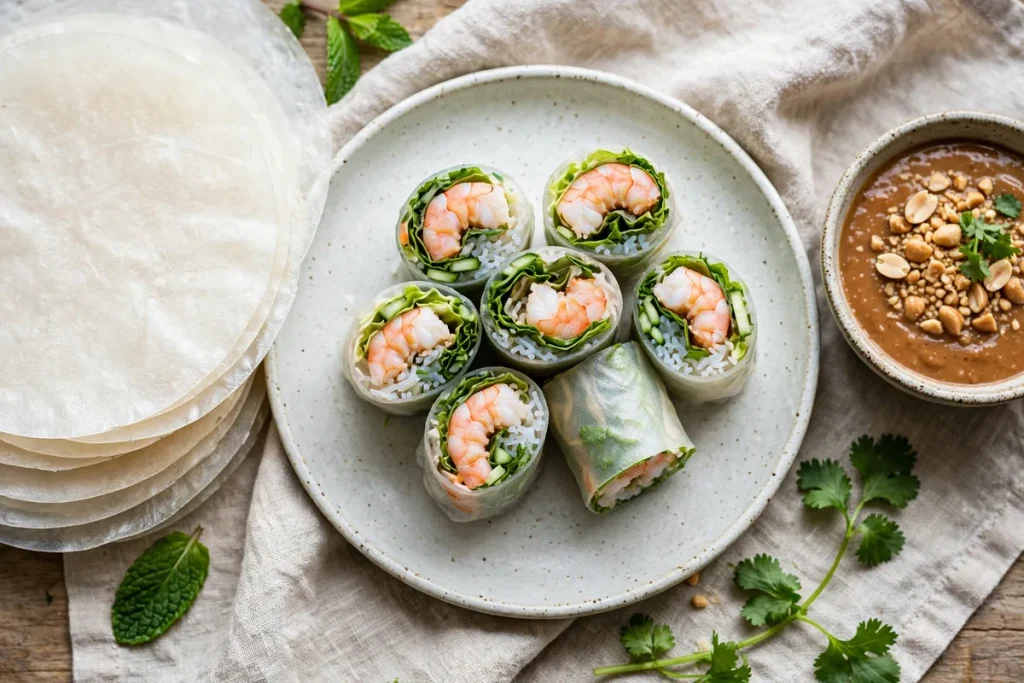

Quick Answer: Rice paper calories come to about 35 per dry sheet (22 cm) — one of the lightest wrappers in any kitchen, with about 8 g of carbs and essentially no protein. A fresh shrimp spring roll built on one lands at about 120 calories, and a fried roll at about 170. The sheet is never the problem: what you roll inside it, and what you dip it in, decides the rest. Here is the sheet, the finished rolls, the sauces and the wrap comparison, all priced out.
The Sheet Itself
A rice paper sheet is a near-nothing food, and the table shows why: it is mostly a matter of how little of it there is. One 22 cm round sheet weighs only about 10-12 g dry:
| Amount | Weight | Calories |
|---|---|---|
| 1 sheet (22 cm) | ~10-12 g | ~35 kcal |
| 2 sheets | ~20-24 g | ~70 kcal |
| Per 100 g (dry) | 100 g | ~335 kcal |
That last row is the trap. Per 100 g, rice paper reads about 335 calories — as dense as dry pasta or flour — and people regularly panic at it. But nobody eats 100 g of rice paper: that would be nine or ten sheets. Dry rice products always look dense per 100 g because there is no water in them; what matters is the weight of what you actually eat, and a sheet weighs almost nothing. Judged by the piece, which is how rice paper is used, it is one of the lightest foods in the cupboard.
Nutritionally the sheet is simple: roughly 8 g of carbohydrate, no meaningful protein or fat, and a little sodium. It is a vehicle, not a food group — a neutral, slightly chewy wrapper whose job is to hold fresh things together. That neutrality is its diet superpower: unlike a tortilla or a bread roll, the wrapper contributes almost nothing, so nearly every calorie in a spring roll is a filling you chose on purpose.
If you have never handled one, a dry sheet is a brittle, translucent disc stamped with a crosshatch pattern, made from rice flour, water, a little salt and often some tapioca starch. It softens in warm water in about 10-20 seconds and turns pliable and slightly sticky — soak it too long and it tears, too briefly and it stays leathery at the edges. Sheets come in several diameters, too: the 22 cm round is the standard used here, smaller sheets cost proportionally less, and the big 31 cm ones proportionally more.
Bought dry, rice paper keeps for months in a cool cupboard, which makes it one of the most forgiving wrappers to stock. If a package lists a different size than the standard, weigh one sheet the first time: at about 335 calories per 100 g — roughly 3.4 calories per gram of dry sheet — any sheet prices itself in seconds.
What a Finished Roll Really Costs
Roll the sheet up and the numbers get more interesting. A finished fresh roll carries noodles, protein and vegetables — and a fried roll carries the frying oil as well:
| Finished roll | Calories each |
|---|---|
| Fresh veggie roll | ~95 kcal |
| Fresh shrimp roll | ~120 kcal |
| Fresh tofu roll | ~130 kcal |
| Fried spring roll (cha gio style) | ~170 kcal |
Break one shrimp roll open and the surprise is where the calories live — not in the wrapper:
| Inside a fresh shrimp roll | Calories |
|---|---|
| Rice paper sheet | 35 kcal |
| Rice noodles | ~55 kcal |
| Shrimp (3) | ~30 kcal |
| Herbs, lettuce & cucumber | ~5 kcal |
| Total | ≈ 120 kcal |
The rice noodles inside the roll cost more than the wrapper around it — about 55 calories to the sheet’s 35 — and the shrimp add another 30 or so. The herbs, lettuce and cucumber that make the roll taste fresh are essentially free at about 5. This is also why a veggie roll, dropping the shrimp and keeping the noodles, lands at about 95, and why the tofu roll at about 130 runs slightly above the shrimp one: tofu portions tend to be more generous than three shrimp.
Frying changes the equation in one specific way: the wrapper drinks the oil. A fried spring roll (cha gio style) comes out at about 170 calories — roughly 50 more than its fresh shrimp counterpart — and almost all of that difference is oil absorbed by the rice paper as it crisps and blisters. The same sheet that costs 35 fresh becomes the most expensive part of the roll once it has been through the fryer.
One more variation to watch when you eat out: some shops roll with two sheets for sturdiness, which adds another 35 calories before anything else changes, and restaurant rolls are often simply bigger than homemade ones. When a menu roll looks like it could feed two, it probably prices like it too. At home, one sheet per roll and a standard filling keeps you on the table’s numbers.
The Sauce Ladder
Spring rolls are rarely eaten dry, so the dip is part of the meal’s math. The sauces vary more than the rolls themselves do — here is the ladder, lightest first:
| Dipping sauce | Per 2 tbsp |
|---|---|
| Nuoc cham (fish-sauce dip) | ~15-20 kcal |
| Sweet chili sauce | ~35 kcal |
| Peanut sauce | ~75 kcal |
Put the extremes side by side: a modest 2-tablespoon puddle of peanut sauce, at about 75 calories, costs more than the roll’s wrapper and all its herbs and vegetables combined (35 + 5), and more than half of the entire fresh roll it is dipping. Nuoc cham — the Vietnamese fish-sauce dip with lime, garlic and chili — delivers the biggest flavor per calorie in the whole meal at roughly 15-20 per 2 tablespoons. Sweet chili sits between them at about 35: sweet, friendly, and very easy to over-pour.
None of this bans peanut sauce, which is delicious and the classic pairing. It just prices it. Dip lightly rather than dredging, keep the sauce on the side (it usually is), and count a generous serving as the ~75-calorie item it is — or split the difference with a half-and-half of peanut sauce thinned with nuoc cham, a common kitchen trick that keeps most of the flavor for roughly half the cost.
A note on making nuoc cham at home: it is little more than fish sauce, water, lime juice, a pinch of sugar and fresh chili, which is exactly why it is so light — mostly water and intensity, with almost nothing to count. It keeps for weeks in the fridge and improves nearly everything it touches, so it is worth having a jar ready before peanut sauce becomes the default purely by habit.
Rice Paper vs Other Wraps
A wrap is a delivery system, and rice paper is not the only one in the kitchen. Priced per wrapper, here is how the usual options compare:
| Wrap | Calories |
|---|---|
| Lettuce leaf | ~1-2 kcal |
| Rice paper sheet | ~35 kcal |
| Corn tortilla | ~52 kcal |
| Flour tortilla (8-inch) | ~135 kcal |
| Large wrap tortilla | ~210 kcal |
Lettuce aside — and a lettuce cup is a crunch, not really a wrap — rice paper is the lightest true wrapper on the list, at about a quarter of an ordinary flour tortilla and a sixth of the big cafe-style wraps that quietly cost 210 before a single filling lands. A corn tortilla at about 52 is a respectable second. And for the rest of the rice story, the noodles inside your roll come from the same grain as the rice on your plate — our guide to the calories in 1 cup of rice covers what rice costs once it is cooked and portioned.
Rice paper has one more quiet advantage: it is made from rice, so it is naturally gluten-free — one of the few wraps that gluten-avoiding eaters can use without hunting down a specialty product at specialty prices. It asks for no cooking, either: a wide bowl of warm water is the entire appliance, which is more than can be said for warming tortillas properly.
The honest caveat is capacity. A large tortilla holds a burrito’s worth of filling, and a rice paper sheet simply does not; the comparison is fair for the jobs they share — hand-held, fresh-filled wraps — and on those jobs rice paper wins on calories every single time.
Using Rice Paper on a Diet
Rice paper is close to a dieter’s ideal wrapper, and a few habits keep it that way. First, fresh beats fried: the fresh roll (goi cuon) at 95-130 calories and the fried one (cha gio) at about 170 are the same basic idea separated by a bath of oil. Choose fresh as the default and fried as the occasional treat, and you save roughly 50 calories a roll without giving anything up.
Second, build for volume. The cheapest ingredients in the roll are the fresh ones — herbs, lettuce, cucumber, bean sprouts, shredded carrot — so load them generously and let the noodles share the space rather than own it. Keep the protein lean: shrimp (about 30 for the three in a roll), chicken breast or tofu are the classic choices, and all of them keep a roll inside the 95-130 band. A plate of two fresh shrimp rolls with nuoc cham is a genuinely filling lunch for roughly 260 calories.
Third, manage the dip — it is the only part of the meal that can double in secret. Measure peanut sauce once (2 tablespoons, about 75) so your eye learns the portion, or switch the default dip to nuoc cham and save about 55-60 a serving. And if it is the crispy texture you miss, rice paper crisps beautifully without the fryer: air-fried or oil-sprayed rice paper chips run about 55-65 calories per ounce, against roughly 140 for the deep-fried kind.
For meal prep, fresh rolls hold up for a few hours if you plan for their one weakness — drying out. Wrap each roll individually, or lay them between damp paper towels in a sealed container, so they neither dry nor stick together. They are at their best the day they are made, since the wrapper firms up in the fridge, so roll what you will eat and store the components, not the finished rolls, for tomorrow.
Finally, keep the rolls inside the day’s plan rather than outside it. Two fresh rolls make a light meal, four make a normal one, and the sauce decides which side of the line you land on. Our maintenance calories calculator shows the daily budget those rolls are drawn from — and at 35 calories a wrapper, rice paper is one of the easiest foods in the world to fit into it.
A 35-calorie wrapper, fresh fillings and a light dip: rice paper is not a diet food because it is virtuous. It is a diet food because the math keeps working out in your favor.
Frequently Asked Questions
How many calories in rice paper?
About 35 calories per dry sheet (22 cm). A sheet weighs only about 10-12 g, so even two sheets come to roughly 70 calories.
How many calories in a fresh spring roll?
About 120 with shrimp, before sauce. A veggie roll is about 95 and a tofu roll about 130, because the filling, not the 35-calorie wrapper, does most of the work.
How many calories in a fried spring roll?
About 170 each. Frying adds roughly 50 calories over a fresh roll because the rice paper wrapper drinks the frying oil as it crisps.
Rice paper vs flour tortilla — which is lighter?
Rice paper, by a distance: about 35 calories a sheet versus roughly 135 for an 8-inch flour tortilla (and about 210 for a large wrap). Rice paper is the lightest real wrap in most kitchens.
Is rice paper good for weight loss?
The sheet itself, yes — at 35 calories it is barely a wrapper at all. Keep the rolls fresh rather than fried, fill them with vegetables and lean protein, and treat peanut sauce as a measured extra at about 75 calories per 2 tablespoons.