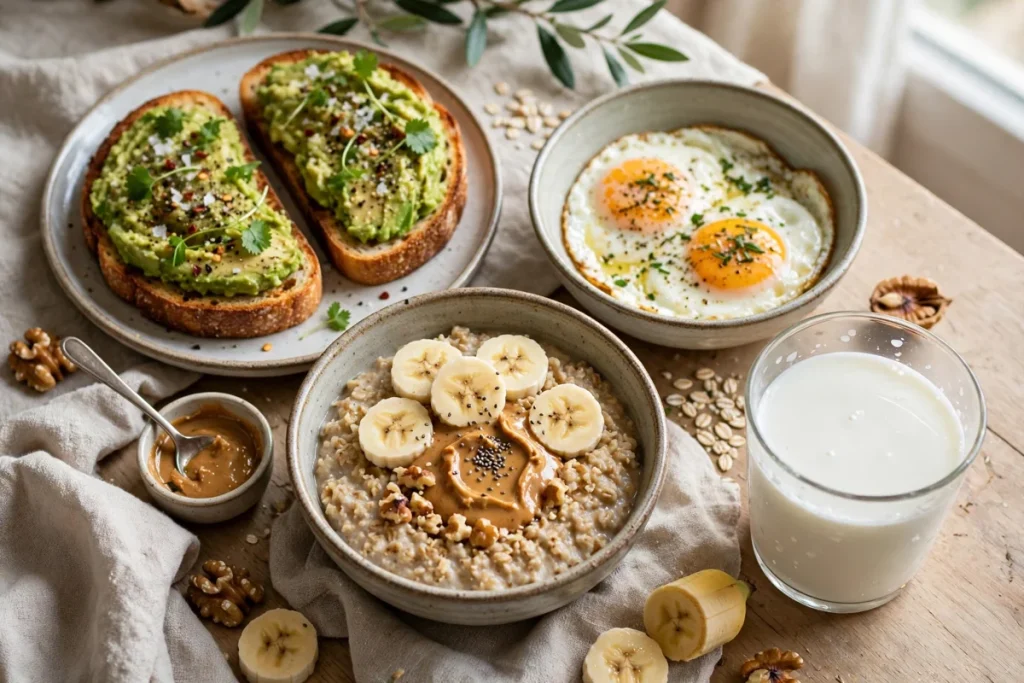

A high calorie breakfast is simply a morning meal built to do a big job: front-load a large share of the day’s energy before you even leave the house. Every idea below lands between about 640 and 900 calories, is built from ordinary whole foods, and shows its maths, so you can see exactly where the calories come from.
Who a high calorie breakfast is for
A big breakfast suits people trying to gain weight in a healthy way, athletes and anyone doing a physical job, and people with small appetites who struggle to eat enough later in the day. It is not for anyone trying to lose weight: if your goal is a deficit, a 600-plus-calorie breakfast makes the rest of the day much harder. The figures below use the same standard values throughout: whole milk 150 calories and 8 g protein per cup, peanut butter 190 calories and 8 g protein per 2 tablespoons, a banana 105 calories, an egg 70 calories and 6 g protein, oats 150 calories and 5 g protein per 40 g dry, and honey 60 calories per tablespoon.
The 8 ideas
1. Peanut butter banana smoothie — about 708 calories, 23 g protein
Blend 1 cup whole milk (150 calories) + 2 tablespoons peanut butter (190) + 1½ bananas (158) + 40 g oats (150) + 1 tablespoon honey (60) = 708 calories. Protein: 8 + 8 + 2 + 5 = 23 g. It takes two minutes, travels well, and is the easiest way to eat a big breakfast when solid food feels like too much first thing.
2. Loaded oatmeal bowl — about 838 calories, 29 g protein
Cook 80 g oats in 1 cup whole milk, then top with 2 tablespoons peanut butter, 1 sliced banana and ½ oz walnuts. The maths: 300 + 150 + 190 + 105 + 93 = 838 calories. Protein: 10 + 8 + 8 + 1 + 2 = 29 g. Make the oats the night before and it reheats in two minutes.
3. Eggs & avocado toast with cheese — about 790 calories, 28 g protein
Scramble 2 eggs and pile them on 2 slices of buttered sourdough with 1 whole sliced avocado and 1 oz grated cheddar. The maths: 140 + 200 + 240 + 110 + 100 = 790 calories. Protein: 12 + 6 + 3 + 7 = 28 g. The avocado and cheese do most of the heavy lifting here, which is why this tastes like a cafe brunch rather than a chore.
4. Greek yogurt parfait — about 690 calories, 29 g protein
Layer 1 cup full-fat Greek yogurt with ½ cup granola, 1 oz mixed nuts, 1 tablespoon honey and ½ cup berries. The maths: 220 + 200 + 170 + 60 + 40 = 690 calories. Protein: 20 + 4 + 5 = 29 g. No cooking, no blender, and it keeps in the fridge overnight if you leave the granola off until morning.
5. Breakfast burrito — about 800 calories, 34 g protein
Fill 1 large flour tortilla with 2 scrambled eggs, 1 oz cheese, ½ cup black beans and 1 whole avocado, then roll it tight. The maths: 200 + 140 + 110 + 110 + 240 = 800 calories. Protein: 5 + 12 + 7 + 7 + 3 = 34 g. Wrap it in foil and it is a genuinely portable 800-calorie breakfast for a workday.
6. Pancakes with peanut butter & banana — about 899 calories, 20 g protein
Stack 3 large pancakes, spread with 2 tablespoons peanut butter, top with 1 sliced banana and 2 tablespoons maple syrup. The maths: 500 + 190 + 105 + 104 = 899 calories. Protein: 11 + 8 + 1 = 20 g. This is the highest-calorie idea in the list, and the one most likely to actually get eaten by a teenager.
7. Full cooked breakfast — about 790 calories, 36 g protein
Fry or scramble 2 eggs, serve with 2 slices of buttered toast, 1 cup baked beans and 1 glass of whole milk. The maths: 140 + 260 + 240 + 150 = 790 calories. Protein: 12 + 4 + 12 + 8 = 36 g. The beans and milk quietly add a lot here, which is why this classic is such an effective weight-gain breakfast.
8. Overnight oats jar — about 640 calories, 30 g protein
Stir 60 g oats with 1 cup whole milk, ½ cup full-fat Greek yogurt, 1 tablespoon nut butter and 1 tablespoon honey, then leave it in the fridge overnight. The maths: 225 + 150 + 110 + 95 + 60 = 640 calories. Protein: 8 + 8 + 10 + 4 = 30 g. The lightest idea here, and the best one for mornings when you have no time at all.
Summary table
| Idea | Calories | Protein |
|---|---|---|
| Peanut butter banana smoothie | 708 | 23 g |
| Loaded oatmeal bowl | 838 | 29 g |
| Eggs & avocado toast with cheese | 790 | 28 g |
| Greek yogurt parfait | 690 | 29 g |
| Breakfast burrito | 800 | 34 g |
| Pancakes with peanut butter & banana | 899 | 20 g |
| Full cooked breakfast | 790 | 36 g |
| Overnight oats jar | 640 | 30 g |
Easy add-ons to push any breakfast higher
- A glass of whole milk: +150 calories
- A glass of orange juice (240 ml): +110 calories
- An extra tablespoon of peanut butter: +95 calories
- Cheese on eggs: +110 calories per oz
Add any two of these to an idea above and it gains roughly 200–400 calories, which is how a 640-calorie overnight oats jar becomes an 800-plus breakfast without a second helping.
Honest notes
High-calorie does not have to mean junk: every idea here is built from whole foods like eggs, oats, nuts, fruit and dairy, not from pastries and fried food. If a giant breakfast kills your appetite for the rest of the morning, split it in two: eat half at home and the rest mid-morning, since two smaller morning meals work just as well. And remember that gainers still need protein across the whole day, not just at breakfast, so use these ideas alongside a full day of eating like the 2000 calorie meal plan, and read the calories for glute gain guide if your goal is muscle rather than just weight. A sliced banana on top of almost anything here is the cheapest 105 calories you will find.
What is a good high-calorie breakfast for weight gain?
A smoothie with milk, peanut butter, banana and oats at 708 calories, a loaded oatmeal bowl at 838 calories, or a breakfast burrito at 800 calories are all strong choices, because they combine calories with 20 g or more of protein.
How many calories should breakfast be when gaining weight?
Roughly a quarter to a third of your day. On a 2,500 to 3,000 calorie gaining day, that means about 600 to 900 calories at breakfast, which is exactly the range of the ideas in this post.
What can I add to breakfast to increase calories?
A glass of whole milk adds 150 calories, an extra tablespoon of peanut butter adds 95, cheese on eggs adds 110 per oz, and a glass of orange juice adds 110 per 240 ml. Any two of these push a breakfast up by roughly 200 to 400 calories.
Is a 1,000-calorie breakfast healthy?
It can be, if it is built from whole foods like eggs, oats, nuts, fruit and dairy and it fits your total daily needs. A 1,000-calorie breakfast is a poor fit for anyone trying to lose weight, but for someone gaining, it is simply a large share of a large day.
What is the highest-calorie healthy breakfast?
In this list it is the pancakes with peanut butter and banana at 899 calories. Add a glass of whole milk and it passes 1,000 calories while still being built from ordinary whole foods.