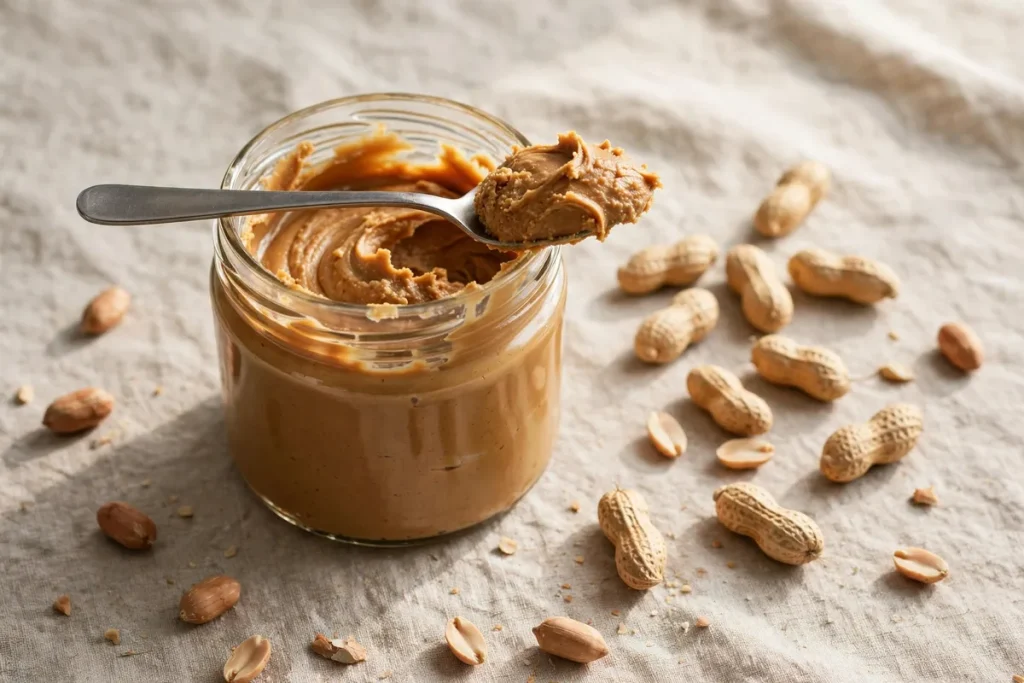

Peanut butter might be the most trusted food in the pantry — wholesome, protein-packed, no cooking required. It is also one of the most chronically under-counted. Not because the label lies: two level tablespoons hold 188 calories, plain as day. Because nobody’s spoon agrees with the label’s idea of a tablespoon.
This page does the full accounting: the spoon table from teaspoon to quarter cup, the trap that turns one spoon into two, the whole regular-versus-natural-versus-reduced-fat-versus-powdered story, exact sandwich math, and how the same jar serves both people losing weight and people gaining it.
A fairness note before we start: peanut butter is not junk food wearing a halo. It is a mostly-whole food with real protein, healthy fats and vitamins. The only problem it has is a measurement problem — and measurement problems have solutions.
Quick Answer: Two tablespoons of peanut butter have 188 calories; one level tablespoon (16 g) has 94, with about 3.6 g of protein. The calories are not the scandal — peanut butter is honest, filling food. The scandal is the unmeasured spoon: a heaped one can hold nearly double the level one before you have technically taken a tablespoon.
The Spoon Table
Everything here is built on one reference: smooth peanut butter runs 588 calories per 100 g. A level tablespoon weighs 16 g — work it out and you get 94 calories. Scale from there:
| Amount | Weight | Calories | Protein |
|---|---|---|---|
| 1 teaspoon | ~5 g | ~31 kcal | ~1.2 g |
| 1 level tablespoon | 16 g | 94 kcal | ~3.6 g |
| 2 level tablespoons | 32 g | 188 kcal | ~7.3 g |
| ¼ cup (4 tbsp) | 64 g | ~376 kcal | ~14.6 g |
Now the trap, which is the whole reason this article exists. A heaped spoon — the rounded, generous scoop everyone actually takes — easily holds 25-30 g of peanut butter. That is 147-176 calories for what you will log, in good faith, as one 94-calorie tablespoon. Do that twice a day and you have quietly added 100-160 calories you never wrote down.
The visual that fixes it: two level tablespoons — the full 188-calorie serving — is about the size of a ping-pong ball, or your thumb from knuckle to tip, twice over. It is less than you think. Spread on toast it looks thin. That thinness is the truth; the deli-thick layer is closer to a quarter cup.
The level-spoon technique, since we keep using the phrase: drag the spoon across the jar’s foil edge, or level it with a straight knife, so the peanut butter sits flush with the spoon’s rim. If it domes, it is heaped. In scale terms, level means 16 g — a dome means 25 g or more.
Do the scale test once: put your toast or bowl on a kitchen scale, spread the way you normally spread, and look at the grams. Most people land at 25-40 g for what they call a normal serving, and never guess wrong again. One weighing session is all it takes to teach your eyes what 16 g actually looks like.
And a word for smoothie makers, because that is where peanut butter disappears fastest: the scoop that goes into the blender is almost never level, and two blender scoops routinely measure out at 50-60 g — 300-plus calories before the banana and milk have even joined. Weigh the jar before and after blending, just once; the difference will recalibrate your scooping forever.
Full Nutrition (Per 2 Tbsp)
For the standard serving — two level tablespoons, 32 g — the full picture is:
| Nutrient | Per 2 tbsp (32 g) |
|---|---|
| Calories | 188 kcal |
| Protein | ~7.3 g |
| Fat | ~16 g |
| Carbs | ~6.3 g |
| Fiber | ~1.9 g |
Why is it so dense? Peanuts are roughly half fat by weight, and fat carries nine calories per gram — more than double protein or carbs. Dry-roasting drives off the water, grinding concentrates everything, and the result is one of the most calorie-dense whole foods in the average kitchen: 588 per 100 g is closer to chocolate territory than to most spreads.
Look at that fat more closely, because it is the point. Of the roughly 16 g of fat in two tablespoons, most is monounsaturated — the same heart-friendly family that made olive oil famous — with a smaller saturated share. This is why peanut butter keeps people full for hours: fat slows digestion, the 7-plus grams of protein help, and the 2 grams of fiber nibble at the edges of hunger.
The micronutrients are a quiet bonus: peanut butter is a solid source of niacin (vitamin B3) and vitamin E, the antioxidant that helps protect cell membranes, plus magnesium. None of them headline on their own — but together they explain why this is a genuinely nutritious food that also happens to be calorie-dense, rather than an empty treat.
For calibration, the unprocessed version: whole peanuts run about 161 calories per ounce (28 g). Peanut butter is slightly denser per bite — grinding settles out the air gaps — which is why the spread out-paces the handful even though they are the same food.
Regular vs Natural vs Reduced-Fat vs Powdered
Four jars, four reputations, and one surprise: the calories barely move until the fourth.
| Type | Per 2 tbsp | The story |
|---|---|---|
| Regular (smooth) | 188 kcal | Peanuts, oil, a little sugar and salt |
| Natural (peanuts only) | ~188 kcal | Essentially the same calories; no added sugar or hydrogenated oil |
| Reduced-fat | ~190 kcal | Fat swapped for sugar and fillers — no calorie saving |
| Powdered (reconstituted) | ~60 kcal | Most fat pressed out; ~6 g protein |
Natural first: peanut butter made from peanuts alone — the kind with the oil layer on top — is essentially the same calories as the classic jar, spoon for spoon. What you skip is the added sugar and hydrogenated oils, and what you gain is a shorter ingredient list. It is a quality upgrade, not a calorie strategy.
Reduced-fat is the honest trap of this aisle. Take out some peanut fat and the jar turns starchy and flat — so in go sugar, corn syrup solids and fillers to rescue the texture. The result lands at roughly 190 calories per two tablespoons on common labels, the same as regular or a hair more, with extra sugar as your reward. Read the label, not the banner.
Powdered peanut butter is the genuinely different tool. Press most of the fat out of roasted peanuts, grind what is left, and two tablespoons of powder mixed with water come back at about 60 calories with roughly 6 g of protein — about a third of regular’s calories. The flavor is peanutty and lighter, the texture slightly thinner. As a smoothie add-in or a spread thinned with water, it is the one swap on this page that actually changes the math.
Crunchy versus smooth, the eternal question, is a calorie tie — peanut chunks displace peanut butter gram for gram, so the spoon reads the same either way. Choose by texture loyalty. The same goes for salted versus unsalted: the difference is sodium, not energy.
The Sandwich Math
Where most peanut butter actually gets eaten is between bread, so let us total the classics on white bread (about 79 calories a slice):
| Sandwich | Build | Calories |
|---|---|---|
| Peanut butter sandwich | 2 slices white bread + 2 tbsp peanut butter | ~346 kcal |
| PB&J, light jam | Bread + 2 tbsp PB + 1 tbsp jam | ~402 kcal |
| PB&J, generous jam | Bread + 2 tbsp PB + 2 tbsp jam | ~458 kcal |
The plain peanut butter sandwich at about 346 calories is a perfectly sensible lunch — roughly 11 g of protein once the bread’s share is counted, filling, and shelf-stable. Notice how the jam behaves: at about 56 calories a tablespoon it doubles quickly, and the difference between a light and a generous PB&J is a full 56 calories hiding behind the word jelly.
Swap white bread for whole-wheat and the totals barely move — the gain is fiber and staying power, not calories. Swap the jam for banana slices and you get a sandwich with natural sweetness and potassium instead of added sugar — the pairing the next section is built on.
Two sandwich levers are worth knowing: an open-face build — one slice, the full two tablespoons — lands near 267 and keeps the flavor ratio high, while toasting the sandwich makes the same calories taste richer, because warm peanut butter spreads thinner and coats every bite. Perception is a legitimate tool here.
One more build for the road: peanut butter on apple slices is the dieter’s remix. A medium apple brings the crunch and most of the volume for about 95 calories, so two tablespoons of peanut butter spread over slices lands near 283 and eats like a real snack, not a compromise.
Peanut Butter and Weight Loss/Gain
Peanut butter serves two opposite goals, sometimes in the same household, and the difference is entirely the spoon.
For weight loss: it is not banned — it is measured. Dieters who weigh their peanut butter once or twice learn the level spoon, and honest 94-calorie tablespoons fit any sensible budget, delivering real fullness per bite. The failure mode is never the food; it is the jar-and-spoon grazing that turns into 300-plus unlogged calories standing at the counter. Plate it, log it, close the jar.
There is a reason peanut butter turns up in diet plans so often despite its density: in satiety terms, fat-plus-protein foods like it simply keep people full longer after a meal, which makes the next meal easier to keep small. The dieter’s job is not to fear it — it is to make the spoon official.
For weight gain: the same density is a gift. People who struggle to eat enough use peanut butter precisely because 188 calories fit into two spoonfuls that go down easy — in smoothies, on oats, on toast twice a day. A daily PB&J at about 400 calories is one of the cheapest, easiest calorie surpluses ever assembled.
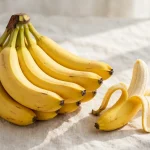
The classic pairing deserves its link: peanut butter and banana were practically designed for each other — the banana brings volume, potassium and natural sweetness for 105 calories, while the peanut butter brings the staying power. Our banana calories guide has every banana size worked out. And if you are fitting peanut butter into daily protein targets, our protein calculator will tell you exactly how much protein your day needs, so those 7.3 g per serving land in context.
Frequently Asked Questions
The questions readers ask most about peanut butter calories, answered with the same numbers used throughout the page:
How many calories in 2 tablespoons of peanut butter?
188 calories (32 g), with about 7.3 g of protein. That is the level-spoon figure — a heaped serving can run far higher.
How many calories in 1 tablespoon of peanut butter?
94 calories for a level tablespoon (16 g). A heaped spoon holds 25-30 g and can reach 150 calories or more, which is why measuring matters with this food.
Is peanut butter fattening?
It is calorie-dense, not magic. Measured, it fits most diets — 188 calories buys a genuinely filling serving. Unmeasured, two casual spoons straight from the jar can quietly add 300-plus calories to your day.
How many calories in a peanut butter and jelly sandwich?
About 402 calories with one tablespoon of jam — two slices of white bread, 2 tbsp of peanut butter and the jam. With two tablespoons of jam, figure about 458.
What is the lowest-calorie peanut butter option?
Powdered peanut butter — about 60 calories per 2 tablespoons prepared, roughly a third of regular, while keeping about 6 g of protein. Reduced-fat versions do not save calories; they swap fat for sugar.