
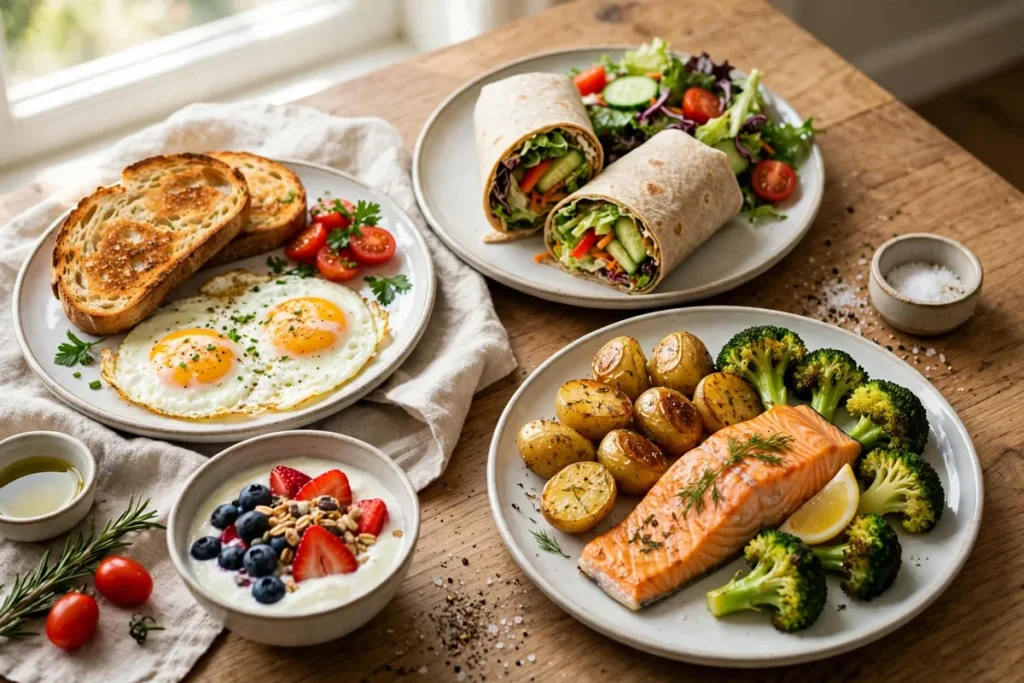

If you are looking for a 1700 calorie meal plan that feels like normal life, not a punishment, this full day of eating is for you. For thousands of people, 1,700 kcal is the target they land on when their maintenance sits near 2,200 calories. That makes it a steady, livable deficit: big enough to move the scale, small enough to live with on a busy Tuesday.
This article shows exactly what a full day at about 1,700 kcal looks like: real meals, no starvation portions, and about 115 g of protein to keep hunger quiet. Every meal total here is approximate, because real food and real kitchens vary a little. That is fine – a plan you follow roughly every day beats a perfect plan you quit by Friday.
You also get easy swaps for every main meal, so the same day fits vegetarians and people who simply hate fish. Use this day as a template: repeat it as it is, swap the parts you do not love, and notice how a well-built day feels very different from a day of random small meals and constant snacking.

Who Is 1,700 kcal Right For (And Who Not)?
1,700 kcal works well for many people, but it is not right for everyone, and it is not a number to copy just because it is popular online.
It is often a good fit for many women whose maintenance is around 2,100 to 2,300 kcal a day. At that level, about 1,700 kcal creates a calm deficit of roughly 400 to 600 kcal, which is enough for steady progress without feeling wiped out. It can also suit smaller or less active men whose maintenance is not much higher, especially men who sit for most of the day and train lightly.
It is not automatically right for taller or very active men. Many of them maintain at about 2,600 kcal or more, so dropping straight to 1,700 can feel like a crash diet: hunger, low energy, poor training and a plan that falls apart within two weeks. Teenagers are still growing, and pregnant or breastfeeding women have extra needs, so a fixed low target like this is not suitable for them without professional guidance.
The honest rule is simple: 1,700 only works if your own maintenance is a few hundred calories above it. If your maintenance is about 1,800, this plan is barely a deficit. If it is about 2,800, it is probably too low. Check your own numbers first with our Macros Calculator for Weight Loss – it works out your maintenance and also turns the day into your protein, carb and fat grams, so you can build this shape around your own target.
The Full Day at a Glance
Here is the whole day on one page – nothing hidden, no extra snacks to guess at, and drinks are covered below. The four meals add up to about 1,690 kcal, presented as about 1,700 because nobody eats in exact numbers.
| Meal | What you eat | About |
|---|---|---|
| Breakfast | Veggie omelette (2 eggs, peppers, spinach, 30 g cheese) + 1 slice wholegrain toast + an orange | 420 kcal |
| Lunch | Grilled chicken and avocado wrap (120 g chicken, half an avocado, salad, light mayo) + an apple | 560 kcal |
| Snack | Greek yogurt (170 g pot) with a handful of berries | 150 kcal |
| Dinner | Salmon fillet (150 g) + 200 g baby potatoes + broccoli and green beans with a teaspoon of olive oil | 560 kcal |
| Day total | Protein about 115 g – the fullness engine of the day | About 1,690 kcal |
Notice the shape, not just the total: lunch and dinner are the biggest meals, breakfast is solid, and the snack is small and deliberate. Protein reaches about 115 g – the main reason this day feels filling even in a deficit.
Meal by Meal: Why This Day Works
Each meal has a job. When a meal has a clear job, you stop needing willpower all day long.
Breakfast. The veggie omelette gives you protein and fibre right up front, from the eggs, cheese, spinach and peppers, with toast and an orange to make it feel like a real breakfast. That combination is exactly what stops the classic 11 am crash, where a sweet, low-protein start leaves you hunting for snacks by mid-morning. If breakfast is your rushed meal, make the omelette filling the night before and reheat it while the toast is on.
Lunch. The grilled chicken and avocado wrap is the biggest meal of the day at roughly 560 kcal, and that is deliberate. The biggest meal sits in the middle of the day, where hunger and social eating actually live. Most people do not struggle at 10 am in their own kitchen; they struggle at lunch with colleagues, family or a busy high street. A wrap that is generous, tasty and easy to pack solves that problem before it starts, and the apple adds crunch and fibre for very little extra.
Snack. The Greek yogurt with berries is small on purpose, at about 150 kcal. Its job is not to be another meal; it is a bridge to dinner, so you never start cooking while you are ravenous. Ravenous cooking is how extra handfuls, tastes and nibbles quietly add a few hundred calories nobody planned. The yogurt also adds a useful chunk of protein for its size, which is why it works better than a biscuit with the same calories.
Dinner. Salmon, baby potatoes, broccoli and green beans is a proper plate: protein, potatoes and two vegetables, with a teaspoon of olive oil for flavour and satisfaction. At roughly 560 kcal, it is big enough that the day ends feeling finished, not punished. That feeling matters. People rarely quit a plan at breakfast; they quit at 9 pm when dinner felt like a diet plate and the evening stretches out empty in front of them.
Drinks. Through the day, stick to water, tea and black coffee, which add roughly zero calories. Sugary drinks and large milky coffees can turn about 1,700 kcal into about 2,000 kcal without making you any fuller, so keep them out, or count them honestly.
Easy Swaps (Same Calories, Your Taste)
You do not need a new plan when your taste changes: swap like for like and the day stays at about the same calories.
| Swap | For this | Notes |
|---|---|---|
| Salmon | Cod, chicken or tofu | White fish is leaner – add a teaspoon of olive oil back to keep the meal satisfying |
| Chicken wrap | Tuna, egg or hummus and roasted vegetables | The vegetarian day: eggs at breakfast, hummus wrap at lunch, lentil dinner below |
| Dinner potatoes | Rice, pasta or a bread roll | Same fist-sized portion – the shape matters, not the carb |
| Greek yogurt | Skyr, cottage cheese or a protein smoothie | All land near the same protein for the snack slot |
| Avocado | 2 teaspoons of olive oil or a small handful of nuts | Healthy fats swap freely – just mind the portion |
For a full vegetarian day in one simple version: keep breakfast, swap lunch to the hummus wrap, and swap dinner to a lentil and vegetable curry with rice – the day still lands at about 1,700 kcal with protein near 90-100 g.
One rule for any swap: match the protein first, then the portion size. If a swap has much less protein, add a protein food back into the meal. That habit keeps almost any version of this day filling.
Still Hungry? Add Smart, Not More
Some hunger in a deficit is normal, especially in the first few days. Constant, miserable hunger is information, not a test of character. Work through these fixes in order before you decide the plan has failed.
- Add volume first: a big side salad or a bowl of soup before dinner adds a lot of food for about 50-80 kcal, and it takes the edge off before the main plate arrives.
- Move calories to your weak hour: if evenings are when you struggle, move roughly 50-100 kcal from lunch to an evening snack. The day total stays the same, but the timing finally matches your real life.
- Check protein before you add food: days under about 100 g of protein are usually the hungry days. If your swaps have quietly dropped your protein, fix that first and hunger often settles on its own.
- Give it four to five days: week-one hunger is often habit, not need. Your body expects food at the old times and in the old amounts, and those signals usually fade once the new routine feels normal.
- Know when the target is wrong: if you are truly dragging after two honest weeks, with sleep and protein in place, your target is probably too low. Raise it by roughly 150-200 kcal and keep losing more slowly, because a slower plan you keep beats a fast plan you abandon.
The One-Day Shopping List
Everything here is for this exact day, grouped so you can shop in a few minutes. Quantities are for one person for one day, although most packs will cover several days.
- Fruit and vegetables: orange, apple, avocado, salad leaves, peppers, spinach, berries, baby potatoes, broccoli and green beans.
- Protein and fridge: eggs, cheese, chicken breast, Greek yogurt and a salmon fillet.
- Bread and wraps: wholegrain bread and one large wrap.
- Store cupboard and basics: olive oil and light mayo.
Everything here is ordinary supermarket food – no special diet products to hunt down. Most items also serve the rest of the week: eggs, bread, cheese, yogurt, potatoes and berries roll easily into other meals, so little is wasted.
Frequently Asked Questions
Will I lose weight on a 1700 calorie meal plan?
Only if 1,700 is below your maintenance. If you maintain near 2,200, expect roughly 0.5 kg a week. If your maintenance is 1,800, the same plan barely moves the scale – the number only works relative to you.
Is 1,700 calories enough for a man?
For smaller or less active men it can be a sensible deficit. For taller or active men it is usually too low – many maintain at 2,600 or more. Check your own maintenance before copying any fixed number.
How much protein is in this 1,700 kcal day?
About 115 g, mostly from the eggs, chicken, yogurt and salmon. That level keeps hunger down and protects muscle while you lose weight.
Can I repeat this same day every day?
You can, and many people happily repeat breakfast and lunch daily. Use the swaps table to rotate dinners so the week never tastes identical.
What if I exercise on this plan?
Keep the plan and watch your weekly trend. On very hard training days many people add a planned 150-200 kcal snack; if loss runs faster than about 0.7 kg a week for several weeks, eat a little more.
1,700 is not magic. It is just a well-built day at a popular deficit, with enough protein, enough real food and swaps that let you live with it. If your number is different, the same shape scales up or down: keep the protein high, keep the biggest meals where your hunger is, and adjust the portions. Build your own version from your own figures with our Macros Calculator for Weight Loss, and remember that this article is general information, not medical advice. If you have a medical condition or a history of eating problems, talk to a professional before using any fixed calorie target.



Pingback: How Many Calories in a Hershey Kiss? Per Kiss & Per Serving
Pingback: 1800 Calorie Meal Plan: A Full Day of Eating (With Swaps)