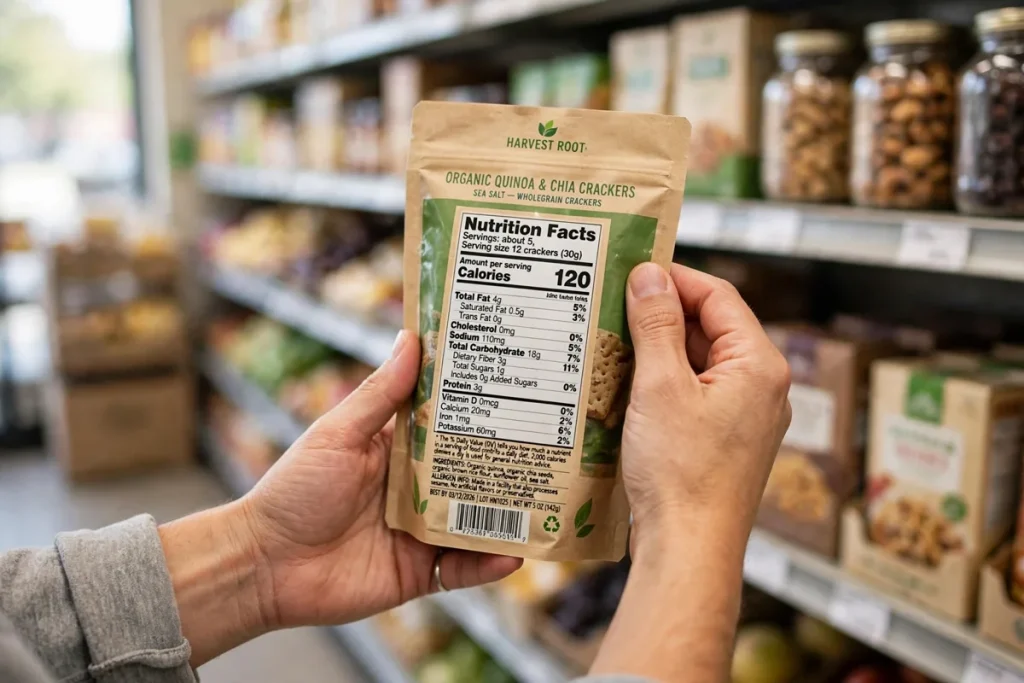

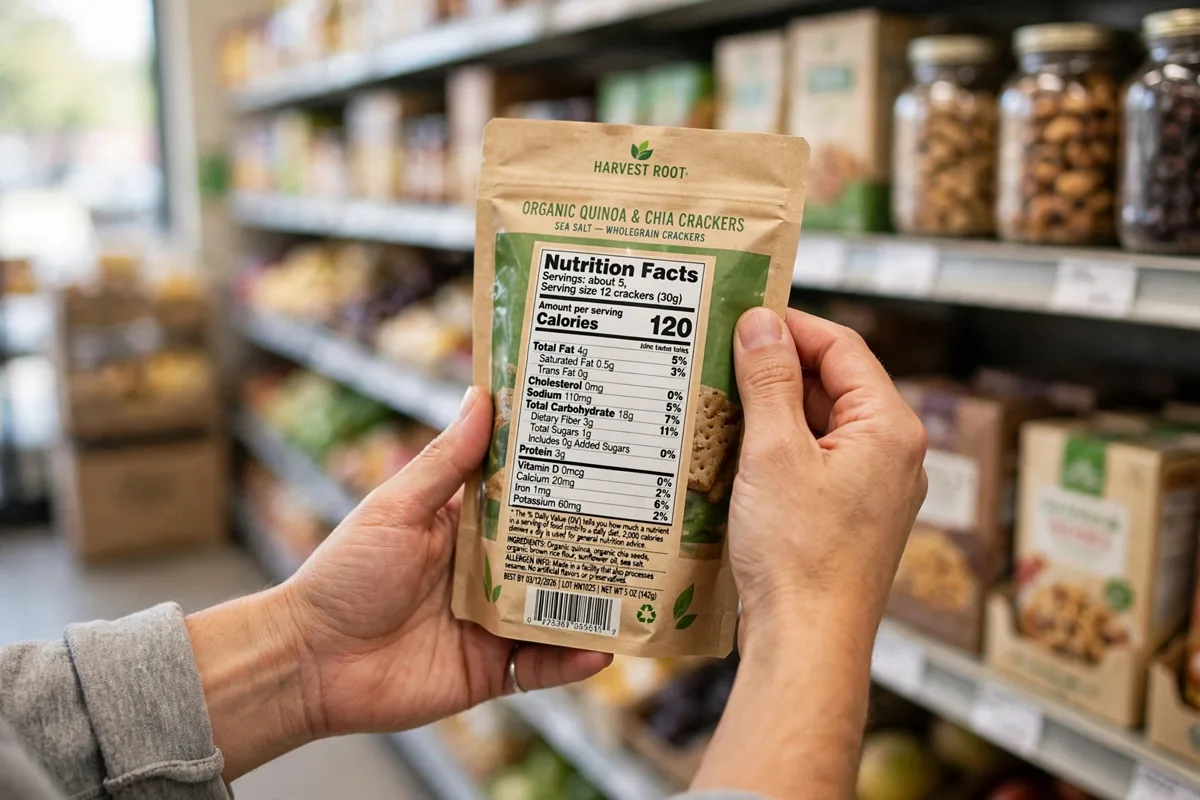
The nutrition label is the most honest part of the package. The front is advertising, designed to sell the food in seconds. The back is the truth, printed in plain black and white whether it flatters the product or not. If you learn one shopping skill, learning how to read nutrition facts label panels properly is the one that pays you back on every trip.
Most people only read the calories, and that is where they get caught out. A friendly calorie number means little until you know how much food it describes, because serving sizes can be shrunk on paper. This guide walks the label top to bottom, then decodes one real-style label line by line.
Step 1 – Start With the Serving Size (The Trap That Catches Everyone)
Everything on the label describes ONE serving – not the packet, not the bottle, and not the portion you pour yourself. At the top, the label gives the serving size and how many servings the container holds. Every number below it, from calories to sodium, is for that one serving only.
Many packages quietly contain 2 or more servings, even when they look like a single portion. So the rule is simple: if you eat the whole pack, multiply everything. A noodle pack that says 190 kcal per serving but holds 2 servings is really a 380 kcal pack, with double the salt and fat to match.
Step 2 – Calories
Calories tell you how much energy is in one serving. They do not tell you whether that energy comes from protein and fibre that keep you full, or from sugar and refined starch that leave you hungry again in an hour, which is why calories should never be the only line you read.
Always separate calories per serving from calories per pack. As a quick sanity band, a snack at around 100-200 kcal is light, while a meal at 500-700 kcal is a normal main meal. Anything far outside those bands deserves a closer look at the rest of the label.
Step 3 – The % Daily Value and the 5/20 Rule
Down the right-hand side, the % Daily Value tells you how much of a full day’s recommended amount of each nutrient is in one serving. Those percentages are based on a 2,000 kcal day, the standard reference used on labels, so you can judge a food without memorising gram limits for every nutrient.
Then apply the golden rule, the 5/20 rule: 5% or less of a nutrient per serving is LOW, and 20% or more is HIGH. Use it with a direction in mind. You want LOW for saturated fat, sodium and added sugar. You want HIGH for fibre, protein (where shown), vitamins and minerals.
Step 4 – Fats
Start with total fat, then look closely at saturated fat, because the type of fat matters more than the total. The daily limit for saturated fat is 20 g, so a serving carrying 5 g has already used a quarter of your day, even if the total fat number looked unremarkable.
Next, check trans fat and aim for 0 g. Small amounts can hide behind rounding, so check the ingredients too: watch for “partially hydrogenated oil” in the ingredients list. If you see those words, the food contains industrially produced trans fat, whatever the front of the pack suggests.
Step 5 – Sodium
Sodium is the silent problem in processed food. It accumulates quietly in sauces, soups, instant meals, bread and snacks, rarely tasting as salty as its numbers deserve. The daily limit is 2,300 mg, about 1 teaspoon of salt in total from everything you eat and drink across the whole day.
Against that limit, a single serving with 800 mg is already 35% of the day, before you have eaten anything else or added a sauce. That is how a modest-looking portion can blow the salt budget by lunchtime, and why sodium earns its own step in this guide.
Step 6 – Carbs, Fibre and Sugar
Read this section in order. Start with total carbs, the full carbohydrate load in one serving. Then look at fibre, the part of that total working in your favour, slowing digestion and helping you feel full. The daily goal for fibre is 28 g, and most people fall well short of it.
Then turn to Total Sugars, which mixes sugars that occur naturally, in foods like fruit or milk, with sugars added in manufacturing. The line that matters sits underneath it: “Includes X g Added Sugars”. That is the honest total for sugar the maker chose to add, and the daily limit for added sugars is 50 g.
Sugar also hides under other names. Learn its aliases: words ending in -ose, such as sucrose, dextrose, maltose and glucose, plus cane sugar, corn syrup, honey, agave, fruit juice concentrate and molasses. They sound different, some even wholesome, but they are different names for the same sugar.
Step 7 – Protein
With protein, the grams matter more than the %. The gram figure lets you compare products directly, and signals how substantial a food is, because protein supports muscle and keeps hunger steadier.
As a practical guide, a meal item with 15 g or more is genuinely high-protein. A snack with 5-10 g sits in a useful middle ground, especially when it also brings fibre. Below that, treat any high-protein claim on the front with suspicion and let the back settle it.
Step 8 – The Ingredients List
Ingredients are listed heaviest first, in descending order by weight, so the first item is what there is most of in the food. In practice, the first 3 ingredients are most of what you are eating, and reading just those three gives you the real story of the product.
If sugar, under any of its names, is in the first 3, you are basically buying sweetened food, however healthy the marketing sounds. Shorter lists are usually, though not always, simpler food: fewer additives, fewer hiding places, and fewer surprises when you set the list beside the nutrition panel.
Reference Table: Daily Values for a 2,000 kcal Day
Keep these Daily Values nearby until the main limits feel familiar. They are the figures behind every % Daily Value on a label, based on a 2,000 kcal day:
| Nutrient | Daily Value |
|---|---|
| Total Fat | 78 g |
| Saturated Fat | 20 g |
| Sodium | 2,300 mg |
| Total Carbs | 275 g |
| Added Sugars | 50 g |
| Fibre | 28 g |
| Protein | 50 g |
A Real Label, Decoded
Now put the steps together on one real-style label: instant noodles. One pack contains 2 servings, and a serving is half a pack, about 43 g. Per serving, the panel reads:
| Nutrient | Per Serving | % Daily Value |
|---|---|---|
| Calories | 190 | – |
| Total Fat | 7 g | 9% |
| Saturated Fat | 3.5 g | 18% |
| Sodium | 800 mg | 35% |
| Total Carbs | 27 g | 10% |
| Fibre | 1 g | – |
| Total Sugars | 1 g | – |
| Protein | 4 g | – |
Half the pack already costs 35% of the day’s sodium and 18% of the day’s saturated fat, with only 1 g of fibre and 4 g of protein in return. It is an uneven trade: large slices of two limits you want low, and very little of what you want more of.
And almost nobody eats half a pack. Eat the whole pack, as most people do, and everything doubles: 380 kcal, total fat 14 g, saturated fat 7 g (35% of the day), sodium 1,600 mg (70% of the entire day), total carbs 54 g, and protein of just 8 g. The verdict: fine as an occasional food, a problem as a daily habit – and you can only see that if you read servings first.
Front-of-Pack Claims That Mislead
“Low fat”. Often high in sugar instead, added for flavour when fat comes out. Compare sugar and calories before believing it is lighter.
“Multigrain”. This just means more than one grain is present. Those grains are often still refined, so check fibre rather than counting grains.
“Made with real fruit”. This can mean a tiny percentage of fruit in a mostly sugar-based product. The ingredients list will show how much is really there.
“Natural”. This word has no strict meaning for most foods, so it tells you almost nothing about sugar, salt or processing. Treat it as decoration, not information.
“Light” or “lite”. This can refer to colour or flavour, or to 50% less fat than a reference product. Only the back of the pack tells you which meaning applies here.
“Sugar-free”. This may still be high in fat and calories. Remember the rule that covers all six claims: the front sells, the back tells.
The 10-Second Label Check
When you are standing in an aisle, run this closing checklist in order. It takes about ten seconds once the habit forms:
- How many servings are in the pack?
- What are the calories multiplied by those servings?
- Is the sodium under 20% DV per serving?
- How many grams of added sugar are there?
- Is the fibre or protein worth anything?
If a food fails 3 of these 5 checks, it is a treat, not a staple. That single distinction, made in seconds, will quietly improve most of the food you buy in a week.
One last thought: every % Daily Value in this guide is built on a 2,000 kcal day, so the same label means something different if your own target is 1,700 or 2,400 kcal. That is why it helps to know how many calories should I eat daily, then read every label through that personal number.
Frequently Asked Questions
What is the first thing to check on a nutrition label?
The serving size and servings per container. Every number below it describes one serving, so if the pack holds 2 servings and you eat it all, you must double everything – calories, sodium, sugar, all of it.
What does % Daily Value mean?
How much of a full day’s recommended amount of that nutrient is in one serving, based on a 2,000 kcal diet. Use the 5/20 rule: 5% or less is low, 20% or more is high.
How much sodium is too much in one food?
A single serving with 20% DV or more (about 460 mg+) is high; some processed foods hide 800 mg (35%) in half a pack. The full-day limit is 2,300 mg.
Where does sugar hide on a label?
Under many names: sucrose, dextrose, maltose and other -ose words, cane sugar, corn syrup, honey, agave and fruit juice concentrate. The “Added Sugars” line gives you the honest total.
Is a low-fat product always healthier?
No. Removing fat often means adding sugar or salt for flavour, so a low-fat product can have as many calories as the original. Always compare the full label, not the front claim.