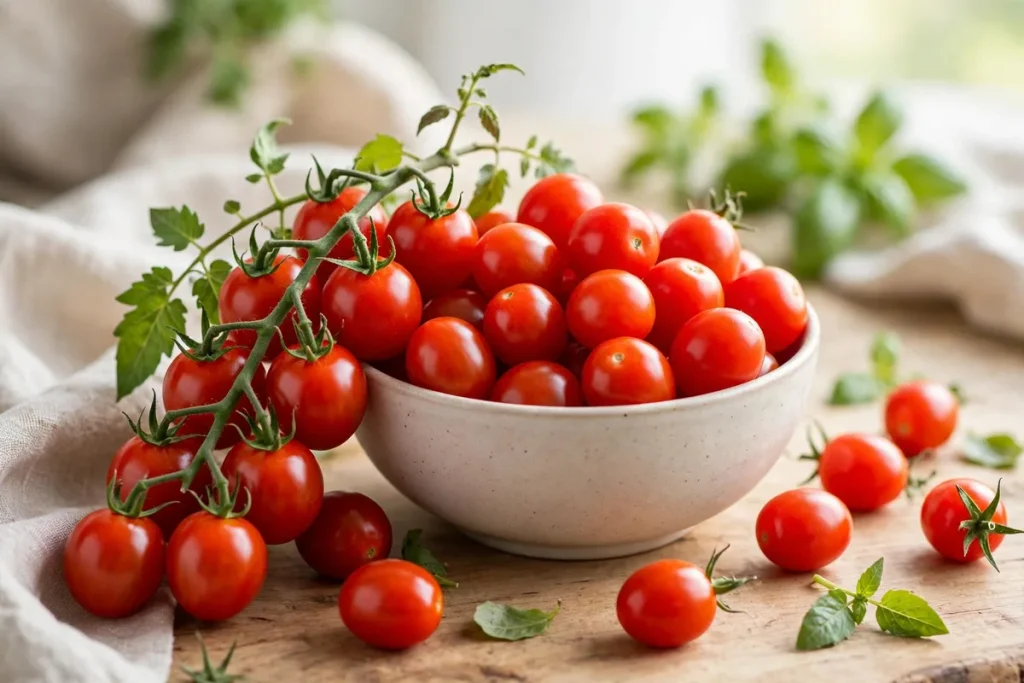

Quick Answer: The calories in grape tomatoes are about as low as real food gets: a whole cup (149 g) has just 27 calories, and each little tomato carries only about 1-2. Ten of them add up to roughly 14 calories, half a cup is about 14, and even an entire pint container — the full snack-size tub — comes to only about 53 calories. Grape tomatoes run about 18 calories per 100 g, the same as every other tomato, but their snackable size is what makes them special: this is one of the few foods you can genuinely eat the whole bowl of.
Calories by Amount
Because nobody weighs a snack, here is the count in the amounts people actually eat. A grape tomato is a small thing — about 8 g, roughly the size of a large olive — so the numbers stay tiny however you scoop them:
| Amount | Weight | Calories |
|---|---|---|
| 1 grape tomato | ~8 g | ~1-2 kcal |
| 10 grape tomatoes | ~80 g | ~14 kcal |
| ½ cup | 75 g | ~14 kcal |
| 1 cup | 149 g | 27 kcal |
| 1 pint container | 298 g | ~53 kcal |
Notice how forgiving the math is. Going from a sensible handful to the entire pint — the whole container you bought for the week — moves you from about 14 calories to about 53. For scale, that entire pint is still fewer calories than one slice of plain bread. If any snack food earns a free pass, it is this one: you would have to eat several pints before grape tomatoes made a dent in a day’s eating.
The one number worth remembering is 18 calories per 100 g. Every figure in this article — and in fact every tomato in the shop — is built on it. Once you know it, you never need to look a tomato up again: estimate the weight, take roughly a fifth of it, and that is your calorie count.
If you track your food seriously for a week or two, weigh your usual handful once. Most people are surprised twice: first by how light their normal portion is, and second by how many tomatoes it takes to reach even 100 g — about a dozen. After that one weighing, you can eyeball grape tomatoes forever with total confidence.
Nutrition per Cup
Low calorie does not mean empty. A cup of grape tomatoes is mostly water, but the part that is not water does real work for you:
| Nutrient | Per 1 cup (149 g) |
|---|---|
| Calories | 27 kcal |
| Carbs | 5.8 g |
| Sugar (natural) | 3.9 g |
| Fiber | 1.8 g |
| Protein | 1.3 g |
| Potassium | ~350 mg |
| Vitamin C | ~20 mg (about 22% of the daily value) |
The headline nutrient is not even on most labels. Lycopene is the antioxidant pigment that makes a ripe tomato red, and tomatoes are the richest everyday source of it in most diets. Unusually for a nutrient, lycopene becomes more available after cooking: heat breaks down the tomato’s cell walls and lets your body absorb more of it. Eating tomatoes with a little fat helps absorption too, which is one reason tomatoes and olive oil are such a natural pair in the kitchen.
The supporting cast is solid too. The vitamin C in a cup — about 20 mg — covers roughly a fifth of your day, and the potassium, around 350 mg per cup, is in the same league as half a banana at a fraction of the calories. The 3.9 g of sugar on the label is the tomato’s own sugar, arriving packaged with water and fiber, which is why a cup of tomatoes does not behave in your body the way 27 calories of sweets would.
The fiber figure — 1.8 g per cup — looks modest on its own, but snack foods rarely bring any fiber at all. Combined with all that water, it is a big part of why a pint of grape tomatoes takes the edge off hunger in a way that 53 calories of almost anything else simply cannot.
Grape vs Cherry vs Roma
Shoppers regularly ask whether grape and cherry tomatoes differ nutritionally. They do not: every common tomato sits at the same ~18 calories per 100 g. What actually changes from type to type is shape, texture, and the job each one does best:
| Type | Shape & size | Per piece | Per cup | Best for |
|---|---|---|---|---|
| Grape | Oval, firm, ~8 g each | ~1-2 kcal | 27 kcal | Snacking, salads, roasting |
| Cherry | Round, juicy, ~17 g each | ~3 kcal | ~27 kcal | Snacking, skewers, salads |
| Roma | Plum-shaped, meaty, ~123 g | ~22 kcal | ~32 kcal chopped | Sauces, cooking, salsas |
Grape tomatoes are the oval ones — firmer, thicker-skinned and usually a touch sweeter than the rest, which is why they survive a lunchbox without splitting and burst satisfyingly when you bite them instead of spraying juice down your shirt. Cherry tomatoes are round and juicier, with thinner skins. Romas are the big, meaty cooking tomatoes of the family; rather than repeat their numbers here, our Roma tomato calories guide breaks them down per tomato, per cup and per 100 g.
The practical takeaway is simple: buy whichever type looks best and suits the dish. There is no calorie reason to choose one over another — a cup is a cup, and all three land within a few calories of each other.
Price and season matter more than type. In summer, local grape and cherry tomatoes are cheap and properly sweet; in winter, grape tomatoes tend to hold their flavor best of the three. None of that changes the calorie count — it just changes how much you enjoy eating them.
The Volume-Eating Snack
Volume eating is the simple idea of choosing foods you can eat a lot of for very few calories, and grape tomatoes are close to the perfect example. A whole pint is about 53 calories — less than a single plain cookie — yet it takes real time to finish, gives your hands and mouth something to do, and genuinely fills stomach space thanks to its water and fiber. For anyone who snacks out of habit rather than hunger, that combination is gold.
A few habits make the pint strategy work even better. Keep the tomatoes washed, visible, and at the front of the fridge — or in a bowl where you work — because snacking is mostly about whatever is closest. Eat them at a normal pace rather than by the absent-minded handful, and let them be a bridge between meals rather than a replacement for meals that carry protein.
There is exactly one reliable way to ruin all this: the dip. Here is what common dips do to a virtuous bowl of tomatoes:
| Dip | Per 2 tbsp | The same calories in tomatoes |
|---|---|---|
| Ranch dressing | ~140 kcal | More than 5 cups |
| Hummus | ~70 kcal | About 2½ cups |
| Yogurt-herb dip | ~30-40 kcal | About 1¼ cups |
Read that first row again: two tablespoons of ranch — a modest-looking dollop — costs more than five whole cups of the tomatoes you are dipping into it. The tomatoes did not change; the vehicle did. Hummus is a better citizen at about 70 calories per 2 tablespoons, and it at least brings protein and fiber to the bowl. The smart swap is a yogurt-herb dip — Greek yogurt with garlic, lemon, chopped herbs and salt — at roughly 30-40 calories for the same 2 tablespoons: the creamy, salty hit for about a quarter of the ranch.
Even simpler: skip the dip and try a pinch of flaky salt, a squeeze of lemon, or a few torn basil leaves — all effectively zero calories, and all genuinely good. Whatever you choose, it helps to know the budget it has to fit into: our maintenance calories calculator works out the daily total your snacks are drawn from, and at 27 calories a cup, grape tomatoes are one of the few snacks that barely touch it.
Roasted & In Cooking
Cooking changes the water, not the tomato. Grape tomatoes are mostly water, and roasting drives some of it off, so the same tomatoes slump down, concentrate in flavor, and take up less space. A roasted cup lands around 35-40 calories — a small rise per cup, purely because more tomato fits into the cup once it has collapsed. No calories are created in the oven; they are simply packed tighter.
The number to watch in cooking is, as ever, the oil. One tablespoon of olive oil is 119 calories, but spread across a whole sheet pan of tomatoes it adds only a modest amount to each serving — and a little fat genuinely helps your body absorb the lycopene. The trick is measuring the oil the first few times rather than free-pouring, so the pan gets its tablespoon and not three.
Two uses are worth knowing. Burst-tomato pasta: blister a pint of grape tomatoes in a hot pan or oven with garlic until they collapse into their own sauce, then toss through cooked pasta with basil. And sheet-pan dinners: roast the tomatoes alongside chicken or fish, where their juices become the sauce for free. In both cases the tomatoes deliver a sauce’s worth of flavor for fewer calories than almost any jarred sauce — and they stay a light food for as long as the oil stays measured.
To pick well, choose tomatoes that are deeply colored, glossy and heavy for their size, with no soft spots. Store them on the counter if you will eat them within a few days — the fridge dulls their flavor — and rinse them just before eating rather than before storing, so they keep longer.
However you eat them — straight from the pint, roasted into a sauce, or tossed through a salad — grape tomatoes are about as close to a free food as real food gets. Snack accordingly.
Frequently Asked Questions
How many calories in grape tomatoes?
About 27 calories per cup (149 g), which works out to roughly 18 calories per 100 g — the same as every other tomato. A whole pint container is only about 53 calories.
How many calories in 10 grape tomatoes?
About 14 calories. Ten grape tomatoes weigh roughly 80 g, and at 18 calories per 100 g that comes to just 14 — barely a snack at all, in the best way.
How many calories in one grape tomato?
Just 1-2 calories. A single grape tomato weighs about 8 g, making it one of the smallest calorie counts of any food you can eat whole.
Grape vs cherry tomatoes — same calories?
Yes — nutritionally they are near-identical, at about 18 calories per 100 g for both. Grape tomatoes are oval, firmer and often a little sweeter; cherry tomatoes are round and juicier. A cherry tomato is bigger (about 17 g), so it runs about 3 calories per piece, but cup for cup they match.
Can you eat too many grape tomatoes?
Practically, the tomatoes themselves are not the problem — an entire pint is only about 53 calories. Watch what you dip them in instead. The one real caveat is acid: people prone to reflux may find a very large amount uncomfortable.