
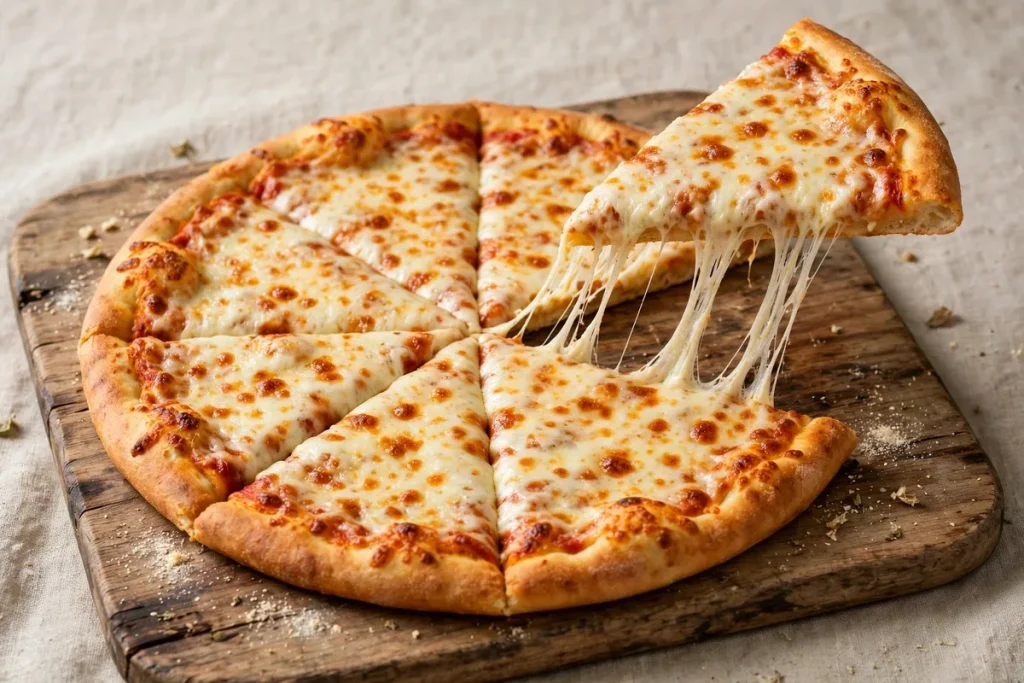

Quick Answer: How many calories in a slice of cheese pizza? For the standard slice — one eighth of a 14-inch regular-crust pie, about 107 g — the answer is 285 calories, with 12 g of protein, 36 g of carbs and 10 g of fat. But a slice is not a fixed unit: depending on the crust and the size of the pie, one slice runs from about 210 calories for thin crust to about 430 for deep dish. So the honest answer is another question — which pizza? Below is the number by style, by pie size and by topping, so you can log the slice you actually ate.
Slices by Style
Cheese, sauce and toppings stay fairly constant from one pizza to the next. What changes — dramatically — is the crust underneath them, because crust is heavy, and more crust means more calories before a single topping lands. A deep-dish slice can carry close to double the dough of a thin-crust slice, and the calorie gap follows the dough almost exactly:
| Style | The slice | Calories per slice |
|---|---|---|
| Thin crust | 1/8 of a 14-inch pie | ~210 kcal |
| Regular crust (standard) | 1/8 of a 14-inch pie, ~107 g | 285 kcal |
| New York style | 1 large foldable slice | ~320 kcal |
| Thick crust | 1/8 of a 14-inch pie | ~350 kcal |
| Deep dish | 1/8 of a 14-inch pie | ~430 kcal |
| Frozen rising-crust | 1/6 of a frozen pie | ~320 kcal |
The crust alone accounts for roughly 40% of a standard slice’s calories — about 115 of the 285. That is why the style column swings so widely while the cheese stays the same, and it is also why the most effective lighter swap is not less cheese but less bread: going thin instead of regular saves about 75 calories a slice without touching the part of the pizza most people actually love.
Two rows deserve a note. New York style slices are not richer — they are simply bigger, cut from large pies and meant to be folded, so their ~320 calories buy more pizza, not a denser one. And the frozen row surprises people: a rising-crust frozen pizza is usually cut into sixths rather than eighths, so each slice is a bigger wedge, about 320 calories, even though nothing about the pizza is extreme. Always check what fraction of the pie your one slice actually is.
One more wrinkle: how the pie is cut. Most round pizzas are cut into eighths, but party and tavern-style pies are often cut into squares or into ten or twelve pieces, and a slice of those is a smaller unit than anything in the table. When the cut changes, go back to the whole pie and divide by the number of pieces you can actually see — it is the only count that never lies.
The Whole-Pie Math
Sometimes the unit is not the slice but the pie: a shared takeaway, tomorrow’s leftovers, or the honest half-the-pizza entry in a food diary. Here is the full picture for regular-crust cheese pizzas, each cut into the usual eight slices:
| Pie size | Per slice | Slices | Whole pie |
|---|---|---|---|
| 12-inch | ~230 kcal | 8 | ~1,840 kcal |
| 14-inch | 285 kcal | 8 | ~2,280 kcal |
| 16-inch | ~340 kcal | 8 | ~2,720 kcal |
Two useful anchors fall out of this table. First, one slice more or less is a 230-340 calorie decision depending on the pie in front of you — the pie’s size moves the number as much as its style does. Second, half of a standard 14-inch pizza is about 1,140 calories, which is most of a day’s eating for some people. That is not an argument against pizza; it is an argument for knowing which half you are dealing with.
For leftovers, the same math applies cold the next day — a slice from the fridge has the same calories it had hot, which makes yesterday’s whole-pie numbers the easiest logging shortcut there is. If you regularly order the same pie, count it once and reuse the figure; pizza is one of the most repeatable meals people eat.
Restaurant and chain slices deserve a word of caution. Chains publish nutrition for their own standard cut, and their standard slice is often from a 12- or 14-inch pie; the giant slices sold individually in New York-style shops are a different unit altogether (about 320 calories, as the style table shows). When you are logging someone else’s pizza, the pie-size table above is a more honest guide than any single chain’s number.
Toppings: What Each One Adds
Start from the 285-calorie cheese slice and add whatever lands on top. For a standard 14-inch pie, the common additions run roughly like this, per slice:
| Topping | Added per slice | Slice total |
|---|---|---|
| Pepperoni | +~25 kcal | ~310 kcal |
| Extra cheese | +~35 kcal | ~320 kcal |
| Sausage | +~45 kcal | ~330 kcal |
| Vegetables | +~10 kcal | ~295 kcal |
| BBQ chicken | +~30 kcal | ~315 kcal |
Worked through, a pepperoni slice lands at about 305-310 calories, and a sausage slice at around 330. Vegetables barely move the needle: a veggie slice is roughly 275-295, because the vegetables add about 10 calories but often displace a little of the cheese — and a thin-crust veggie slice is only about 220, the lightest full-size slice in this entire guide. BBQ chicken sits in the middle at about 315, though a sweet barbecue base sauce can nudge it higher at some chains.
The pattern worth noticing is how modest these numbers are. No common topping doubles a slice, and none is completely free either; toppings typically move a slice by about 10-15% one way or the other. Stack three meat toppings and the additions do compound — roughly another 100 calories across the slice — but the base underneath, its crust and its size, is still doing most of the work.
The one addition that breaks the modest pattern is extra cheese, simply because it scales the base ingredient itself: +35 calories a slice sounds small until it is riding on an already thick crust. A smarter order at most shops is regular cheese with double vegetables — the vegetables add water, fiber and sheer coverage, so the slice looks and eats like a loaded one for about 10 extra calories instead of 35.
What Is Actually in a Slice
Here is the standard cheese slice — one eighth of a 14-inch pie, about 107 g — in full:
| Nutrient | Per slice |
|---|---|
| Calories | 285 kcal |
| Protein | 12 g |
| Carbs | 36 g |
| Fat | 10 g |
| Sodium | ~640 mg |
The protein genuinely surprises people: 12 g is decent — more than you get from an egg and a half — because both the cheese and the wheat crust contribute. Pizza is not empty food; it is dense food. Its carbs are mostly refined white flour, its fat is moderate rather than extreme, and the number that deserves real attention is the sodium: about 640 mg in a single slice is roughly 28% of the 2,300 mg daily limit, so three slices deliver most of a day’s salt before any sides, dips or drinks join in.
That profile explains pizza’s reputation problem. Nothing in a slice is terrible on its own, but everything arrives concentrated — calories, salt and refined carbs packed into a food that is famously easy to keep eating slice after slice. The food itself is fine; the default portion is the problem, and a portion is a much easier thing to fix than a food group.
It is also worth giving the tomato sauce its due. It is the lightest major component of the slice, and it brings lycopene — the same red antioxidant found in fresh tomatoes — plus a little vitamin C, for very few calories. Pizza’s nutritional story is not a villain story; it is a concentration story, and the sauce is the one ingredient pulling in the other direction.
A Lighter Pizza Night (Without Skipping Pizza)
None of this requires a pizza-free life. A few small, repeatable moves keep pizza night intact and cut its cost substantially — starting with the crust swap from earlier: thin instead of regular saves about 75 calories per slice, so a two-slice dinner falls from about 570 calories to roughly 420-440 before you have changed anything else at all.
Blotting works too. Dragging a napkin across a hot slice picks up the oil pooled on the cheese, and that surface oil is worth roughly 30-40 calories per slice. It will not transform the meal on its own, but across two slices it is another 60-80 calories gone, and most people find the pizza tastes cleaner for it. Do it as soon as the slice lands, while the oil is still sitting on top.
Then structure the meal around the slices. Put vegetables on the pizza, where they add bulk for almost nothing, instead of pretending they do not belong there. Eat a salad first, so the first slice arrives at a stomach that is no longer empty. And decide the count before the box opens: two slices eaten slowly is a planned meal at about 570 calories on regular crust; three slices eaten on autopilot is roughly 855, and the difference is rarely hunger — it is momentum.
Cheese pizza is not the only cheesy favorite with this exact profile, by the way — our grilled cheese sandwich calories guide runs the same math on the other comfort classic, butter and all. And if you want pizza night to fit a real number rather than a guess, our maintenance calories calculator works out the daily budget your meal is drawn from, which turns how much pizza can I eat into a question with an actual answer.
Finally, plan the leftovers on purpose. Two slices tonight and two slices boxed for tomorrow’s lunch is a strategy; four slices tonight because the box was open is an accident. Cold leftover pizza, eaten as a planned portion, has ended more pizza-night regrets than any diet rule ever written.
Order the pizza. Just know which slice you are holding — style, size and topping — and it stops being a dietary mystery and becomes what it should be: a 285-calorie food you can plan around and enjoy.
Frequently Asked Questions
How many calories in a slice of cheese pizza?
285 for a standard slice — one eighth of a 14-inch regular-crust pie. By style, a slice runs from about 210 for thin crust to about 430 for deep dish, so the style matters more than the cheese.
How many calories in a whole cheese pizza?
About 2,280 calories for a whole 14-inch cheese pizza cut into eight slices. By size: roughly 1,840 for a 12-inch pie and about 2,720 for a 16-inch.
What is the lowest-calorie pizza slice?
Thin-crust cheese, at about 210 calories a slice. A thin-crust veggie slice is close at about 220 and adds more fiber and volume, so it keeps you full for nearly the same calories.
Does blotting pizza oil really help?
Yes, modestly. Blotting the oil pooled on the cheese with a napkin removes roughly 30-40 calories per slice. It is a small saving, but it costs nothing and adds up across two or three slices.
How many slices fit a weight-loss diet?
It depends on your total day, but for many budgets two regular slices (about 570 calories) with a salad is a reasonable planned meal. Thin crust brings the same two slices down to about 420-440.


Pingback: Whopper with Cheese Calories (Official Numbers) + Lighter BK Orders
Pingback: Domino's Calories: Full Menu Guide (Pizza, Wings, Sides)