
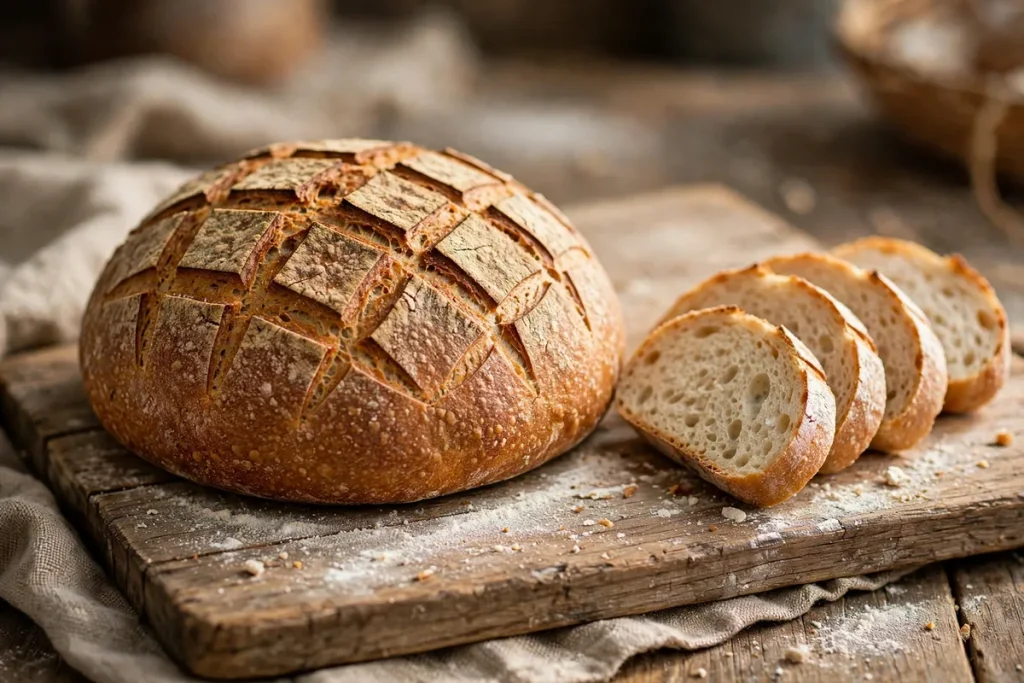

Quick answer: sourdough bread calories are about 120 per typical thick slice (about 50 g) and about 260 per 100 g — roughly the same calories as white bread by weight, but with a lower glycemic index (about 54 vs about 75 for white bread) and fermentation benefits that make it the better everyday choice. Everything below is priced by weight, because with sourdough the slice size is where the honest differences live.
Sourdough has a health halo, and halos make people stop counting. The loaf looks rustic and wholesome, so a thick slice feels free — until you weigh it. A bakery sourdough slice is usually cut thick from a round loaf and lands near 50 g, while a sandwich-bread slice is a thin, uniform 30 g or so. Compare slice to slice without the weights and sourdough looks like the heavy option; compare them per 100 g and the two breads are nearly identical. That is why every number in this article states its weight.
Below you will find the full nutrition table for white sourdough, a fair per-100 g comparison against white, whole wheat and rye bread, and the sandwich math that shows where a sourdough sandwich really gains its extra calories. The short version: sourdough wins on blood sugar and satisfaction, not on calories — and knowing that is exactly what makes it usable in a real eating plan.
Sourdough Nutrition Table
Here is white sourdough by the standard reference weight, with the per-slice math right under it:
| Nutrient | Per 100 g |
|---|---|
| Calories | 260 kcal |
| Fat | 0.5 g |
| Carbohydrates | 51 g |
| Fiber | 2 g |
| Protein | 9 g |
| Sodium | About 400 mg |
Per slice, the weight decides everything. One thick slice of about 50 g — the normal cut from a bakery loaf — runs about 120 to 130 calories. One thin slice of about 30 g, closer to a sandwich-bread cut, is about 78 calories. Same loaf, same recipe, a difference of more than 50 calories created entirely by the knife. If you eat sourdough most days, weigh one of your usual slices once; after that you can estimate your loaf’s slices by eye with confidence.
Read the table and two things stand out. First, sourdough is almost fat-free at 0.5 g per 100 g — the calories are carbohydrate calories, which means spreads and toppings, not the bread, bring the fat. Second, the protein is a respectable 9 g per 100 g for a bread, which is part of why a sourdough sandwich feels more substantial than its white-bread twin. The sodium, about 400 mg per 100 g, is the quiet line to watch if you eat several slices a day.
Why Fermentation Changes the Picture
Sourdough is made with a live starter — wild yeast and bacteria — rather than baker’s yeast alone, and the dough ferments slowly before baking. During that ferment the bacteria produce organic acids, and those acids slow down how fast the starch is broken down and absorbed. That is why sourdough’s glycemic index lands around 54 while plain white bread sits around 75: the same flour and the same calories per 100 g, but a slower, flatter blood-sugar rise after eating, and for many people a meal that keeps them full noticeably longer.
Fermentation also does some of digestion’s work in advance. The long ferment partially breaks down starches and some of the gluten, which is why many people find sourdough gentler on the stomach than standard white bread, and it can make the flour’s minerals a little easier to absorb. The honest limits matter just as much: these are real but modest advantages. Fermentation does not remove calories, does not make the bread low-carb, and does not make it gluten-free — a point the FAQ below states plainly, because it matters for anyone with celiac disease.
Sourdough vs Other Breads
Here is the comparison done fairly — every bread priced per 100 g, so slice sizes cannot rig the result:
| Bread | Calories per 100 g |
|---|---|
| Sourdough | 260 |
| White sandwich bread | About 265 |
| Whole wheat bread | About 250 |
| Rye bread | About 260 |
The point is hard to miss: by weight, the calories are nearly identical. Five calories per 100 g separate sourdough from white sandwich bread — nothing. Whole wheat edges the table on calories and brings more fiber, and rye matches sourdough almost exactly. So sourdough does not win this table; it wins the things the table cannot show — glycemic index and digestibility. Anyone selling sourdough as a diet bread is overselling it. It is a better bread, not a lighter one.
The Sandwich Math
Now price a real lunch. Take a grilled chicken sandwich on sourdough: two thick slices at about 240 calories, a grilled chicken breast at about 165, and lettuce and tomato at about 15 — a total of about 420 calories for the sandwich. Build the identical sandwich on white sandwich bread and the bread line drops to about 160 for two thin slices, giving about 340 in total.
That 80-calorie gap is the slice size, not the bread type — a 50 g slice against a roughly 30 g slice, twice over. Per 100 g the two breads are five calories apart; per sandwich they are 80 apart, purely because one loaf is cut thick and the other thin. So choose sourdough for fullness and slower blood sugar, not for fewer calories, because on calories the honest verdict is a tie that your knife decides. And if the 420 total is more than your lunch budget allows, the fix keeps the bread you like: go open-faced with one thick slice and the full filling, and the sandwich lands back near the white-bread total with the sourdough flavor intact.
Making Sourdough Work Day to Day
A few habits make sourdough easy to keep in a calorie-aware kitchen. Weigh your usual slice once and write the number down — from then on, your tracking is honest without any daily effort. Treat toppings as the real variable: the bread brings almost no fat, so butter, mayonnaise and cheese decide whether a slice stays a modest base or quietly doubles. Pair the bread with protein at the meal, as the chicken sandwich above does, because the combination of slow carbs and protein is what turns one sandwich into hours of fullness. And when a recipe or café menu lists a sourdough serving, assume a thick slice unless told otherwise — the 120-calorie figure, not the 78, is the safe default.
Frequently Asked Questions
How many calories in a slice of sourdough bread?
About 120 calories for a thick slice of about 50 g, the size most bakery loaves are cut to. A thin slice of about 30 g is about 78 calories, and per 100 g sourdough runs about 260 calories.
Is sourdough bread fattening?
No more than any other bread. Per 100 g it has about the same calories as white bread — about 260 vs about 265 — so portions and toppings decide whether it is fattening in practice, not the bread itself.
Is sourdough better than white bread?
Yes on glycemic index — about 54 for sourdough vs about 75 for white bread — and on digestion, thanks to fermentation. On calories per 100 g, the two are nearly the same.
Is sourdough good for weight loss?
It can help through fullness: thick, chewy slices and a slower blood-sugar rise make a meal more satisfying. But it is not low-calorie, so slice size and toppings still decide the total.
Is sourdough gluten-free?
No. Sourdough contains gluten. Fermentation lowers some of the gluten and can make the bread easier to digest, but it does not remove the gluten, so sourdough is not safe for people with celiac disease.
The bottom line: sourdough bread calories are about 120 a thick slice and about 260 per 100 g — the same as white bread by weight, with a slower blood-sugar rise and a fermentation story that genuinely helps digestion. Buy it for those reasons, cut it with the calories in mind, and it earns its place as the better everyday bread without pretending to be a diet food.
Variations Worth Knowing
Most of this article prices the classic white loaf, but bakeries sell a family of sourdoughs, and the variations shift the picture a little. Whole wheat sourdough uses the same starter and the same slow ferment with whole-grain flour: per 100 g it lands near the whole wheat line in the comparison table above, about 250, with more fiber than the white loaf’s 2 g, and the fermentation advantage still applies. The slices are cut just as thick, though — a hearty whole wheat slice is still a 50 g decision, so weigh it rather than assuming the healthier flour made it lighter.
Seeded and multigrain sourdoughs are the ones where the plain-loaf table stops applying exactly. Seeds and grains worked into the dough add fat and protein along with their crunch, so a seeded loaf runs somewhat above 260 calories per 100 g. Treat 260 as the floor for those loaves, and where a bakery label exists, let it overrule the general table — that is true of every specialty loaf, sweetened ones most of all.
Finally, a word on supermarket sourdough-style loaves. Some are genuinely fermented; others are standard bread flavored to taste tangy, with no live starter doing any work. For calories it makes no difference — flour is flour, at about 260 per 100 g either way — but the glycemic and digestion benefits in this article belong to the real ferment. A short ingredient list built around flour, water, salt and starter is the sign of the genuine article; a long list with flavorings is the sign of an imitation wearing the name.



Pingback: Calories of Chocolate Croissant — Plain and Almond Croissants Compared