
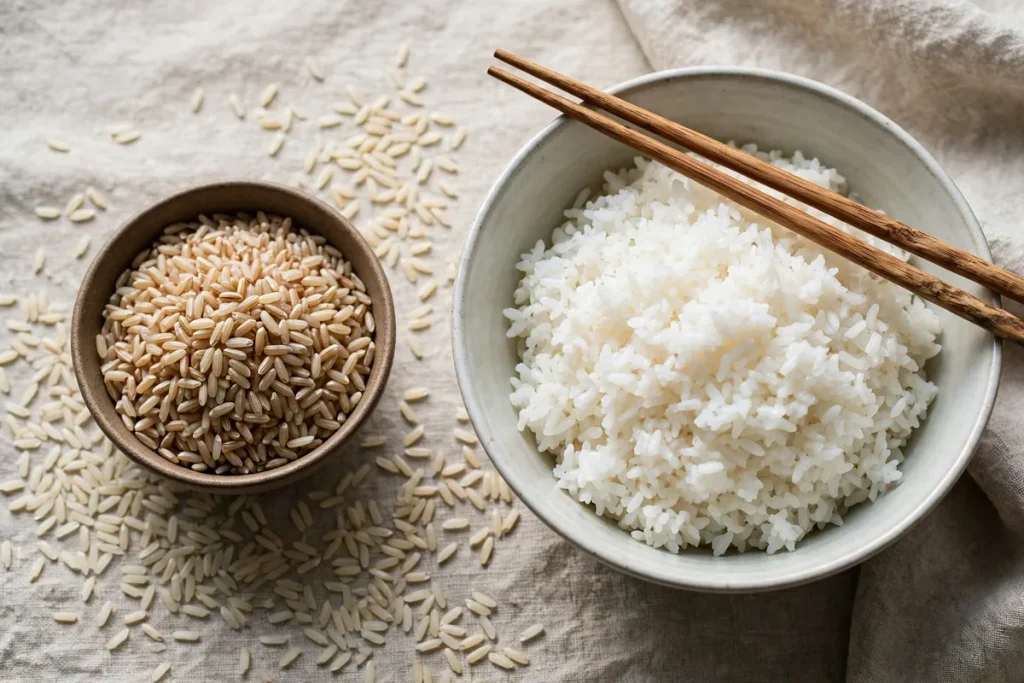

Rice is the world’s default side dish, and its calorie count looks simple — until you meet the two numbers that confuse everyone: the cup of cooked rice on your plate, and the cup of dry rice described on the packet label. They differ by nearly three to one, and mixing them up is the single most common rice mistake in calorie tracking.
This page settles it once and for all: the cooked cup, the dry cup, every major rice type compared, and how to keep rice in your life — and in your budget — without giving it up.
It also helps that rice is one of the easiest foods to portion once you know the trick. There is even a swap near the end of this page that cuts a cup of rice nearly in half, calories-wise, without shrinking the bowl at all.
Quick Answer: One cup of cooked white rice has 242 calories; one cup of cooked brown rice has 218. Half a cup of cooked white rice is 121. The number most people get wrong is the dry one: a cup of uncooked rice holds about 675 calories — but it cooks into roughly three cups, so it is never a single portion, however alarming it looks in a tracking app.
The Cup Table
Everything in this article hangs off one reference amount, so here it is first. Cooked white long-grain rice runs 130 calories per 100 g, and a standard cooked cup weighs 186 g — that is where the headline 242 comes from. Scale it up, scale it down, or start from dry:
| Portion | Calories | Notes |
|---|---|---|
| ½ cup cooked white rice | 121 kcal | ~93 g |
| 1 cup cooked white rice | 242 kcal | 186 g |
| 2 cups cooked white rice | 484 kcal | ~372 g |
| ¼ cup uncooked white rice | ~169 kcal | ~46 g dry; makes ~¾ cup cooked |
| 1 cup uncooked white rice | ~675 kcal | 185 g dry; makes ~3 cups cooked |
Read the last two rows twice, because they are the whole trap in miniature. The dry measures look alarming, but dry rice is an ingredient, not a serving. Nobody sits down to a cup of uncooked rice; they sit down to the three cups it becomes — and then, sensibly, eat one of them.
For the full nutrition of that reference cup of cooked white rice: 242 calories, 53 g of carbs, 4.4 g of protein, 0.4 g of fat and 0.6 g of fiber. Rice is essentially a clean carbohydrate food — almost no fat, a little protein, and energy that depends entirely on how much of it lands on the plate.
If you weigh your food, the cooked cup is the number to remember: 186 g for white rice. Brown rice packs a little denser — a cooked cup is 195 g — which is worth knowing before you assume the two cups are interchangeable on the scale. Scooped loosely versus packed down can shift a cup by 10-15% either way, so the fist-size visual further down the page is a useful backup.
The Dry-vs-Cooked Trap
Here is the clash. The nutrition label on a bag of rice is written for the dry product, because that is what is in the bag: a typical label serving is a quarter cup dry, about 169 calories. Calorie-tracking apps, on the other hand, are full of entries for cooked rice, because that is what people actually eat. Both are correct. The disaster happens when the two meet — logging a cooked cup using the dry numbers, or weighing cooked rice and entering it as if it were dry.
The reason for the gap is nothing but water. As rice cooks, each grain absorbs roughly twice its weight in water: 185 g of dry rice becomes about 550 g of cooked rice. Water adds weight and volume but zero calories, so the same calories get spread across three times the food. That is the whole story — cooked rice is not lighter rice, it is diluted rice.
Which one should you log? Whichever matches how you measured. If you weighed the rice dry before cooking, log the dry entry. If you are scooping cooked rice onto your plate — at home, at a restaurant, or from a rice cooker someone else filled — log the cooked numbers on this page. When in doubt, cooked is the safer default, because cooked is what you actually ate.
One more wrinkle: rice cooked in stock, coconut milk or oil is not the rice on this page. Coconut rice can carry noticeably more calories than the same cup boiled in water, and a restaurant pilau is rarely just rice and water. When the grains on your plate look glossy, they are telling you something — something oily joined them in the pot.
Rice Types Compared
White long-grain is the reference, but it is not the only rice in the cupboard. Here is how the common types compare, all per cup cooked unless stated:
| Rice type | Calories per cup cooked | Fiber |
|---|---|---|
| White long-grain | 242 kcal | 0.6 g |
| Brown | 218 kcal | 3.5 g |
| Jasmine | ~240 kcal | — |
| Basmati | ~225 kcal | — |
| Fried rice (restaurant-style) | ~350-400 kcal | — |
| Cauliflower rice | ~25-30 kcal | — |
Two things stand out. First, the plain rices cluster tightly: jasmine at about 240 and basmati at about 225 sit either side of white rice’s 242, because they are all doing the same job — starch plus absorbed water. Second, the outliers are not really rices in the same sense: fried rice is white rice plus oil, egg and a hot wok, and cauliflower rice is a vegetable wearing a rice costume.
Note the brown rice number, too: 218 per cup, from a cup that weighs 195 g — heavier than the white cup’s 186 g. The two rices are closer than the headline suggests, which the next section pulls apart properly.
What about leftovers? Cold, stored rice firms up as its starches set, and reheated rice lands at essentially the same calories as fresh — the water story does not change. Just refrigerate cooked rice promptly, chill it fast and reheat it thoroughly; rice is one of the foods that food-safety guidance is firmest about.
White vs Brown, Honestly
The white-versus-brown debate generates more heat than the numbers justify. Per cooked cup it is 242 versus 218 — a 24-calorie gap that is mostly an artifact of the cups weighing differently (186 g versus 195 g), not a meaningful difference in the grains themselves. Nobody’s diet succeeds or fails over 24 calories of rice.
Where brown rice genuinely wins is fiber: 3.5 g per cup against white rice’s 0.6 g — nearly six times as much. The bran layer that makes brown rice brown also carries magnesium and other minerals that milling removes, and that fiber slows digestion a little, so a cup of brown tends to keep people full slightly longer. Those are real advantages. They are just quieter than the marketing suggests.
You may also hear about blood sugar. Brown rice’s fiber gives it a somewhat gentler effect than white for most people, but the difference shrinks fast once rice is eaten as part of a mixed meal with protein, fat and vegetables — which is how most of us actually eat it. Pairing beats swapping, most of the time.
And the honest conclusion cuts the other way as well: neither rice is fattening by itself. White rice has fed billions of people at healthy weights for centuries. What matters is the portion it arrives in and the company it keeps — which is exactly where the next section goes.
How to Keep Rice in a Calorie Deficit
Rice does not need to leave the menu when calories come down. It needs a measuring habit, and it needs sensible partners. Four rules cover almost everything:
- Measure the dry rice once or twice. Cook a known amount — say a quarter cup dry per person, about 169 calories — and see how much cooked rice it makes. After that, your eye knows the portion and the scale can retire.
- Use the fist rule when you cannot measure. One cup of cooked rice is about the size of your fist, or a tennis ball. That is a 242-calorie serving of white rice — a reasonable side for most meals.
- Watch the restaurant multiplier. Restaurant and takeout servings are often 1½ to 2 cups mounded on the plate — 360 to 480 calories of rice before a single topping or sauce lands on it. Eating half the mound is the easiest save in this whole article.
- Try the half-and-half swap. Half white or brown rice, half cauliflower rice, mixed in the same bowl. The texture stays rice-like, the volume stays full, and the cup drops to roughly 135 calories.
A rice cooker quietly helps, too: consistent water ratios mean consistent portions, batch after batch. The absorption method — measured water, lid on, no peeking — beats boiling in a big pot of water and draining, because the cooked yield per dry cup is predictable. Predictability is what makes the numbers on this page match the rice on your plate.
The last rule is about partners, not rice. Plain rice is a modest 242; rice under a ladle of oily curry, a sweet sauce or a pile of fried toppings becomes a different meal entirely. What you serve with rice usually matters more than the rice itself — a grilled protein and vegetables over a measured cup is a complete, filling plate that fits most budgets. To see exactly where that plate fits in your day, our maintenance calories calculator gives you your personal daily target. And if your rice usually arrives in a burrito bowl, our Chipotle macro calculator breaks down exactly what the rice, beans and toppings add up to.
Build the plate around the rice rather than under it: rice as roughly a third of the plate, with protein and vegetables taking the rest, lands most dinners in a sensible range without any counting at all. The cup measure is for learning; the plate picture is for living.
A final word of reassurance: a cup of rice at lunch has never been the difference between a diet working and failing. Total days and total weeks decide that. Keep the portion honest, keep the partners sensible, and rice stays where it belongs — on the plate.
Frequently Asked Questions
The questions readers ask most about rice and calories, answered with the same numbers used throughout the page:
How many calories in 1 cup of cooked white rice?
242 kcal. A standard cooked cup weighs 186 g, and cooked white long-grain rice runs 130 kcal per 100 g, with 53 g of carbs and 4.4 g of protein.
How many calories in 1 cup of brown rice?
218 kcal for a cooked cup (195 g) — with 3.5 g of fiber, much more than white rice (0.6 g), for slightly fewer calories.
How many calories in 1 cup of uncooked rice?
About 675 kcal, but that dry cup cooks into roughly 3 cups of cooked rice, so nobody eats it as one portion. A quarter cup dry (about 169 kcal) makes about ¾ cup cooked.
Is rice fattening?
No food is fattening by itself. The real risks are portion size — restaurant servings of 1½ to 2 cups — and oily or saucy partners. A measured cup of cooked rice at 242 kcal fits comfortably in most calorie budgets.
What is the lowest-calorie rice swap?
Cauliflower rice, at about 25-30 kcal per cup. Or mix half regular rice with half cauliflower rice for a full cup at roughly 135 kcal that still eats like rice.



Pingback: Rice Paper Calories: 35 per Sheet — Fresh Roll ~120, Fried ~170
Pingback: Pho Noodle Soup Nutrition — Calories in Beef and Chicken Pho