
If you love the sharp, salty punch of blue cheese, here is the number that matters first: blue cheese calories run about 100 per ounce. That puts a single ounce in the same neighborhood as provolone, and noticeably above feta, which lands at 75 per ounce. The good news is that almost nobody eats blue cheese by the slab. It is a crumble cheese, a flavor cheese, and that changes the whole calorie picture.
This guide uses USDA figures for blue cheese throughout, so every number below comes from the same source. The headline is simple: blue cheese is calorie-dense by weight, like every full-fat cheese, but its strong flavor means a small amount does a lot of work. Measure it in tablespoons and crumbles, not in wedges, and it fits a calorie budget far more easily than its per-100-gram number suggests.
Blue Cheese Calories by Amount
The table below is the one to bookmark, because blue cheese is sold by the wedge and eaten by the crumble. A tablespoon of crumbles is the realistic serving for a salad, an ounce is the standard nutrition-label serving, and 100 grams is the number you will see on nutrition databases.
| Amount | Calories |
|---|---|
| 1 tablespoon crumbled | About 30 |
| 1 ounce (28 g) | 100 |
| 1/4 cup crumbled | About 120 |
| 100 g | 353 |
Notice how the numbers scale. A tablespoon of crumbles at about 30 calories is barely a dent in a day, while a full 100 grams at 353 calories is a serious chunk of a meal. The difference between those two is portion, not cheese. That is the whole game with blue cheese: the flavor is so strong that the small end of this table is where most people actually live.
A practical rule follows from the table. If you are crumbling blue cheese over a salad, weigh or spoon it once and learn what your usual handful looks like. A free-poured handful from the container can easily be a quarter cup, about 120 calories, when you meant to add a tablespoon at about 30. The cheese did not change; the portion did.
Blue Cheese Nutrition Facts
Here are the full USDA figures for blue cheese, per 100 grams and per ounce. The per-ounce column scales the 100-gram values to the 28-gram serving, rounded to sensible figures.
| Nutrient | Per 100 g | Per ounce (28 g) |
|---|---|---|
| Calories | 353 | 100 |
| Protein | 21.4 g | About 6 g |
| Fat | 28.7 g | About 8 g |
| Saturated fat | About 18.7 g | About 5.2 g |
| Carbohydrates | 2.3 g | About 0.6 g |
| Sugar | 0.5 g | About 0.1 g |
| Sodium | 1,146 mg | About 320 mg |
| Calcium | 528 mg | About 148 mg |
Two things stand out. First, blue cheese is a genuine protein food: about 6 grams of protein per ounce is respectable for a condiment-style cheese, and the calcium, about 148 mg per ounce, is a real contribution. Second, the sodium is the number to respect: about 320 mg per ounce means three ounces quietly deliver close to half a typical daily sodium budget.
The fat profile is what it is: most of the calories come from fat, and about two-thirds of that fat is saturated. That is normal for a full-fat cheese, and it is why blue cheese belongs in the flavoring role rather than the main-protein role. You are not eating it for leanness; you are eating it because nothing else tastes like it.
Blue Cheese vs Other Cheeses
How does blue cheese stack up against the cheeses already on this site? The table below compares calories per ounce, and the honest answer is that blue cheese sits right in the middle of the pack. It is not the lightest cheese, and it is not the heaviest either.
| Cheese | Calories per ounce |
|---|---|
| Feta | 75 |
| Mozzarella | 85 |
| Blue cheese | 100 |
| Provolone | 100 |
| Parmesan | 110 |
| Cheddar | 115 |
Feta wins this comparison at 75 calories per ounce, which is one reason it shows up in so many light salads. Mozzarella at 85 is next, and then blue cheese ties provolone at 100. Our provolone cheese guide covers that cheese in detail, including its own per-slice numbers.
The comparison that matters most is not the table alone but how each cheese is used. Parmesan is usually grated in small amounts, feta is crumbled like blue cheese, and cheddar is often sliced thick onto sandwiches. If your goal is simply fewer cheese calories, our low fat cheese guide ranks the lowest-calorie cheeses by protein, and it is the better next read. For flavor per calorie, though, blue cheese is hard to beat: an ounce of it flavors a whole salad, where an ounce of mild cheese can disappear unnoticed.
Is Blue Cheese Healthy?
The honest answer is: it depends on the portion, and that is not a cop-out. On the plus side, blue cheese delivers real protein and calcium, and it contains the same milk nutrients as any cheese. It is also one of the few foods where a little genuinely satisfies, because the flavor is so intense.
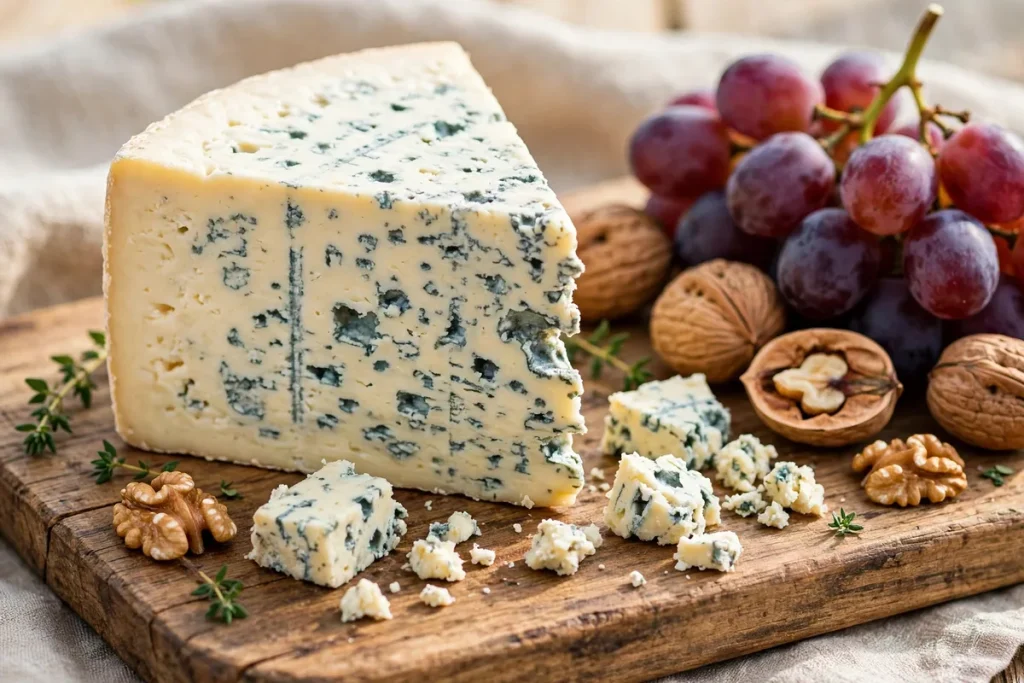
Then there is the mold question, which worries more people than the calories do. The blue veins are Penicillium roqueforti, a safe food mold deliberately added during cheesemaking. It is not the mold that grows on forgotten leftovers, and eating it is the entire point of the cheese. If the cheese smells sharply of blue cheese, that is normal; if it has turned slimy or smells of ammonia, it has gone past its best and should go.
The watch-outs are sodium and saturated fat. At about 320 mg of sodium per ounce, blue cheese is one of the saltier cheeses, so if you are watching blood pressure, the tablespoon measure is your friend. And with about 5.2 g of saturated fat per ounce, it is a food to enjoy in crumbles, not in slabs.
One short note for pregnancy: soft mold-ripened cheeses are usually on the avoid-unless-cooked list in pregnancy guidance, so if you are pregnant, check with your doctor about blue cheese rather than guessing.
Put together, blue cheese is neither a health food nor a villain. It is a strong-flavored, protein-containing cheese with a salty, fatty profile, and its built-in portion control, you simply cannot eat much of it before the flavor overwhelms, is a genuine advantage over milder cheeses that invite second helpings.
How to Use Blue Cheese Without Blowing the Budget
The strategy is simple: use blue cheese as a seasoning, not a main ingredient. Crumble a tablespoon or two over a salad, a steak, or roasted vegetables, and let the flavor carry the dish. Two tablespoons of crumbles cost about 60 calories and flavor a whole plate; a wedge melted into a sauce costs several times that for the same flavor.
Watch the dressing, because that is where blue cheese calories quietly multiply. Bottled blue cheese dressing runs about 75 calories per tablespoon, so the two tablespoons most salads receive add about 150 calories before a single crumble is counted. If you love the dressing, measure it, or thin a spoonful of dressing with yogurt or lemon juice to stretch it.
Pairing matters too. Blue cheese loves sweet partners, grapes, pears, walnuts, honey, and those partners add their own calories, so keep the whole plate in mind rather than the cheese alone. And if you are planning the day around a number, a maintenance calories calculator will give you the budget to fit blue cheese into without guessing.
Finally, buy the wedge and crumble it yourself when you can. Pre-crumbled cheese is convenient, but the wedge keeps longer, tastes sharper, and makes you measure rather than pour, and with blue cheese, measuring is the whole trick.
Frequently Asked Questions
How many calories are in blue cheese?
About 100 calories per ounce (28 g), about 30 calories per tablespoon crumbled, and 353 calories per 100 g.
Is blue cheese healthy?
It is a mixed picture: real protein and calcium on the plus side, but high sodium at about 320 mg per ounce and about 5.2 g of saturated fat per ounce. Its strong flavor is a genuine portion advantage, since a little goes a long way.
How many calories are in blue cheese dressing?
About 75 calories per tablespoon for bottled dressing, so two tablespoons add about 150 calories to a salad.
Is the mold in blue cheese safe to eat?
Yes. The blue veins are Penicillium roqueforti, a safe food mold deliberately added during cheesemaking. It is not spoilage mold, and eating it is the entire point of the cheese.
Which has fewer calories, blue cheese or feta?
Feta, at 75 calories per ounce against blue cheese at 100 calories per ounce.
The bottom line is a friendly one: blue cheese calories are about 100 per ounce, the flavor is worth every one of them when the portion is a crumble, and the dressing is the part to measure. Keep the spoon honest and the cheese stays a pleasure, not a problem.
One last practical note: keep blue cheese tightly wrapped in the fridge, where it holds for three to four weeks after opening, and let it sit at room temperature for about twenty minutes before serving so the full flavor comes through. A cheese that tastes its best at a small portion is the easiest kind to enjoy without overdoing it.