
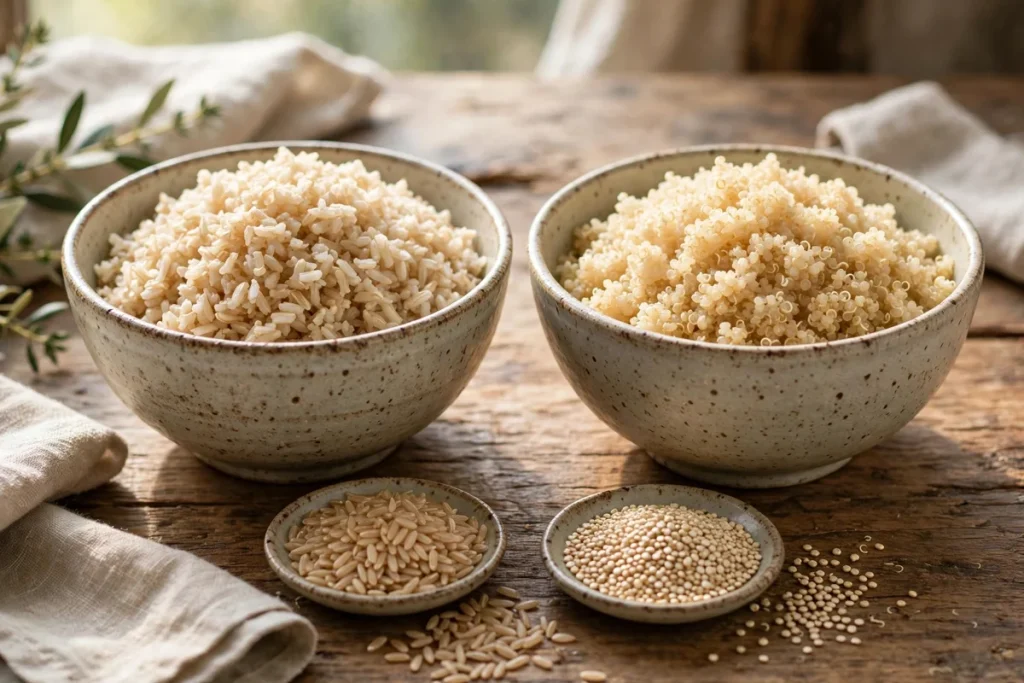

Brown rice and quinoa are the two sides that show up in almost every healthy eating plan, and for good reason. Both are filling, both beat white rice on fibre and nutrients, and both work with just about any protein. So which one deserves the space on your plate? The short answer: cooked quinoa and brown rice are close on calories — about 120 vs 112 per 100 g cooked — but quinoa has more protein (4.4 g vs 2.6 g per 100 g), all essential amino acids, and slightly more fibre. Brown rice wins on price and mild taste. Here is the full comparison, so you can pick the right one for your goal.
The numbers at a glance
All figures below are for cooked grains with nothing added — no oil, butter or stock. A cup of cooked quinoa weighs about 185 g; a cup of cooked brown rice weighs about 195 g.
| Quinoa (1 cup cooked, 185 g) | Brown rice (1 cup cooked, 195 g) | Quinoa (per 100 g) | Brown rice (per 100 g) | |
| Calories | 222 | 218 | 120 | 112 |
| Protein | 8 g | 5 g | 4.4 g | 2.6 g |
| Carbohydrates | 39 g | 45 g | 21.3 g | 23.5 g |
| Fibre | 5 g | 3.5 g | 2.8 g | 1.8 g |
| Fat | 3.6 g | 1.8 g | 1.9 g | 0.9 g |
| Net carbs | 34 g | 41.5 g | 18.5 g | 21.7 g |
The two bases agree with each other. A cup of quinoa works out as 120 × 1.85 = 222 calories, and a cup of brown rice as 112 × 1.95 = 218.4, rounded to 218. Net carbs are total carbs minus fibre — see our Net Carbs guide for the full formula — so quinoa lands at 39 − 5 = 34 g per cup and brown rice at 45 − 3.5 = 41.5 g. Small differences between the cup and per-100 g columns are just rounding.
Protein: quinoa’s biggest win
This is where quinoa pulls clearly ahead. A cup of cooked quinoa gives you about 8 g of protein against brown rice’s 5 g — and the quality of that protein is better too. Quinoa is a complete protein, meaning it contains all nine essential amino acids in useful amounts. Brown rice is low in lysine, one of those essential amino acids, so on its own its protein is incomplete. That gap is exactly why quinoa shows up in so many vegetarian and vegan meal plans: it does more of the protein work by itself.
Neither grain replaces a real protein source on its own — 8 g is a contribution, not a day’s protein. Pair either with beans, lentils, chicken or fish and the meal’s protein is covered. If you want to see how the numbers stack up across foods, our Calories in Protein guide explains the 4-calories-per-gram rule and compares common sources.
Fibre and fullness
Quinoa leads here too, with about 5 g of fibre per cup against brown rice’s 3.5 g. The gap is real but not dramatic, and both are a big step up from white rice, which manages only about 0.6 g of fibre per cup — see our Calories in 1 Cup of Rice comparison for the full white-vs-brown breakdown. Fibre slows digestion and helps a meal keep you full, which is one reason a quinoa bowl can feel more satisfying than the same calories of white rice.
Micronutrients: quinoa leads, brown rice holds its own
Quinoa is the more nutrient-dense of the two. Per cooked cup it provides roughly 118 mg of magnesium (about a third of a day’s needs), 78 mcg of folate and 2.8 mg of iron — all notably higher than brown rice. Brown rice answers with manganese and selenium, where it actually beats quinoa, plus B vitamins from its bran layer. Neither grain is a multivitamin, and the rest of your plate matters more than this gap, but if you eat grains daily, quinoa quietly adds more minerals over time.
Blood sugar: both moderate, quinoa slightly lower
Both grains sit in the moderate glycaemic index range, in the 50s, with quinoa slightly lower than brown rice. In practice the difference is small: what matters far more is portion size and what you eat with the grain. A cup of either with vegetables and a protein source will raise blood sugar far more gently than a heaped plate of either on its own. If you manage blood sugar, check your own targets with your clinician — portion still matters more than the small gap between these two.
Taste, texture and cooking time
Here brown rice claws back ground. It has a mild, nutty taste and a pleasantly chewy texture that suits stir-fries, curries and fried rice, and it holds its shape well the next day. Quinoa is lighter and fluffier, with a slightly nutty taste and tiny spiral tails that give it a distinctive look; some people love it, others find it a little earthy. Cooking time is the practical difference: quinoa is done in about 15 minutes, while brown rice takes 40–45 minutes. One job quinoa demands is rinsing: rinse it under cold water before cooking (unless the packet says pre-rinsed) to wash off saponins, the natural coating that can taste bitter.
Price: brown rice wins easily
Brown rice is much cheaper per kilogram than quinoa, and it is sold everywhere in large bags. Quinoa costs more — it is mostly imported, grown in smaller quantities, and sold in smaller packets. For a family eating grains most nights, that price gap adds up fast, and it is the strongest single argument for keeping brown rice in the rotation even if quinoa wins on nutrition.
The verdict: which should you choose?
For weight loss, quinoa has the slight edge: more protein and more fibre per calorie means a quinoa-based meal tends to keep you full longer. For muscle gain, either works — quinoa edges the protein count, but the protein on the rest of your plate matters far more than the 3 g difference between the grains. For budget and family meals, brown rice is the clear winner. For diabetes-conscious eating, quinoa has a slight edge, but portion still matters most. And if you honestly prefer the taste of one over the other, that is a good enough reason to pick it: the grain you enjoy is the one you will actually eat.
Try the 50/50 blend
Cooking a 50/50 blend of brown rice and quinoa is common, and it balances cost and protein nicely: you get some of quinoa’s protein and fibre while keeping the meal affordable and familiar. Because the cooking times differ, cook them separately and mix after, or start the rice and add the quinoa part-way through. A half-and-half bowl with roasted vegetables and a protein source is one of the easiest healthy dinners there is.
Frequently Asked Questions
Is quinoa healthier than brown rice?
Slightly, yes — on protein, fibre and minerals, quinoa comes out ahead. But brown rice is close behind, much cheaper, and still a genuinely healthy whole grain. Either is a big upgrade on white rice.
Which has more protein, quinoa or brown rice?
Quinoa: about 8 g per cooked cup (4.4 g per 100 g) against brown rice’s 5 g per cup (2.6 g per 100 g). Quinoa is also a complete protein, containing all nine essential amino acids; brown rice is low in lysine.
Can I eat quinoa instead of rice every day?
Yes. Quinoa every day is fine as part of a varied diet, and rotating it with brown rice and other grains gives you a wider mix of nutrients and keeps meals interesting.
Is quinoa or brown rice better for weight loss?
Quinoa, slightly. Its extra protein and fibre help you feel full on the same calories. But both work for weight loss — portion size and what you serve with the grain matter more than the choice between them.
Do you rinse quinoa?
Yes, rinse it under cold water before cooking unless the packet says it is pre-rinsed. Rinsing washes off saponins, the natural coating that can make quinoa taste bitter.



Pingback: Are Poke Bowls Healthy? Calories, Best & Worst Ingredients