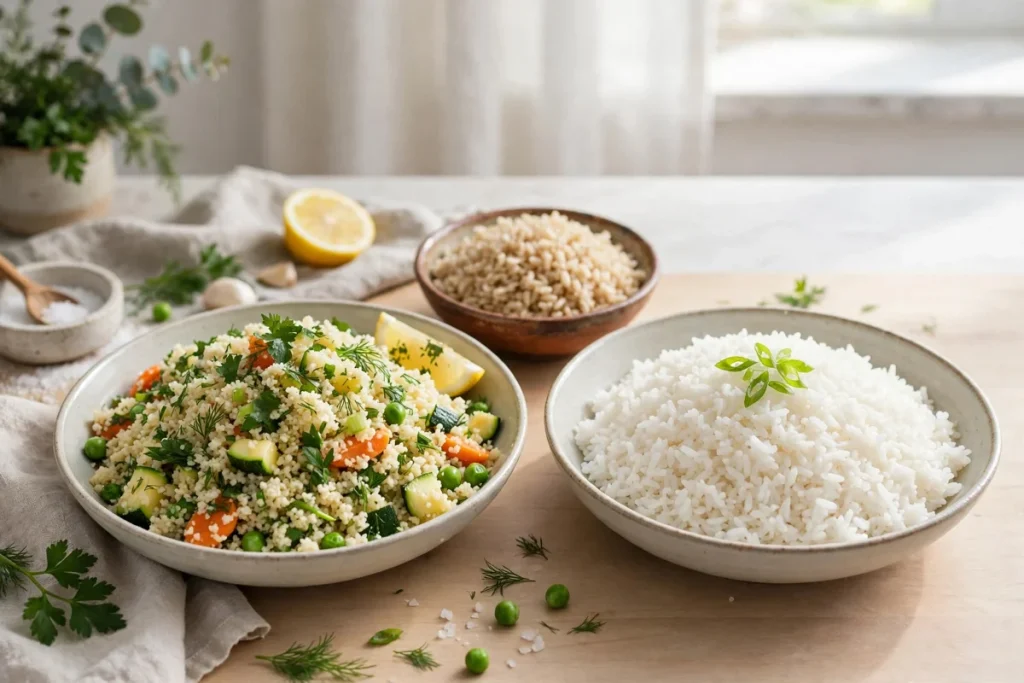

Couscous looks like a grain, cooks like a grain, and sits in the grain aisle, so it is natural to assume it beats rice on health. The honest answer is more interesting: it depends on which rice you mean. Against white rice, couscous is a small upgrade. Against brown rice, couscous loses on fibre, the nutrient that matters most for staying full. This comparison uses standard reference values per 1 cup cooked, so you can see exactly where each one wins.
Quick answer: is couscous healthier than rice? Couscous slightly beats white rice, with fewer calories and a bit more protein per cup, but brown rice beats couscous on fibre. So if you usually eat white rice, switching to couscous is a small upgrade; if you usually eat brown rice, you are already on the fibre winner.
Couscous vs rice: the numbers per cup cooked
All figures below are standard reference values for 1 cup cooked, plain, with nothing added – no oil, butter, or stock. That keeps the comparison fair, because what you serve with the base changes the meal far more than the base itself.
| Food (1 cup cooked) | Calories | Protein | Fibre | GI (approx.) |
|---|---|---|---|---|
| Couscous | ~176 | 6 g | 1.5 g | ~65 |
| White rice | ~205 | 4.3 g | 0.6 g | ~73 |
| Brown rice | 218 | 5 g | 3.5 g | ~50 |
Calories: couscous wins, but not by much
Per cup cooked, couscous comes in at about 176 calories, white rice at about 205, and brown rice at 218. That makes couscous roughly 29 calories lighter than white rice per cup, about 14 percent less, and about 42 calories lighter than brown rice. In a single meal, that is a small difference, roughly the calories in a tablespoon of hummus. Where it adds up is across a week of grain-based dinners, and only if your portion stays the same. A heaped second helping of couscous wipes out the advantage instantly, so treat the calorie win as a tiebreaker, not a reason to eat more.
Protein: couscous leads the three
Couscous gives you about 6 g of protein per cooked cup, ahead of brown rice at 5 g and white rice at 4.3 g. It is a genuine lead, but keep it in proportion: none of these three is a protein food on its own. A palm-sized portion of chicken, fish, or tofu adds 20-30 g, dwarfing the 1-2 g gap between the bases. The practical takeaway is to pair your base with a real protein source – chickpeas and vegetables with couscous, or beans with rice – rather than choosing a base for its protein alone.
Fibre: where brown rice pulls away
This is the biggest nutritional gap in the comparison. Brown rice provides about 3.5 g of fibre per cooked cup, more than double the 1.5 g in couscous and far above the 0.6 g in white rice. Fibre slows digestion, steadies blood sugar, and is the main reason a meal keeps you full for hours rather than leaving you hungry again quickly. If fullness is your goal, brown rice is the clear winner here. Whole-wheat couscous closes some of the gap, since it keeps more of the wheat’s bran, but it still usually trails brown rice on fibre, so check the packet if fibre is what you are after.
GI and blood sugar: brown rice is the steadiest
The glycaemic index (GI) ranks foods by how quickly they raise blood sugar. The figures here are approximate reference values: couscous sits around 65, white rice around 73, and brown rice around 50. Lower is steadier, so brown rice is the clear winner for blood-sugar control, couscous sits in the middle, and white rice spikes fastest. Two caveats matter. First, GI varies with cooking time and variety – overcooked couscous or sticky white rice will score higher. Second, you rarely eat a base alone: pairing it with protein, fibre, and vegetables lowers the glycaemic response of the whole meal, which can matter more than the base’s GI number on its own.
Gluten: couscous is pasta, not a grain
Here is the fact that surprises most people: couscous is not a grain at all. It is tiny pasta made from refined wheat, usually durum semolina, rolled into small pearls. That means it contains gluten, and regular couscous is not a whole grain – only couscous labelled whole-wheat counts as a whole-grain version. White rice, by contrast, is naturally gluten-free, as is brown rice. So for anyone with coeliac disease or following a gluten-free diet, rice wins outright and couscous is simply out. For everyone else, the gluten in couscous is not a health negative on its own; it only matters if you need to avoid it.
Which is better for weight loss?
Against white rice, couscous has a small edge: fewer calories and a little more protein per cup. Against brown rice, the picture flips in a subtler way: brown rice has more calories per cup, but its 3.5 g of fibre may keep you full for longer, which can prevent the second helping or the evening snack that undoes a calorie saving. The honest verdict for weight loss is that brown rice or whole-wheat couscous are the strongest choices, and if the choice is only between regular couscous and white rice, pick couscous. Either way, portion size and what you serve with the base – vegetables and a protein source, rather than butter and cheese – matter far more than the base itself.
Which is better for specific diets?
The best base depends on the diet you are actually following. For a gluten-free diet, the answer is simple: rice, white or brown, because couscous contains wheat gluten. For a high-fibre diet, brown rice wins by a wide margin. For blood-sugar control, brown rice again, with its approximate GI of 50 against couscous at 65 and white rice at 73. For a quick weeknight dinner, couscous wins on practicality: it is ready in about 5 minutes, while brown rice takes 40 minutes or more. And for a tight grocery budget, rice is usually the cheaper base. None of these makes one base “bad” – they just change which one fits your priorities.
The verdict
Coming from white rice, switching to couscous is a small upgrade: fewer calories (176 vs 205 per cup), more protein (6 g vs 4.3 g), and a lower GI (about 65 vs 73).
Coming from brown rice, there is no need to switch: brown rice is still the fibre winner at 3.5 g per cup against 1.5 g, and it has the lowest GI at about 50.
The middle option is whole-wheat couscous: it keeps the 5-minute cooking time of regular couscous with more fibre than the refined kind, making it a better everyday base than white rice. If you want another fibre-rich swap to compare, our Brown Rice and Quinoa guide puts brown rice against quinoa on the same measures.
The bottom line
Is couscous healthier than rice? Against white rice, yes, slightly. Against brown rice, no – brown rice’s fibre and lower GI keep it ahead. But the base is only part of the meal: a cup of couscous with vegetables, chickpeas, and herbs beats a cup of brown rice with butter and cheese, whichever way the table leans. Choose the base that fits your diet, your time, and your taste, then build the rest of the plate well.
Frequently Asked Questions
Is couscous healthier than rice?
It depends on the rice. Couscous beats white rice slightly, with about 176 calories and 6 g of protein per cooked cup against white rice’s 205 calories and 4.3 g of protein. But brown rice beats couscous on fibre, with 3.5 g per cup against 1.5 g.
Is couscous a grain?
No, not botanically. Couscous is tiny pasta made from refined wheat, usually durum semolina. That is why it contains gluten and why regular couscous is not a whole grain. Only couscous labelled whole-wheat counts as a whole-grain version.
Is couscous gluten-free?
No. Couscous is made from wheat and contains gluten, so it is not suitable for coeliac disease or a gluten-free diet. White rice and brown rice are both naturally gluten-free.
Which is better for weight loss, couscous or rice?
Against white rice, couscous has a small edge: fewer calories and more protein per cup. Against brown rice, the fibre in brown rice may keep you fuller for longer. Either way, portion size and what you serve with it matter more than the base alone.
What is the glycaemic index of couscous?
About 65, an approximate reference value, putting it in the moderate range. That is lower than white rice at about 73 and higher than brown rice at about 50. Cooking time and what you eat with it can shift the meal’s overall effect on blood sugar.
One last tip: whichever base you choose, build the bowl around it. Stir couscous through with roasted vegetables, chickpeas, lemon, and herbs, or serve rice with beans and greens, and the base becomes the least important part of a very good meal.