Calories in McDonald’s fries medium are 320. That is the number most people actually order, and it is the one this guide is built around: a small is 230 and a large is 480. All three figures come from McDonald’s official Nutrition Calculator, read live for this article, and every other number below is either from that same official source or clearly labeled as calculated from it.
Fries are the rare fast-food item where the question is not really whether they are high in calories. A fried potato will never be a light food. The real question is how much the carton size changes the answer. The jump from a small to a large more than doubles the calories, and most of that jump is portion, not recipe. This guide gives you the official table, the per-100-gram math, the dip and meal totals, and the swaps that actually move the number.
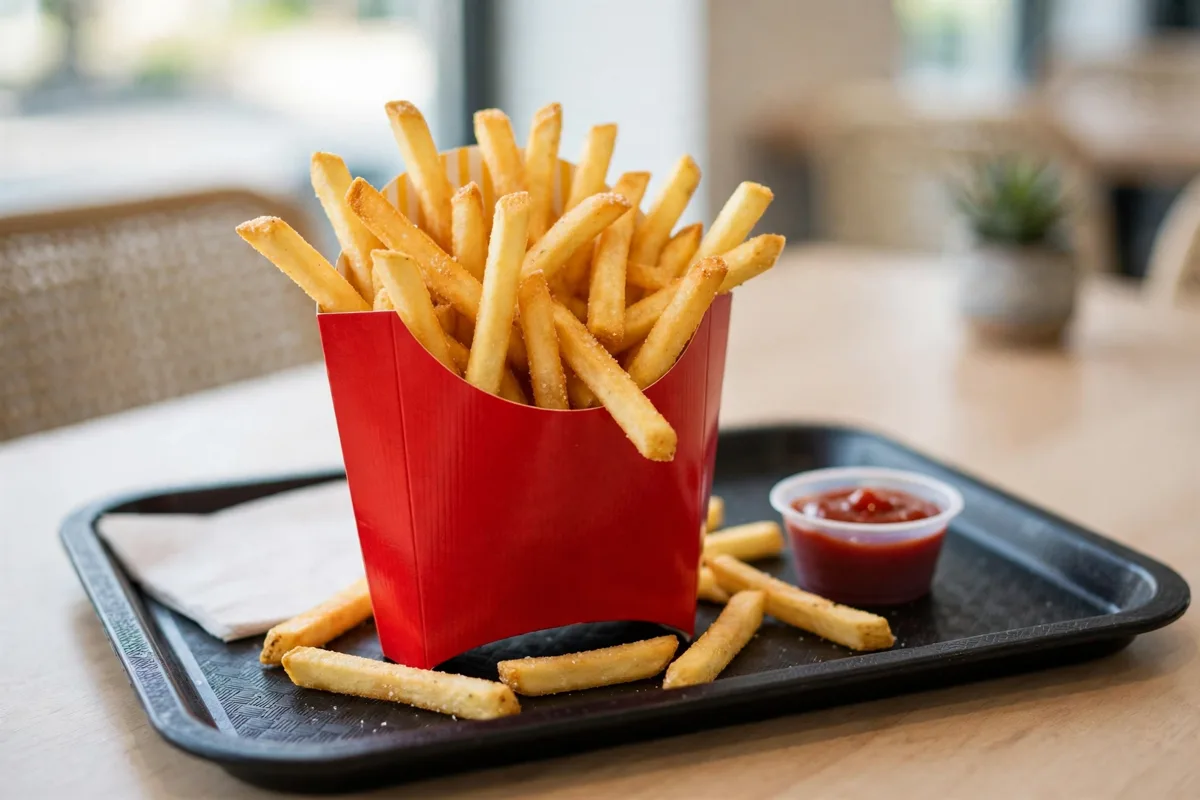
McDonald’s Fries Nutrition by Size
Here is the official table, exactly as McDonald’s Nutrition Calculator lists it for World Famous Fries, without the ketchup packet. Serving weights are McDonald’s published serving weights, and the sodium and carbohydrate figures are the calculator’s current values.
| Size | Serving weight | Calories | Fat | Carbs | Protein | Sodium |
|---|---|---|---|---|---|---|
| Small | 71 g | 230 | 11 g | 31 g | 3 g | 190 mg |
| Medium | 111 g | 320 | 15 g | 43 g | 5 g | 260 mg |
| Large | 163 g | 480 | 23 g | 65 g | 7 g | 400 mg |
Two things stand out. First, fries carry almost no protein, just 3 to 7 g depending on size, so they do not fill you the way the same calories from a burger would. Second, the calculator lists 0 g of total sugars for all three sizes. The calories come from starch and frying oil, not sugar, which is also why fries feel less sweet than their calorie count might suggest.
Calories per 100 g
Divide the official calories by the official serving weights and you get the per-100-gram picture. These figures are calculated, not printed on any menu board, but they are the fairest way to compare carton sizes with each other and with other foods.
| Size | Calories per 100 g (calculated) |
|---|---|
| Small (71 g) | About 324 |
| Medium (111 g) | About 288 |
| Large (163 g) | About 294 |
That range, about 288 to about 324 kcal per 100 g, tells you something useful: the fry itself is roughly the same food in every carton. The small looks a touch denser per gram, most likely because a smaller carton has proportionally more salted surface and a little more oil clinging to each fry, but the differences are small. What matters is the carton. A large gives you 163 g of fries, more than twice the small’s 71 g, and that is where the extra 250 calories come from. If you remember one line from this section, make it this: portion size matters more than the fry itself.
For context, a plain baked potato lands around 90 to 100 kcal per 100 g, so frying roughly triples the energy density. That is the oil, not the potato: oil carries about 250 kcal per ounce, and fries soak up a meaningful share of it. On the plus side, fries do bring some fiber, 3 g in a small, 4 g in a medium and 6 g in a large, and a useful amount of potassium, 470 mg in a small and 1,000 mg in a large. Neither makes them a health food, but they are not nutritionally empty either.
The Large-Fries Trap
A large fries at 480 calories is about two smalls. Two smalls would be 460, so the large actually runs a little past double, and that is before you count the extra salt. It is the upsell that feels like value: for a small price bump you get more than twice the fries. But value in the carton is not value on the plate if you eat the whole thing yourself.
Sharing changes the picture, but not quite as much as people assume. Split a large between two people and each person gets about 240 calories, slightly more than a small each. The medium-to-large jump is 160 calories, which is the entire price of upsizing, and it is easy to spend without noticing because nobody counts fries one at a time. The practical rule is simple: order the size that matches your appetite, not the size that feels like the better deal. If you genuinely want a large, enjoy it, but count it as 480, not as a side.
What About Dips?
Fries with no dip are the numbers in the table above. Add a ketchup packet and the picture barely moves: one fast-food ketchup packet adds about 10 calories, since ketchup runs about 19 calories per tablespoon, as our ketchup calories guide explains. That makes a medium fries with one packet about 330 calories, and with two packets about 340. Ketchup is the rare dip that does not wreck the math.
Creamy dips are a different story. Ranch dressing runs about 73 calories per tablespoon and mayonnaise about 94, according to the same condiment comparison. Two tablespoons of ranch add about 146 calories, nearly half a medium fries again, and most people dip far more generously than two tablespoons across a whole carton. If you love a creamy dip, ketchup is not the only answer, but it is worth knowing that the dip can quietly add more than the jump from a small to a medium.
Fries in a Full Meal
Fries rarely travel alone, so here is the classic meal counted honestly from official values. A Big Mac is 580 calories, a medium fries is 320 and a medium Coca-Cola is 270, which adds up to 1,170 calories. That is about 59 percent of a 2,000-calorie day in a single meal, and the fries are 320 of it, or about 16 percent of the day on their own. The full burger breakdown lives in our Big Mac calories guide, which uses the same current official figure of 580 for the burger.
The meal math is where the medium earns its reputation as the sensible default. Swap the medium fries for a large and the meal climbs to 1,330. Swap it for a small and the meal drops to 1,080, a saving of 90 calories against the medium and 250 against the large, without changing anything else on the tray. Drinks matter too: switching the medium Coke for water removes 270 calories at a stroke, which is a bigger saving than any fries size change. But if the fries are the part you are negotiating with yourself, the size is the lever.
Lighter Swaps at the Counter
The simplest swap is also the most effective: order a small instead of a large and save about 250 calories. Beyond that, the counter offers a genuinely lighter side. McDonald’s own Apple Slices are just 15 calories, according to the same official calculator, and they are the only side on the menu that turns the fries course into a rounding error. Splitting a large with a friend, dipping in ketchup instead of ranch, and skipping the second packet are smaller moves, but they stack.
| Snack | Calories |
|---|---|
| McDonald’s small fries (per carton) | 230 |
| Potato chips (per ounce) | About 160 |
| Tater tots (per serving, about 9 pieces) | 130 |
Compare those figures carefully, because the portions are not the same. Chips at about 160 per ounce and tots at 130 per serving are both fried potato snacks from our own verified guides, and both look lighter than a carton of fries only until you eat the equivalent weight. A small fries at 230 is a full carton, while an ounce of chips is a small handful. The honest summary is this: a medium fries at 320 is a reasonable side in an otherwise balanced day, and a large at 480 is a meal in itself. Order the size that matches your appetite, dip in ketchup rather than ranch, and the fries stop being a trap.
Frequently Asked Questions
How many calories in a medium McDonald’s fries?
320 calories, with 15 g of fat, 43 g of carbs, 5 g of protein and 260 mg of sodium, according to McDonald’s official Nutrition Calculator.
How many calories in a large McDonald’s fries?
480 calories for a 163 g serving, with 23 g of fat, 65 g of carbs, 7 g of protein and 400 mg of sodium.
How many calories in a small McDonald’s fries?
230 calories for a 71 g serving, with 11 g of fat, 31 g of carbs, 3 g of protein and 190 mg of sodium.
Are McDonald’s fries a lot of calories for their size?
Fairly dense: about 288 to about 324 calories per 100 g when calculated from the official figures, roughly triple a plain baked potato, because of the frying oil. The carton size matters more than the fry itself.
How many calories are fries with ketchup?
A medium fries with one ketchup packet is about 330 calories, since the packet adds about 10. Two packets take it to about 340.
The bottom line is refreshingly simple. A small is 230, a medium is 320 and a large is 480, all from McDonald’s own calculator. Pick the carton that fits your appetite, keep the dip to ketchup if you can, and you will never be surprised by the fries again.