
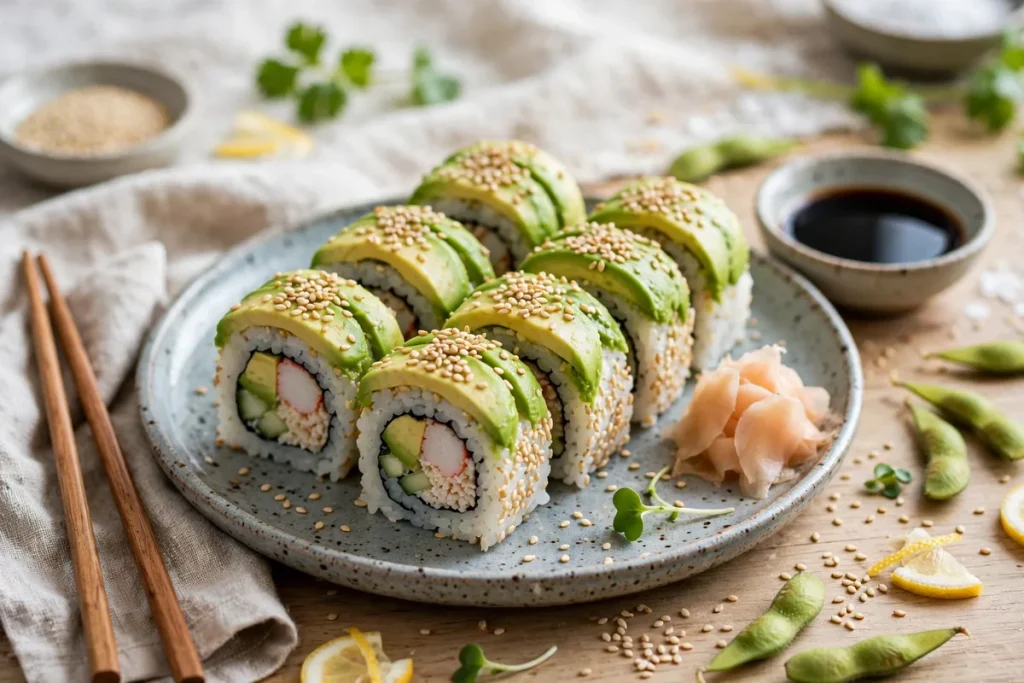

California roll calories come to about 300 for a full 8-piece roll, or about 38 per piece. That is the number to remember at the sushi counter: one roll is a light lunch, but two rolls is a meal — about 600 calories before the soup, the edamame, or the second round of soy sauce. The values in this guide are typical restaurant values, because rolls vary by restaurant: some shops pack the rice tighter, some go heavier on the mayo, and the roll itself can run a little bigger or smaller from one counter to the next. The numbers below are the honest middle of that range.
A standard California roll is an inside-out roll, rice on the outside and nori on the inside, filled with imitation crab, avocado, and cucumber, and usually dusted with sesame seeds. It contains no raw fish, which is exactly why it became the gateway roll for people who were not sure about sushi. It is also why the calorie story is mostly about the rice, not the filling.
California Roll Calories by the Roll and Piece
Restaurants almost always cut a roll into 8 pieces, so the per-piece math is simple division. It is still worth seeing laid out, because most people eat by the piece, not by the roll — and a piece feels so small that the total sneaks up on you.
| Amount | Calories |
|---|---|
| 1 piece | About 38 |
| Half a roll (4 pieces) | About 150 |
| Full roll (8 pieces, about 230 g) | About 300 |
| Per 100 g | About 130 |
Two rolls, the amount many people actually order for dinner, lands at about 600 calories. That is a perfectly reasonable dinner — it is just not the 200-calorie snack some menus imply when they list only the per-piece number. The other reason the roll lands at 300 is portion size: at about 230 grams, a California roll weighs about as much as a small sandwich. It just looks lighter because it arrives in eight neat pieces. Counting pieces instead of rolls is the most common sushi-night mistake, and it is an easy one to fix: decide how many rolls you are eating before the first piece disappears.
What Is Inside a California Roll
The rice is the biggest calorie share of the roll. A standard roll holds roughly a cup of cooked sushi rice, and sushi rice is seasoned with sugar and rice vinegar, so it carries more calories than the same weight of plain steamed rice. Call it roughly half to two-thirds of the roll’s calories — the exact share depends on how thick the rice layer is, and a thick rice layer is the norm at most American sushi counters.
Then there is the imitation crab, or surimi. It is not plain crab: it is processed white fish, usually pollock, mixed with starch, egg white, and a little sugar, then shaped and colored to look like crab leg meat. At about 100 calories per 100 grams, it is lean and light — lighter in fat than real crab meat, but with more added sugar and starch than the real thing. It is also the reason a California roll costs a fraction of a real crab roll: the filling is engineered, not caught. The honest way to think of it is as seasoned fish cake, not as a shortcut to crab nutrition.
The avocado is the most nutritious part of the roll and the second-biggest calorie contributor. Avocado runs about 160 calories per 100 grams, almost all of it from monounsaturated fat — the kind of fat that actually helps you feel full. A roll holds only a few thin slices, so the avocado adds roughly 30 to 50 calories to the roll while doing most of the work on flavor and fullness. The cucumber and the nori add crunch and minerals for almost no calories at all.
Put together, the picture is clear: a California roll is mostly seasoned rice with a light, sweetened fish filling and a little good fat. Nothing in it is a problem on its own — the calories just add up faster than the small, tidy pieces suggest.
Spicy and Fried California Rolls
The spicy version keeps the same roll and adds spicy mayo — mayonnaise mixed with sriracha or chili sauce — drizzled over the top or mixed into the filling. That drizzle is worth about 70 calories, taking the roll from about 300 to about 370. It is a small change on paper and a noticeable one on the plate: spicy mayo is almost pure fat, so it adds calories without adding any fullness.
The deep-fried, or tempura, California roll is a different food wearing the same name. The whole roll is battered and fried, which soaks up oil and adds a thick, crisp shell. Expect about 470 calories per roll, with a fair range of about 450 to 500 depending on the batter and how long it spends in the oil. That is more than half again the regular roll’s calories, and it is the version to skip if the goal is a lighter sushi night.
California Roll vs Other Rolls
California sits in the middle of the roll menu — lighter than anything fried or drowned in mayo, heavier than the simple fish-and-rice rolls. The comparison below is per full roll, using typical values, because that is the unit you actually order.
| Roll | Calories per roll |
|---|---|
| Tuna roll | About 200 |
| Salmon roll | About 230 |
| Avocado roll | About 260 |
| California roll | About 300 |
| Shrimp tempura roll | About 500 |
The pattern is easy to read: the simpler the roll, the lighter it is. A tuna roll is just raw tuna and rice, so it lands near 200. The salmon roll adds a slightly fattier fish and lands near 230 — if you want the deeper numbers on the fish itself, our guide to salmon calories breaks down the fillet, the cuts, and the nigiri. The avocado roll skips fish entirely, but the avocado’s fat pushes it to about 260. California adds imitation crab and a thicker rice layer and reaches 300. And anything with tempura in the name jumps to about 500, because frying oil is the most calorie-dense ingredient in the sushi bar.
Making Sushi Night Lighter
The easiest lighter pattern is one roll plus sides that fill you up without piling on calories. Miso soup is a warm, savory starter for very few calories, and a bowl of edamame adds protein and fiber — the two things that keep you full — for a modest calorie cost. One California roll plus miso and edamame is a satisfying dinner at roughly half the calories of a two- or three-roll order.
Brown rice is the swap everyone asks about, and the honest answer is that it changes the roll less than people hope. Brown rice carries roughly the same calories as white sushi rice, cup for cup; what it adds is a little more fiber and a slightly nuttier flavor. Order it if you like it, not because it rescues the calories — and be aware that brown rice rolls can be harder to find, since not every shop keeps it ready.
Soy sauce, meanwhile, is a sodium story, not a calorie story. A tablespoon adds only about 10 calories, so dipping is not what breaks the budget — but it can add a gram of salt or more per dip, which matters if sodium is something you watch. A small dish, light dips, and no refills is the practical middle ground.
If you want to go lighter still without giving up sushi, sashimi is the obvious move — raw fish with no rice at all — and naruto rolls, which wrap the filling in cucumber instead of rice, cut the biggest calorie share out entirely. Neither tastes like a California roll, but both are worth knowing about for the nights when the rice is the part you want to skip.
If you are fitting sushi into a weekly calorie budget, the maintenance calories calculator gives you the daily number to plan around: one California roll at about 300 fits easily into most budgets, while two rolls plus a spicy or fried version is where the meal starts to compete with dinner.
Frequently Asked Questions
How many calories are in a California roll?
About 300 for a standard 8-piece roll, using typical restaurant values. Rolls vary by shop, so a thick-rice roll can run a little higher.
How many calories are in one piece of California roll?
About 38 per piece. Four pieces, half a roll, come to about 150.
Is a California roll healthy?
Reasonably healthy, but not a health food. You get lean protein from the surimi, healthy fats from the avocado, and cucumber and nori for almost no calories — but most of the roll is seasoned rice, so it is a moderate choice rather than a light one.
How many calories are in a spicy California roll?
About 370 per roll. The spicy mayo adds about 70 calories to the regular roll’s 300.
Which sushi roll has the fewest calories?
Of the common rolls, the tuna roll at about 200 per roll is the lightest. Simple fish-and-rice rolls beat anything fried or topped with mayo.
The bottom line is simple. California roll calories are about 300 a roll and 38 a piece — a fair, middle-of-the-menu number. Enjoy the roll, count it by the roll rather than the piece, and save the spicy mayo and the tempura version for the nights when you actually want them.


Pingback: Alaska Roll Calories — Per Roll, Per Piece and Full Nutrition