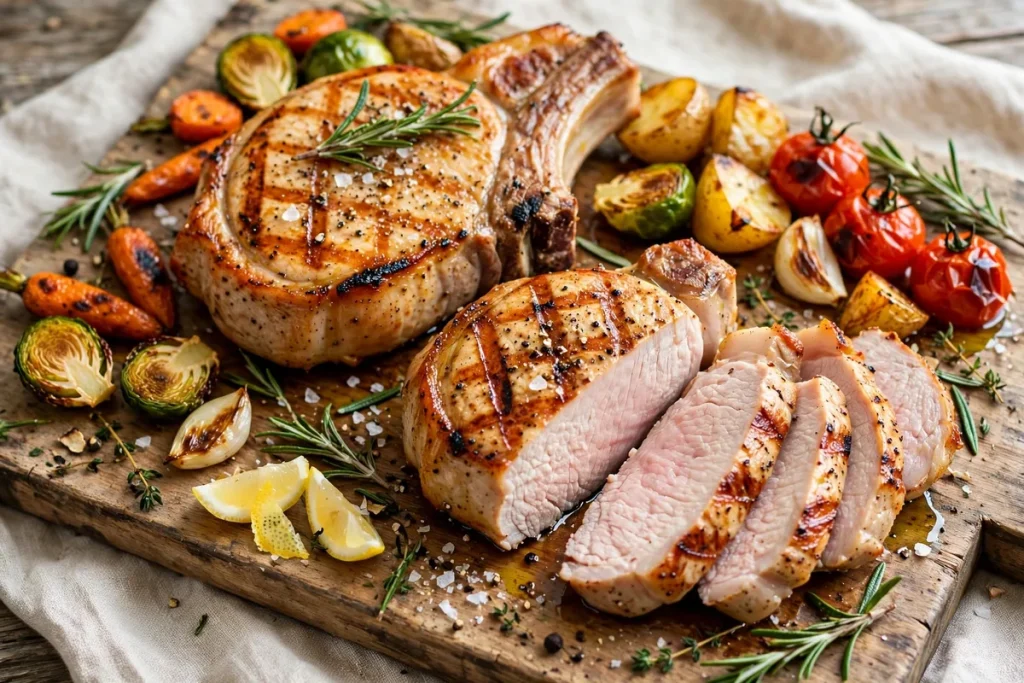

Pork chop calories are not one number — they depend on which cut lands on your plate. A boneless loin chop runs about 230 calories per 100 g cooked, or about 260 for an average 4 oz chop, while a pork tenderloin, the leanest cut of all, comes in at just 170 per 100 g. That is a 60-calorie gap per 100 g before you even think about breading, and it is the reason this guide gives every number by cut.
One important note before the table: every figure below is on a cooked basis, using typical USDA-based values, and says so plainly because raw versus cooked confuses everyone. A chop loses water as it cooks, so 100 g of cooked pork is more actual meat than 100 g of raw pork. If you weigh your chop raw, expect the cooked weight to come out lower and the calories per 100 g to come out higher — the per-chop column below already does that conversion for you.
Pork Chop Calories by Cut
| Cut | Calories per 100 g cooked | Calories per average chop (4 oz / 113 g cooked) |
|---|---|---|
| Pork tenderloin | 170 | About 190 |
| Boneless loin chop | 230 | About 260 |
| Pork loin roast | 220 | About 250 |
| Bone-in loin chop (with fat cap) | 250 | About 280 |
| Breaded and fried pork chop (estimate) | About 295 | About 335 |
The two columns always agree: the per-chop figure is the per-100 g figure multiplied by 113 g and rounded. So a boneless loin chop at 230 per 100 g works out to about 260 for a 4 oz cooked chop, and a tenderloin at 170 works out to about 190. The only estimated row is the breaded and fried chop, because breading thickness and oil temperature vary from kitchen to kitchen; the rest are typical USDA-based values.
Pork Loin vs Tenderloin
The loin family covers most of the chops you see in the meat case. The loin is the long muscle that runs along the pig’s back, and it is sold as boneless loin chops, bone-in loin chops, and whole loin roasts. That is why their numbers cluster together: 220 for the roast, 230 for the boneless chop, and 250 for the bone-in chop with its fat cap still attached. Same muscle, different trimming — and the fat cap is exactly what the extra 20 calories per 100 g are paying for.
The tenderloin is a different muscle entirely. It is the small, tender strip that sits inside the loin, and it is the leanest cut pork offers: about 170 calories per 100 g cooked, with only about 5 g of fat per 100 g. Think of it as pork’s answer to chicken breast — a lean, mild, fast-cooking protein that behaves more like poultry than like the rich pork chops most people picture. A boneless loin chop, by contrast, carries about 27 g of protein per 100 g alongside noticeably more fat, which is where its extra 60 calories come from.
Cooking matters as much as the cut here. Tenderloin dries out fast because it has so little fat to protect it, so it is best roasted or grilled whole to 145°F and rested for a few minutes before slicing — sliced thin across the grain, it stays juicy and eats like a much richer cut. Loin chops are more forgiving, especially bone-in ones, and they take well to a quick brine or a hot sear followed by a gentler finish. Either way, the number on your plate is decided before the pan heats up: pick tenderloin when leanness is the goal, and pick a loin chop when you want a classic chop with a little more richness.
Fried and Breaded Pork Chops
Breading is where a pork chop’s calories jump. A boneless loin chop that starts at 230 per 100 g lands at about 295 per 100 g once it is breaded and fried — roughly 65 extra calories per 100 g, or about 335 for an average chop instead of 260. The reason is simple: the crumb coating soaks up frying oil, and the coating itself is refined carbohydrate that adds weight without adding protein. Pan-frying adds oil on top of that, so a heavily breaded chop fried in a shallow pool of oil can run higher still.
That does not make a fried chop forbidden — it makes it a sometimes food, and one worth counting honestly. An oven-baked breaded chop, or one cooked in an air fryer with a light spray of oil, lands somewhere between the plain grilled number and the deep-fried one, because the crumb crisps without sitting in oil. A thin panko coat also beats a thick battered crust: less coating means less oil absorbed. And the sides matter as much as the chop — a fried chop with roasted vegetables is a different meal from the same chop with fries and gravy.
Pork Chop vs Chicken Breast
The comparison everyone asks about is chicken breast, and the answer is closer than most people expect. Plain grilled chicken breast runs about 165 calories per 100 g cooked — see the full breakdown in our chicken breast calories guide. Pork tenderloin nearly matches it at 170 per 100 g, just 5 calories apart, so for practical purposes a tenderloin medallion and a chicken breast are interchangeable on calories. The gap opens with the loin chop: at 230 per 100 g, a boneless loin chop runs about 65 higher per 100 g than chicken breast, and a bone-in chop with its fat cap runs about 85 higher.
That does not make the loin chop a bad choice — it makes it a different one. The extra calories come with extra fat, which carries flavor and keeps the meat juicy, and a loin chop still delivers about 27 g of protein per 100 g, right in chicken breast territory. The practical rule is simple: if the goal is the leanest possible protein, reach for tenderloin or chicken breast; if the goal is a classic chop dinner, the boneless loin chop is the middle ground, and the bone-in chop with the fat cap is the richer end of the same scale. Knowing which one you bought is worth more than any single number.
Keeping Pork Lean
A few habits keep any pork chop on the lean side of its range. First, trim the fat cap: cutting the visible rim of fat off a bone-in chop saves roughly 20–30 calories per 100 g, an estimate, but a meaningful one across a whole chop — and it brings the bone-in chop most of the way back toward the boneless number. Second, grill or bake instead of breading and frying; the cooking method alone is worth about 65 calories per 100 g on a loin chop. Third, watch the sauce: a sweet glaze or a honey-mustard drizzle can add as many calories as the difference between two cuts, so a mustard, herb, or vinegar-based finish keeps the plate honest.
Finally, build the plate around the chop rather than around more meat. Roasted vegetables, a salad, or a grain like rice stretch one chop into a full meal without a second helping, and they are where the fiber and volume come from. For a red-meat comparison, a lean ground beef calories check shows the same pattern: the leaner the cut and the simpler the cooking, the lower the number, whatever the animal. Pork is not the exception to that rule — tenderloin proves how lean it can be.
The bottom line is refreshingly simple: a pork chop is not one food with one number. Tenderloin at 170 per 100 g is a genuinely lean protein, a boneless loin chop at 230 is a solid middle ground, and a breaded fried chop at about 295 is a treat worth counting. Pick the cut that fits the meal you want, cook it simply, and the calories take care of themselves.
How to Count a Pork Chop on Your Plate
In practice, most people do not weigh a cooked chop, so here is the shortcut: a palm-sized boneless loin chop is close to the 4 oz average in the table, about 260 calories. A thicker, restaurant-sized chop can easily be 6 oz cooked, which pushes the same cut to about 390. If the bone is still in, remember the bone itself is not meat — weigh the edible portion when you can, and count the fat cap only if you eat it. When in doubt, round up a little; a small overestimate beats a confident underestimate.
Frequently Asked Questions
How many calories are in a pork chop?
About 260 calories for an average boneless loin chop (4 oz cooked). The cut moves it a lot: about 190 for a tenderloin chop and about 335 for a breaded and fried chop of the same size.
How many calories are in a boneless pork loin chop?
About 230 calories per 100 g cooked, or about 260 for an average 4 oz cooked chop, with about 27 g of protein per 100 g.
How many calories are in a fried pork chop?
About 295 calories per 100 g cooked, or about 335 for an average chop. This is an estimate, because breading thickness and oil temperature vary.
Pork chop or chicken breast — which has fewer calories?
Chicken breast, slightly: about 165 calories per 100 g cooked, versus about 170 for pork tenderloin and about 230 for a boneless loin chop.
What is the leanest cut of pork?
Pork tenderloin, at about 170 calories per 100 g cooked with only about 5 g of fat per 100 g. It is pork’s answer to chicken breast.