
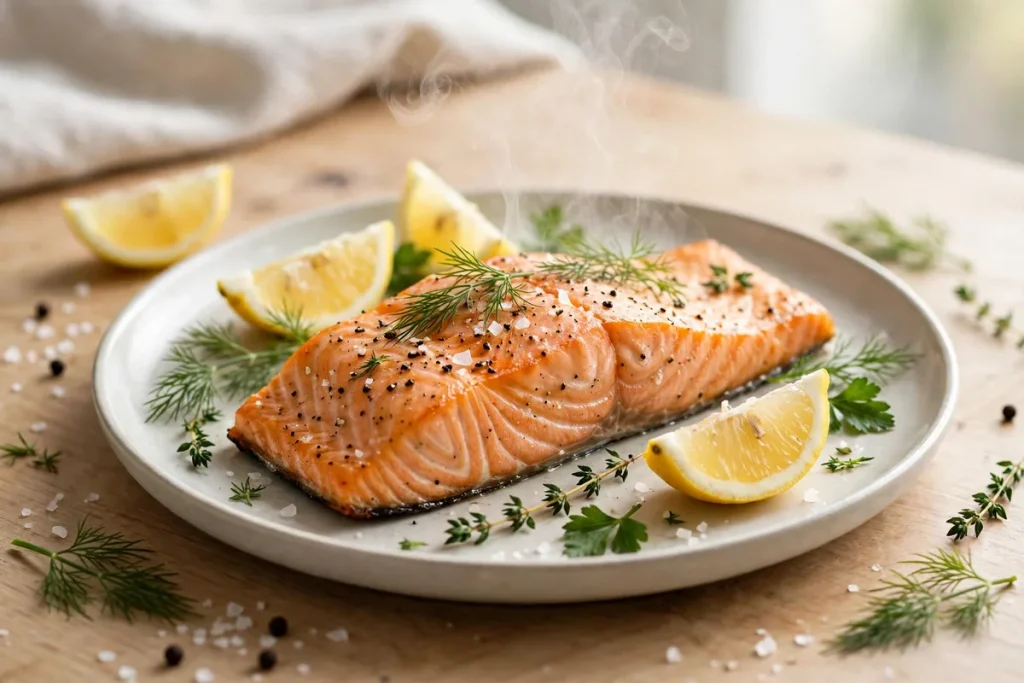

Salmon is the fish people order when they want to feel good about dinner — and the numbers mostly back that feeling up. But “a salmon fillet” can mean anything from a modest 3 oz piece to a restaurant-sized 8 oz slab, and the calories scale right along with it. This guide pins down the counts by size, type and form, from a plain grilled fillet to nigiri and lox.
Quick Answer: An 8 oz cooked salmon fillet has about 466 calories and roughly 45 g of protein — a big, filling portion by any standard. Most home and restaurant fillets are smaller: 4 oz runs about 233 calories and 6 oz about 350. Per 100 g cooked, salmon is about 206 calories — richer than chicken or white fish, and the sections below show why that trade is worth making.
Salmon Calories by Size
All the numbers below are for cooked farmed Atlantic salmon, the standard reference in USDA data. Use them for grilled, baked, roasted or pan-seared fillets with nothing added:
| Fillet size | Weight | Calories | Protein |
|---|---|---|---|
| Per 100 g | 100 g | ~206 kcal | ~22 g |
| 3 oz | 85 g | ~175 kcal | ~19 g |
| 4 oz | 113 g | ~233 kcal | ~25 g |
| 6 oz | 170 g | ~350 kcal | ~34 g |
| 8 oz | 227 g | ~466 kcal | ~45 g |
No scale? Use your hand. A portion the size and thickness of a deck of cards is roughly 3-4 oz. A fillet about the size of your whole palm runs 4-6 oz, depending on thickness — and thickness matters more than length, because a thick center-cut piece can hide an extra ounce or two over a thin tail piece. When a menu just says “salmon fillet” with no weight, assume 6 oz and about 350 calories until proven otherwise.
Which size should you actually serve? For most adults, 4-6 oz is the sweet spot: 4 oz (about 233 kcal) suits a lighter meal or a smaller appetite, 6 oz (about 350 kcal) is the standard dinner portion, and 8 oz is the hungry-athlete serving. Smaller children usually do well with 2-3 oz. If you are between sizes, remember that the protein scales too — every extra ounce adds roughly 55-60 calories and about 6 g of protein.
A quick raw-versus-cooked note: raw Atlantic salmon is about 208 kcal per 100 g. Cooking mostly drives off water, which concentrates what is left, so the cooked per-ounce numbers are the useful ones — and they explain why the same fillet weighs less on the plate than it did in the package.
Cooking method nudges the total a little. Grilling, baking, air-frying and steaming add nothing. Pan-frying in oil can add some calories if the fish absorbs it, usually far less than the full amount in the pan. Blackened and crusted preparations sit in between. The table assumes plain cooking, so treat it as the base and add extras on top.
Full Nutrition
Here is what a 100 g cooked fillet (about 3.5 oz) delivers beyond its calories:
| Nutrient | Per 100 g cooked |
|---|---|
| Calories | ~206 kcal |
| Protein | ~22 g |
| Total fat | ~12 g |
| Omega-3 (EPA + DHA) | Roughly 2-4 g in a typical fillet |
| Vitamin D | ~11 mcg |
| Vitamin B12 and selenium | Among the richest food sources of both |
The standouts are the omega-3s and the vitamin D. A typical cooked fillet provides roughly 2-4 g of EPA and DHA, the long-chain omega-3 fats linked to heart and brain health — more than most people get from the rest of their diet combined. And at around 11 mcg of vitamin D per 100 g, salmon is one of the very few foods that supply it in meaningful amounts, which matters in winter and for anyone who rarely sees the sun.
About that fat: of the roughly 12 g in 100 g of cooked salmon, only a small share is saturated. Most is monounsaturated fat plus the prized omega-3s — the opposite profile to fatty red meat, where saturated fat dominates. It is a big part of why salmon’s fat counts as a feature rather than a warning.
Add genuinely high levels of vitamin B12 and selenium — both essential, both commonly low in modern diets — plus a useful amount of potassium, and you start to see why salmon’s nutrition per calorie is so hard to beat.
One concern people raise is mercury. Salmon sits at the low end of the mercury scale compared with larger fish like swordfish or king mackerel, which is why it is one of the fish most often recommended for regular eating. The nutrition case for salmon comes with an unusually clean safety case alongside it.
Salmon Types & Forms Compared
Not all salmon reaches the plate as a plain fillet. Here is how the common types and forms compare:
Farmed vs Wild
Most salmon sold today is farmed Atlantic, and it is the reference for every table on this page. Wild salmon — sockeye is the common one — generally runs a bit leaner: expect roughly 10% fewer calories per ounce in most USDA entries, with slightly less fat overall. The difference is real but small, and it should not drive the decision. Buy the one that fits your budget and taste, because both are excellent.
Smoked Salmon (Lox)
Smoked salmon surprises people: at about 117 kcal per 100 g, it is leaner per bite than a cooked fillet, because it is sliced thin and never cooked in fat. The catch is sodium — lox is cured, so it carries a lot of it. Wonderful on a bagel or folded through eggs; just treat it as a salty food and you will be fine.
Canned Salmon
Canned salmon lands around 150 kcal per 100 g drained, between smoked and fresh. The traditional bones-in kind has a hidden bonus: the soft, completely edible bones add calcium you would never get from a fillet. It behaves like tuna in salads and patties, with a much stronger nutrition profile.
Salmon Nigiri
Nigiri — a slice of salmon over pressed sushi rice — runs about 60-70 kcal per piece with roughly 3 g of protein, and most of those calories are the rice, not the fish. A typical 6-piece serving comes to about 360-420 kcal before extras. That is a reasonable meal on its own; it is the fried rolls, spicy mayo and sweet sauces around it that quietly double the bill.
Frozen fillets deserve a quick mention too: plain frozen salmon, thawed and cooked, matches fresh nutritionally — freezing does not change the calories. Just check the bag for glazes or breading, which turn it into a different product with different numbers.
So which should you actually buy? For everyday fillets, farmed Atlantic is affordable and consistent, and the numbers on this page apply to it directly. Wild sockeye is the treat: leaner, deeper-coloured, stronger-flavoured. Canned is the budget hero, smoked is the flavour accent, and nigiri is the restaurant pleasure that fits a calorie budget better than most people expect.
Why Salmon Is Worth Its Calories
Some foods are worth every calorie, and salmon is the textbook case. Start with protein quality: salmon protein is complete and highly digestible, and a modest 4 oz fillet already gives you about 25 g of it. If you are checking how a fillet fits your personal target, run your numbers through our protein calculator — most people find that one salmon dinner covers a quarter to a third of their day.
Then there is what comes with the protein. The omega-3 fats EPA and DHA support heart health, brain function and lower inflammation, and oily fish like salmon is the only meaningful food source of them for most people. Supplements exist, but the evidence keeps pointing the same way: people who simply eat fish like this a couple of times a week get the benefit.
The pink colour itself is a clue to another bonus: it comes from astaxanthin, a powerful antioxidant that salmon pick up from their diet. It is part of why salmon’s nutrition profile reads more like a supplement label than a dinner — except it tastes considerably better.
Finally, satiety. Protein plus fat is the most filling combination a meal can offer, and salmon delivers both in a form that digests slowly and tastes like a treat rather than a diet food. Meals that satisfy are the ones a healthy eating pattern is actually built on.
Salmon also suits people who struggle to eat enough of the right things. Older adults, for example, get complete protein, vitamin D and B12 in a food that is soft, quick to cook and easy to portion. Nutrient density matters most exactly where appetites are smallest.
Salmon and Weight Loss
Salmon works beautifully in a calorie deficit for the same reason: it fills you up. A 6 oz fillet at about 350 kcal with 34 g of protein will keep most people satisfied for hours in a way that a 350 kcal sandwich will not, and satisfaction is what makes a deficit survivable past week two.
Where salmon dinners go wrong is rarely the fish. Sweet glazes and teriyaki-style sauces add roughly 50-100 kcal; creamy sauces and butter baths add more. None of that is forbidden — just count it. Our maintenance calories calculator will show you the daily budget your portions need to fit into, and a plainly cooked fillet fits almost any version of it.
One cooking note: keeping the skin on while the fish cooks keeps the fillet moist and protects it from drying out. The skin itself is edible and nutrient-rich — some people crisp it up and love it, others slide it off at the table. Either is fine; it is a preference, not a nutrition decision.
A practical trick: cook two fillets when you cook one. Cold salmon flakes beautifully over salads and grain bowls the next day at exactly the same numbers, and having it ready removes the what-is-for-lunch decision that quietly sinks more diets than any single food ever has.
As for frequency, two oily-fish meals a week is the rhythm most dietary guidelines suggest, and salmon makes that rhythm easy to keep: it cooks in about ten minutes, takes almost any seasoning, and never feels like a punishment dinner. Habits you enjoy are the ones that survive contact with real life.
Frequently Asked Questions
How many calories in 8 oz of salmon?
About 466 calories cooked, for farmed Atlantic salmon, with roughly 45 g of protein. Wild salmon of the same weight usually lands a little lower, at around 10% fewer calories.
How many calories in salmon nigiri?
About 60-70 calories per piece, with roughly 3 g of protein. Most of those calories come from the sushi rice rather than the salmon itself.
Is wild salmon lower in calories than farmed?
Usually a little, yes: roughly 10% fewer calories per ounce in most USDA data, because wild fish like sockeye run leaner. Both are excellent choices, so buy on taste and budget.
Is salmon good for weight loss?
Yes. Salmon is high in protein and healthy fats, which makes it very filling for its calories. Just count the extras: sweet glazes and teriyaki sauces add about 50-100 kcal, and creamy sauces add more.
How much protein is in a salmon fillet?
It depends on the size: a 6 oz cooked fillet has about 34 g of protein, and a full 8 oz fillet has about 45 g. Per 100 g, cooked salmon provides roughly 22 g of protein.


Pingback: California Roll Calories per Roll and Piece, Compared
Pingback: Smoked Salmon Calories: Per Slice, Bagel Math & Sodium
Pingback: Alaska Roll Calories — Per Roll, Per Piece and Full Nutrition
Pingback: Are Poke Bowls Healthy? Calories, Best & Worst Ingredients