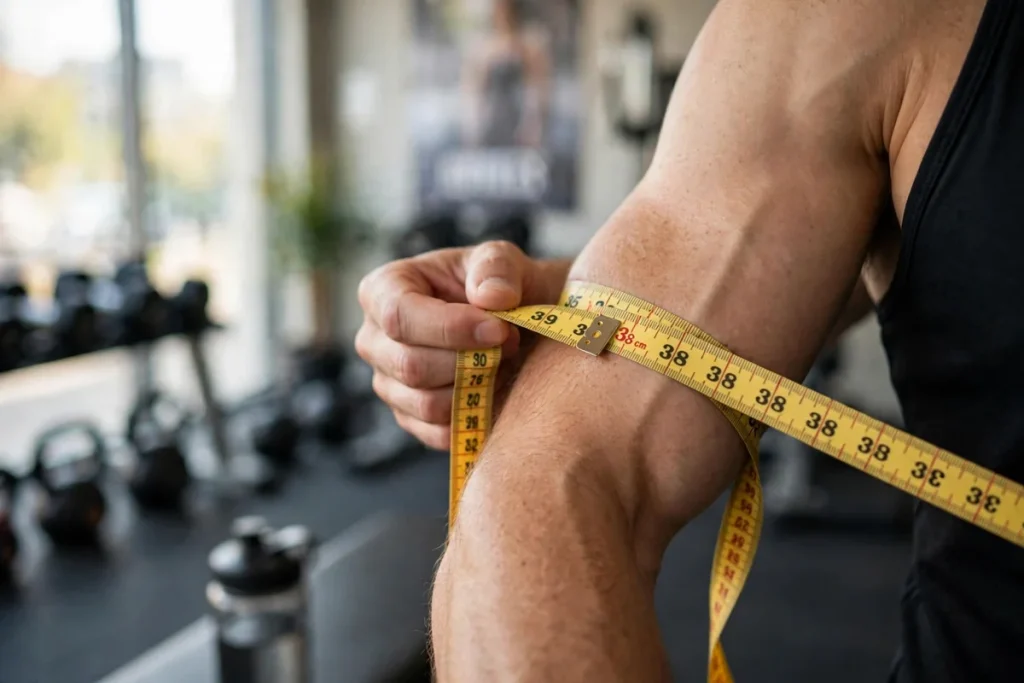

How big should your biceps be? Whether you have just started lifting or you are checking whether your arms are normal, average bicep size is one of the most searched measurements in fitness. The trouble is that the numbers you find online rarely agree — and that is usually because they mix up two different measurements: flexed and unflexed. This guide gives you honest population reference ranges for men and women, by age, and shows you how to measure your own arms so you can compare fairly.
Quick answer: The average bicep size for an adult man is about 13–14 inches (33–35 cm) unflexed and about 14–15 inches (36–38 cm) flexed. For an adult woman, it is about 11–12 inches (28–30 cm) unflexed. These are population reference ranges based on standard anthropometric survey data such as NHANES arm-circumference figures — useful benchmarks, not exact official stats. Your own healthy range depends on your height, weight, and training.
Average bicep size by age
Arm size changes across life: it tends to peak in the 30s and 40s and decline gradually after 60 as muscle mass falls. The tables below give unflexed reference ranges by age group. Treat them as estimates — surveys measure the midpoint of the upper arm on relaxed arms, and averages shift with the height and weight of the population sampled.
Men (unflexed)
| Age group | Unflexed (inches) | Unflexed (cm) |
|---|---|---|
| 20–29 | 13.0–13.5 | 33–34 |
| 30–39 | 13.5–14.0 | 34–36 |
| 40–49 | 13.5–14.0 | 34–36 |
| 50–59 | 13.0–13.5 | 33–34 |
| 60–69 | 12.5–13.0 | 32–33 |
| 70+ | 12.0–12.5 | 30–32 |
For men, the overall adult average sits around 13–14 inches unflexed, which matches the quick answer above. Men in their 30s and 40s sit at the top of the range, while averages drift down after 60.
Women (unflexed)
| Age group | Unflexed (inches) | Unflexed (cm) |
|---|---|---|
| 20–29 | 11.0–11.5 | 28–29 |
| 30–39 | 11.5–12.0 | 29–30 |
| 40–49 | 11.5–12.0 | 29–30 |
| 50–59 | 11.0–11.5 | 28–29 |
| 60–69 | 10.5–11.0 | 27–28 |
| 70+ | 10.0–10.5 | 25–27 |
For women, the overall adult average is about 11–12 inches unflexed. The pattern across age is similar — a peak in midlife, then a gradual decline — but the absolute numbers are lower, reflecting lower average muscle mass.
Notice how wide each range is: a man in his 20s can sit anywhere from 13 to 13.5 inches and still be typical, because height and weight vary so much within an age group. A 6 ft 4 in man and a 5 ft 6 in man are not expected to have the same arms. Use the range that fits your build, not a single magic number.
Flexed vs unflexed: why the numbers differ
Most confusion about average bicep size comes from mixing two measurements. An unflexed measurement is taken with the arm relaxed and hanging at your side, at the midpoint between shoulder and elbow — this is the method used by anthropometric surveys, so it is the right basis for population averages. A flexed measurement is taken with the arm curled and the bicep contracted, at the peak of the muscle. When the muscle contracts, the belly shortens and thickens, which typically adds 1–2 inches to the reading.
That gap explains a lot of online bragging. A man with a 14-inch unflexed arm will often measure 15–16 inches flexed — so when someone claims a 16-inch arm without saying how it was measured, they are usually quoting a flexed number. Compare like with like: if you want to know whether you are above or below average, use your unflexed measurement against the tables above.
How to measure your bicep correctly
A measurement is only useful if it is repeatable. Follow these steps and you will get a number you can trust — and compare over time.
- Find the midpoint: with your arm bent at 90 degrees, measure from the bony point of your shoulder to the tip of your elbow, and mark the halfway point.
- For unflexed: let your arm hang relaxed at your side, palm facing your thigh, and wrap the tape around the marked midpoint.
- For flexed: curl your forearm up, clench your fist, and flex your bicep as hard as you can, then measure around the highest point (the peak).
- Keep the tape snug but not tight: it should sit flat against the skin without digging in or compressing the muscle.
- Measure both arms: your dominant arm is often about half an inch bigger. Record both, and use the average if you want a single number.
- Repeat under the same conditions: measure cold (not straight after a workout, when the pump temporarily adds size) and at the same time of day.
Write the number down with the method — 13.5 in unflexed, for example — so future measurements are comparable. A measurement without a method is just a guess.
What affects bicep size
Averages hide a lot of variation, and several factors move your number up or down. Height matters: taller people have longer upper arms, and a longer muscle belly usually measures larger around, even at the same level of training. Overall body weight matters even more: a heavier person carries more muscle and more fat, and both add to arm circumference — which is why arm size alone says little about leanness. Body fat is the quiet contributor: two people can have the same 14-inch arm, one mostly muscle and the other mostly fat.
Training history is the factor you can change. Rough reference ranges: an untrained adult man typically measures about 12–14 inches unflexed (30–36 cm), while a man who has lifted consistently for a few years often measures about 14–16 inches flexed (36–41 cm). A well-trained man may reach 15–17 inches flexed (38–43 cm). For women, untrained arms are typically about 10.5–12 inches unflexed (27–30 cm), while trained women often measure about 12–13.5 inches flexed (30–34 cm). These are rough ranges, not promises — genetics, especially muscle-belly length and where the tendon inserts, set a ceiling that training alone cannot move.
Age works in both directions. Muscle mass builds into your 30s and 40s, then gradually declines — after 60, the average arm loses roughly half an inch to an inch per decade unless training offsets it. Genetics also play a role you cannot train away: a long muscle belly with a short tendon looks fuller and measures larger than a short belly with a long tendon, even at the same strength.
How to grow your arms
If your arms are below where you would like them, the recipe is unglamorous but reliable. Train biceps two or three times a week with progressive overload — gradually adding weight or reps to curls and pulling movements over months, not days. Eat enough protein (a common target is about 1.6–2.2 grams per kilogram of body weight per day) and enough total food to support growth. And do not neglect triceps: they make up roughly two-thirds of upper-arm size, so overall arm growth stalls if you only curl.
A simple template: two upper-body sessions a week, each with one or two bicep exercises (for example, dumbbell curls and hammer curls) for 3–4 sets of 8–12 reps, plus a pulling movement such as rows or pull-ups. Add a little weight or a rep when you can complete all sets with good form — that steady progression is the whole secret.
Above all, be patient. Beginners often see visible growth within 8–12 weeks, but adding a full inch to your arms is a project of months for a beginner and years for an experienced lifter. Anyone promising inches in weeks is selling something, not coaching.
The bottom line
The average bicep size for a man is about 13–14 inches unflexed (14–15 flexed); for a woman, about 11–12 inches unflexed. Those are population reference ranges, not targets — height, weight, age, and training all shift your personal normal. Measure correctly, compare like with like, and if you want bigger arms, train consistently, eat enough protein, and give it time.
Frequently Asked Questions
What is the average bicep size for a man?
About 13–14 inches (33–35 cm) unflexed and about 14–15 inches (36–38 cm) flexed. These are population reference ranges based on standard anthropometric survey data, not exact official stats — your own normal range depends on your height, weight, and training.
What is the average bicep size for a woman?
About 11–12 inches (28–30 cm) unflexed. Flexed, that is roughly an inch more, about 12–13 inches (30–33 cm). Like the men’s figures, these are reference ranges, not exact official stats.
Should I measure my bicep flexed or unflexed?
Both are valid, but be consistent and say which one you mean. Unflexed, measured at the midpoint with the arm relaxed, is the survey standard used for population averages. Flexed, measured at the peak with the muscle contracted, typically reads 1–2 inches larger. Compare like with like.
Is a 15-inch bicep big?
Flexed, 15 inches is above average for a man and a solid trained arm. Unflexed, 15 inches is large. For a woman, 15 inches flexed is very large. Remember the averages: about 13–14 inches unflexed for men and about 11–12 inches unflexed for women.
How long does it take to grow your biceps?
Beginners often see visible growth within 8–12 weeks of consistent training. Adding a full inch takes months for a beginner and years for an experienced lifter. Progressive overload, enough protein, and patience matter far more than any shortcut.