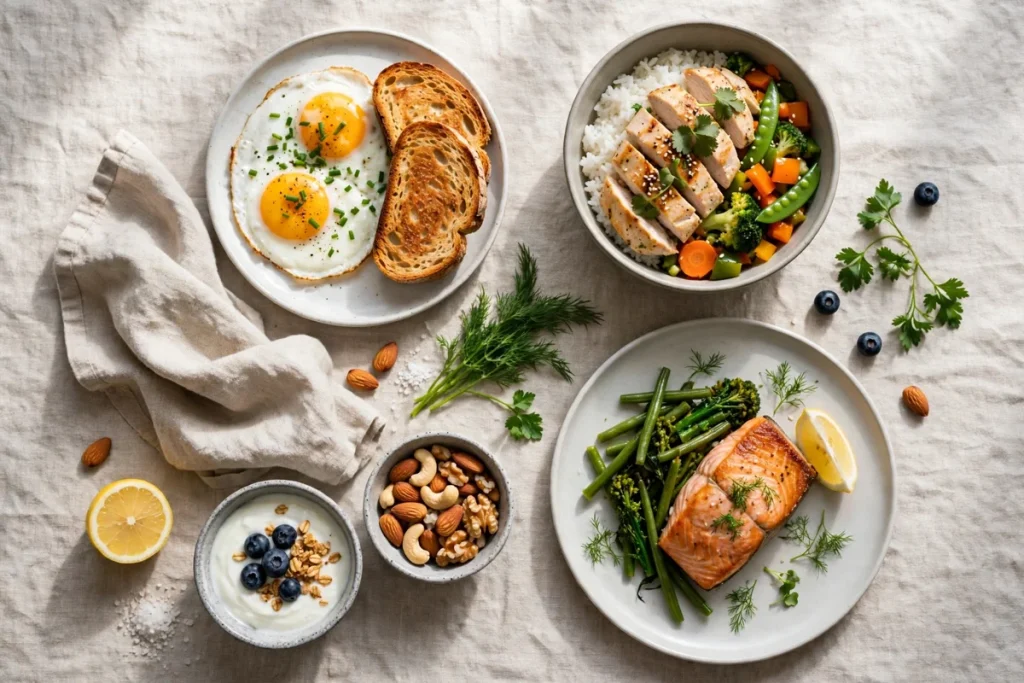

This 2000 calorie meal plan lays out a full day of eating — breakfast, lunch, a snack and dinner — that adds up to exactly 2,000 calories, with about 141 grams of protein. It is built around normal food, realistic portions and meals you can actually repeat, not shakes, tiny portions or a long list of foods you have never bought.
All calorie counts are approximate. Natural foods vary, brands differ and a slightly larger piece of chicken will change the total by a few calories. That does not matter much: what matters is that the day is balanced, filling and close to 2,000 calories overall.
Who a 2,000-Calorie Plan Suits
For many adults, 2,000 calories is close to maintenance — the amount that keeps weight steady with light to moderate activity. For a smaller person who usually eats less, it can be a small surplus, useful for maintaining weight or gaining slowly. For a bigger or more active person, it can be a modest deficit, which is why it is a common starting point for gradual fat loss.
Do not guess your own number. Our Maintenance Calories Calculator estimates how many calories you burn in a day, and our guide to how many calories you should eat to lose weight explains how to turn that number into a daily target. If your maintenance is well above 2,000, this plan will likely leave you hungry; if it is well below, this plan may be too much food.
The Day at a Glance: 2,000 Calories
Here is the whole day in one table. The maths is simple: 520 + 640 + 210 + 630 = 2,000 calories, and the protein adds up to 32 + 48 + 17 + 44 = 141 grams.
| Meal | What to eat | Calories | Protein |
|---|---|---|---|
| Breakfast | Scrambled eggs, wholemeal toast, avocado and cottage cheese | 520 | 32 g |
| Lunch | Chicken, brown rice and hummus bowl | 640 | 48 g |
| Snack | Greek yogurt, walnuts and blueberries | 210 | 17 g |
| Dinner | Baked salmon, sweet potato, broccoli and green beans | 630 | 44 g |
| Day total | 2,000 | 141 g |
Breakfast: 520 calories, 32 g protein
- 2 large eggs, scrambled (140 calories, 12 g protein)
- Wholemeal toast, 2 slices (180 calories, 7 g protein)
- Avocado, 50 g (80 calories, 1 g protein)
- Cottage cheese, 100 g (100 calories, 11 g protein)
- Cherry tomatoes (20 calories, 1 g protein)
Scramble the eggs, toast the bread and serve the avocado and cottage cheese on the side. It is filling without being heavy, and the protein comes from three different foods, which makes the meal easier to enjoy than a plate of plain eggs.
Lunch: 640 calories, 48 g protein
- Grilled chicken breast, 150 g cooked (250 calories, 38 g protein)
- Cooked brown rice, 200 g (220 calories, 5 g protein)
- Mixed vegetables, 100 g (40 calories, 2 g protein)
- Hummus, 40 g (85 calories, 3 g protein)
- Olive oil, 1 teaspoon, for dressing (45 calories)
Build this as a bowl: rice at the bottom, sliced chicken on top, vegetables and hummus around the edge, and the olive oil drizzled over the top. It travels well in a lunchbox, which is why it works for workdays as well as weekends.
Snack: 210 calories, 17 g protein
- Nonfat Greek yogurt, 150 g (90 calories, 15 g protein)
- Walnuts, 15 g (100 calories, 2 g protein)
- Blueberries, 50 g (20 calories)
This snack is deliberately simple and sweet enough to feel like a treat. The yogurt does most of the protein work here, and the walnuts add crunch and staying power.
Dinner: 630 calories, 44 g protein
- Baked salmon fillet, 150 g (315 calories, 34 g protein)
- Roasted sweet potato, 200 g (180 calories, 3 g protein)
- Broccoli, 150 g (50 calories, 4 g protein)
- Green beans, 150 g (40 calories, 3 g protein)
- Olive oil, 1 teaspoon (45 calories)
Roast the sweet potato, broccoli and green beans with the olive oil while the salmon bakes. One tray, one pan, dinner in about 25 minutes, and the vegetables give the plate plenty of volume for the calories.
How the Protein Reaches 141 Grams
The protein total is not an accident. Every meal contains a clear protein source: eggs and cottage cheese at breakfast, chicken and hummus at lunch, Greek yogurt as a snack, and salmon at dinner. That spread matters, because protein at each meal helps you stay full through the day in a way that one large protein-heavy dinner alone does not. Our guide to calories in protein explains why protein is worth prioritising when calories are fixed.
The Vegetarian Version
You do not need to rebuild the day to make it vegetarian. Keep breakfast and the snack the same, and make these swaps:
- Lunch: swap the chicken breast for firm tofu, 200 g (about 220 calories, 22 g protein). Keep the rice, vegetables, hummus and olive oil the same, so lunch becomes about 610 calories.
- Dinner: swap the salmon for cooked lentils, 200 g, plus feta cheese, 40 g (about 335 calories together, 24 g protein). Keep the sweet potato, broccoli, green beans and olive oil the same.
- Snack: swap the walnuts for pumpkin seeds, 15 g, if you prefer — similar calories, a little more protein.
With those swaps the vegetarian day comes to about 1,990 calories and about 115 grams of protein. That is lower on protein than the main plan, because tofu and lentils are less protein-dense than chicken and salmon, but it is still a respectable total for a vegetarian day, and the protein is spread across every meal.
How to Use This Plan for 3 Days Without Repeating It
Do not eat the identical day three times. Keep the structure — the same meal sizes and roughly the same calories — and swap the proteins and carbs:
- Day 2: swap chicken for turkey breast at lunch, salmon for prawns at dinner, brown rice for quinoa, and sweet potato for brown rice at dinner. Keep the snack the same.
- Day 3: swap the eggs for a tofu scramble at breakfast, chicken for canned tuna at lunch, and salmon for lean beef strips at dinner, with potatoes instead of sweet potato.
The totals will move by a few dozen calories on swap days, which is fine. Aim to stay near 2,000, not to hit it to the calorie, and keep a protein source in every meal so the day still feels filling.
Shopping List for the Day
Produce
- Avocado, cherry tomatoes, mixed vegetables, broccoli, green beans, sweet potatoes, blueberries
Protein
- Eggs, cottage cheese, chicken breast, nonfat Greek yogurt, salmon fillet
Pantry
- Wholemeal bread, brown rice, hummus, olive oil, walnuts
For the vegetarian version, swap the chicken and salmon for firm tofu, cooked lentils and feta, and add pumpkin seeds.
Budget and Meal-Prep Notes
- Batch-cook the brown rice and chicken at the start of the week. Cooked rice keeps well in the fridge for a few days, and sliced chicken turns lunch into a two-minute assembly job.
- Frozen vegetables are fine. They are usually cheaper than fresh, they do not go off in the fridge, and nutritionally they are very close to fresh for broccoli, green beans and mixed vegetables.
- Buy salmon and chicken on offer and freeze them. Defrost overnight in the fridge, and keep the snack simple — yogurt, nuts and berries need no cooking at all.
If 2,000 calories turns out to be slightly too much for you, our 1800 Calorie Meal Plan follows a similar full-day format at a lower total. The bottom line is simple: a 2000 calorie meal plan works best when it is made of food you like, protein at every meal, and portions you can repeat without thinking too hard about them.
Frequently Asked Questions
Is 2000 calories a day enough?
For many adults, yes. 2000 calories is close to maintenance for a lightly to moderately active adult, so it is enough to maintain weight and energy for most people in that group. It may not be enough if you are very active, do heavy physical work, or are much larger than average — in that case, check your maintenance figure first.
Can I lose weight on a 2000 calorie meal plan?
Yes, if 2000 calories is below what you burn in a day. Weight loss comes from a sustained calorie deficit, so a 2000 calorie meal plan works for fat loss when your maintenance is higher than 2000. If your maintenance is 2000 or below, this plan will maintain rather than reduce your weight.
How much protein is in a 2000 calorie meal plan?
This plan provides about 141 grams of protein a day: 32 grams at breakfast, 48 grams at lunch, 17 grams as a snack and 44 grams at dinner. That sits inside the 130 to 150 gram range that suits many adults at 2000 calories.
Is a 2000 calorie meal plan good for muscle gain?
It can be, if 2000 calories is at or slightly above your maintenance and you train consistently. Muscle gain needs enough protein and a small surplus, and this plan provides about 141 grams of protein a day. If you are larger or training hard, you may need more calories than 2000 to gain.
What does a 2000 calorie day look like?
In this plan, a 2000 calorie day is breakfast at 520 calories, lunch at 640 calories, a snack at 210 calories and dinner at 630 calories — 520 + 640 + 210 + 630 = 2000 calories in total, with about 141 grams of protein across the day.