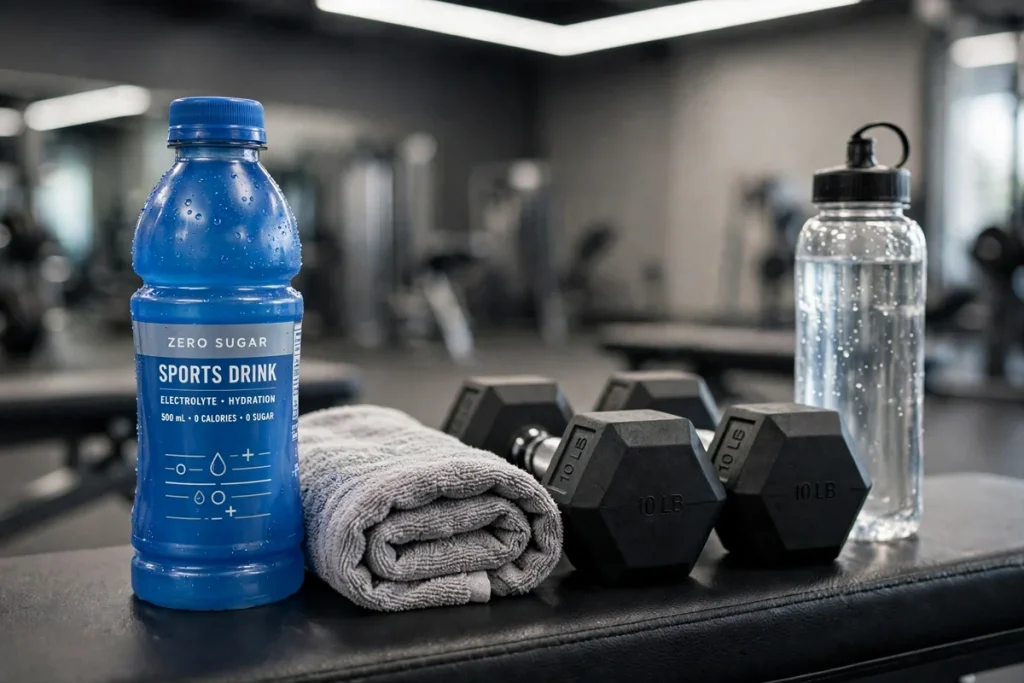

Walk down the sports drink aisle and Powerade Zero promises the best of both worlds: all the electrolytes of a sports drink with none of the sugar. But is Powerade Zero good for you, or is it just a sweetened bottle of salty water? The honest answer sits in the middle, and it depends mostly on when you drink it.
Quick answer: is Powerade Zero good for you? As a hydration tool, yes, in the right situation. It has zero calories and zero sugar, plus the same electrolytes as regular Powerade, so it is a reasonable choice during long, sweaty workouts over 60 minutes. For most shorter workouts and everyday desk hydration, plain water is enough, and Powerade Zero is not a health drink.
What is Powerade Zero?
Powerade Zero is Coca-Cola’s sugar-free version of Powerade, sold in flavors such as Mixed Berry, Fruit Punch, Grape, Orange and Strawberry Smash, in 12, 20 and 28 fl oz bottles. It is built for the same job as regular Powerade: replacing the fluid and salts lost in sweat. The difference is what it leaves out: the sugar. Instead of high fructose corn syrup, it is sweetened with sucralose and acesulfame potassium, two calorie-free sweeteners, so the drink stays at zero calories.
What is in Powerade Zero? The official panel
All figures below come from Coca-Cola’s official Powerade product page, read during this build, for Powerade Zero Mixed Berry. Values are per 12 fl oz serving, and a 28 fl oz bottle holds 2.5 servings.
| Nutrient | Per 12 fl oz serving |
|---|---|
| Calories | 0 |
| Sodium | 240 mg (10% of the Daily Value) |
| Potassium | 80 mg (2% of the Daily Value) |
| Total sugars | 0 g |
| Added sugars | 0 g |
| Vitamin C | 20% of the Daily Value |
| Vitamin B12 | 35% of the Daily Value |
The full ingredients list reads: water, less than 0.5% of citric acid, electrolytes (salt, sodium citrate, magnesium and calcium chlorides, mono-potassium phosphate), vitamins B12 and C, natural flavors, sucralose, acesulfame potassium, calcium disodium EDTA to protect color, and Blue 1. Two things stand out. First, the electrolytes are real but modest: 240 mg of sodium and 80 mg of potassium per serving. Second, the vitamin figures sound impressive – 35% of the Daily Value for B12 – but a sports drink is a poor way to get vitamins; food does that job better.
One serving trap to know: the panel serving is 12 fl oz, but most bottles are 20 or 28 fl oz. With regular Powerade that matters a lot, because the calories multiply. With Zero it does not change the calorie count – zero times anything is still zero – but the sodium does add up: a 28 fl oz bottle gives 2.5 servings, so about 600 mg of sodium.
Powerade Zero vs regular Powerade vs water
The comparison below uses the official Powerade panels for both drinks, per 12 fl oz serving. Plain water is included as the baseline.
| Drink | Calories | Total sugars | Sodium | Potassium |
|---|---|---|---|---|
| Powerade Zero | 0 | 0 g | 240 mg | 80 mg |
| Regular Powerade | 80 | 21 g | 240 mg | 80 mg |
| Plain water | 0 | 0 g | About 0 mg | About 0 mg |
The striking fact is that Zero and regular Powerade have identical electrolytes. The only nutritional difference is the sugar: regular Powerade adds 21 g of sugar, all of it added sugar, and 80 calories per serving. Scale that to a bottle and the gap grows: a 20 fl oz bottle of regular Powerade works out at about 133 calories and 35 g of sugar, and a 28 fl oz bottle at 200 calories and about 52 g of sugar. The same bottles of Zero stay at zero calories. That makes Zero the better pick whenever you want the electrolytes without the sugar, and regular the better pick only when you actually need quick energy during very long exercise.
The sweeteners: sucralose and acesulfame potassium
Powerade Zero is sweetened with sucralose and acesulfame potassium, often called Ace-K. Both are calorie-free, high-intensity sweeteners approved for use by regulators including the US Food and Drug Administration, and they are used together because the blend tastes closer to sugar than either one alone. The official panel does not state how much of each sweetener is in a bottle, which is normal: sweeteners are used in tiny amounts, measured in milligrams. Typical intake from a bottle or two sits far below the acceptable daily intake levels regulators have set, so for most people the sweetener question is a matter of taste and preference, not safety. That said, honesty cuts both ways: the sweeteners make the drink taste good without sugar, but they add no nutrition either. And because there is no sugar, Powerade Zero is kinder to teeth than a sugary sports drink, though it is still acidic, so it is not something to sip all day.
Who actually benefits?
Sports drinks earn their place in a fairly narrow window: exercise lasting longer than about 60 minutes, hard training in heat, or sessions where you are visibly sweating through your shirt. In those conditions you lose meaningful amounts of sodium in sweat, and a drink with salt helps you hold on to the fluid you drink rather than just passing it through. That is where Powerade Zero fits: it replaces some salt and potassium without adding sugar you may not need. It also helps in hot-weather training and for people who struggle to drink enough plain water, since flavor encourages drinking.
Who does not need it?
Most other people do not need it. A 30-minute gym session, a walk, or a day at a desk does not drain your electrolytes enough to need replacing, and plain water covers the fluid loss. Two cautions belong here. First, electrolytes without calories do not give you energy: if you feel tired, that is not something a zero-calorie drink can fix, because there is no fuel in it. Second, the sodium is not free: 240 mg per serving is 10% of the Daily Value, and a 28 fl oz bottle gives about 600 mg. That is fine when you are sweating, but it is pointless salt if you are not.
Is it OK to drink Powerade Zero every day?
An occasional bottle is fine for most healthy adults, but daily drinking is a habit worth questioning. You would be taking in sweeteners, colors and salt every day for no nutritional benefit, and the acidity is not kind to teeth when sipped constantly. Water, sparkling water, or water with a squeeze of citrus gives you the flavor and hydration without the additives. If you do drink it daily, keep it with meals or workouts rather than sipping it across the whole day.
The honest verdict
So, is Powerade Zero good for you? Think of it as a tool, not a health drink. It is a good choice during long, sweaty workouts, and a clearly better choice than a sugary sports drink when you do not need the calories. It is not a source of nutrition, it will not improve your health, and for everyday hydration water wins on simplicity, price and zero additives. Use Powerade Zero when the workout earns it, and reach for water the rest of the time.
Frequently Asked Questions
Is Powerade Zero good for you?
It is a reasonable hydration choice, not a health drink. It has zero calories, zero sugar and the same electrolytes as regular Powerade (240 mg sodium and 80 mg potassium per 12 fl oz), so it makes sense during long, sweaty workouts over 60 minutes. For everyday hydration, plain water is the better default.
Does Powerade Zero have sugar?
No. The official panel lists 0 g of total sugars and 0 g of added sugars per 12 fl oz serving. It is sweetened instead with sucralose and acesulfame potassium.
How many calories are in Powerade Zero?
Zero per 12 fl oz serving, and zero for a whole bottle too, since every serving in the bottle has zero calories. Compare regular Powerade at 80 calories per 12 fl oz, or about 200 calories in a 28 fl oz bottle.
Is Powerade Zero better than regular Powerade?
If you do not need the energy, yes. Both have the same electrolytes per serving, but regular Powerade adds 21 g of sugar and 80 calories per 12 fl oz. Regular only wins when you want quick fuel during very long exercise.
Do I need a sports drink for a normal workout?
Usually not. For workouts under about an hour, plain water replaces what you lose. Sports drinks earn their place in longer, harder or hotter sessions, where sweat losses are large and salt helps you retain fluid.
One last tip: if your workout is under an hour, fill your bottle with water and save the sports drink for the sessions that actually leave you drenched. Your wallet and your teeth will both be better off.