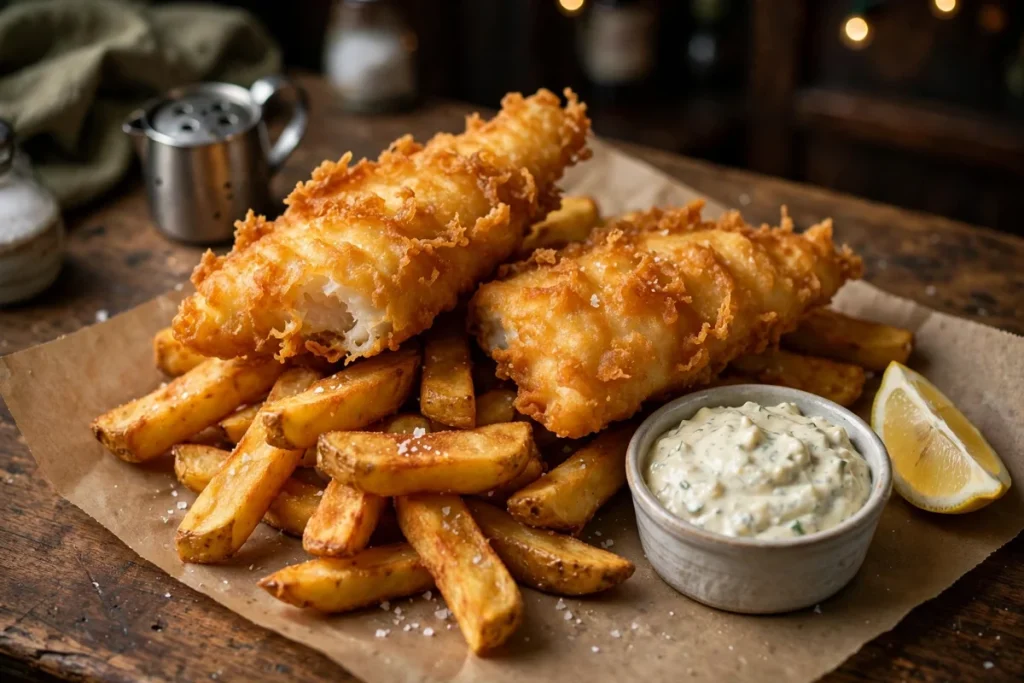

Ask for fish and chips and the fish gets all the attention, but the chips are the quiet half of the meal. They are also the part that varies most: one shop’s regular portion can be half as big again as another’s, and the oil, the cut and the frying time all move the number. This guide counts the chips properly, with portion maths you can check, and then puts the full meal together.
Quick answer: calories in fish and chips chips? A regular chip-shop portion of chips (about 250 g) runs roughly 450-550 calories, and the chips alone are often half the whole meal. A small portion (about 150 g) is roughly 300-330 calories, and a large (about 350 g) is roughly 700-770 calories. All figures in this article are estimates – chip shops vary, and nobody weighs your portion at the counter.
Why thick-cut chips are 200-220 calories per 100 g
A plain baked potato lands around 90-100 calories per 100 g. Frying adds oil, and oil is about 9 calories per gram, so the final number depends on how much oil the potato soaks up. Thick-cut chip-shop chips absorb less oil than thin fries because they have less surface area for their weight: more fluffy potato inside, less fried surface outside. That is why chip-shop chips sit at roughly 200-220 calories per 100 g, while thin fast-food fries work out higher – our McDonald’s Fries guide calculates about 288-324 calories per 100 g from the official figures. The chip-shop chip is lighter per gram; it is the portion size that makes it heavy.
Portion sizes: the maths
Chip shops do not weigh portions, so these are typical weights, and the maths is simply weight times 200-220 calories per 100 g. Multiply the grams by 2.0 for the low end and by 2.2 for the high end.
| Portion | Typical weight | Maths | Calories |
|---|---|---|---|
| Small | 150 g | 150 x 2.0-2.2 | 300-330 |
| Regular | 250 g | 250 x 2.0-2.2 | 500-550 |
| Large | 350 g | 350 x 2.0-2.2 | 700-770 |
You will notice the quick answer gives the regular portion as 450-550 calories, a little wider than the table’s 500-550. That is deliberate: some shops fry lighter or drain longer, which can pull a regular portion toward 450, but at the standard 200-220 per 100 g the honest figure is 500-550. Treat 450 as the kindest case, not the promise.
Judging your own portion is easier than it sounds. A medium fast-food fries weighs 111 g, so if your chip-shop portion looks more than twice that size, it probably is: most chip-shop regulars are 250 g or more. When in doubt, assume the regular and count 500-550.
The fish: battered cod or haddock
A standard battered cod or haddock fillet from a chip shop runs roughly 350-450 calories (estimate). The fish itself is lean protein – a plain white fish fillet is only about 150-200 calories – and the batter and the frying do most of the damage. The batter soaks up oil just as chips do, and a thick, crisp batter coat can add 150-250 calories on its own. Haddock and cod are near-identical here; the shop’s batter matters more than the species. A grilled or steamed fish would be far lighter, but that is a different meal, not the classic.
The full classic meal
Put the two halves together and the classic meal lands around 850-1,000 calories: regular chips at 500-550 plus battered fish at 350-450. That is before anything else touches the tray. It is roughly half the daily intake of many adults in a single meal, which is why the chips deserve the attention: they are the bigger half of the total, and the part you can most easily shrink.
Extras: what the sauces and sides add
Extras are where a fish supper quietly grows. Mushy peas are the kindest addition; curry sauce and tartar sauce are not.
| Extra | Typical serving | Calories (estimate) |
|---|---|---|
| Mushy peas | A serving | About 100 |
| Curry sauce | A serving | About 110 |
| Tartar sauce | Per tablespoon | About 90 |
| Ketchup | Per tablespoon | About 19 |
Two tablespoons of tartar sauce add about 180 calories, which is more than a third of a regular portion of chips. Ketchup, at about 19 calories per tablespoon on our ketchup guide’s figure, is the cheapest extra on the tray. Salt and vinegar, of course, add nothing. Note that the ketchup figure here follows the site’s own ketchup guide (19 per tablespoon) rather than the rough 15 often quoted elsewhere.
Scraps, bread and drinks
A few more items sneak onto the tray. Scraps, the crunchy batter bits scooped from the fryer, are mostly fried batter: a generous handful runs roughly 100-150 calories (estimate). A bread roll or a slice of white bread for a chip butty adds about 150 calories. And a sugary canned drink adds about 140 calories. None of these is huge alone, but a large chips, fish, curry sauce, bread roll and sugary drink together can pass 1,400 calories before you have noticed.
Lighter choices that still feel like fish and chips
You do not have to give up fish and chips to cut the calories. The biggest lever is the chip portion: order a small instead of a regular and you save roughly 200 calories, and sharing a regular portion between two people halves the chips to about 250-275 calories each. At home, oven chips run about 180 calories per 150 g (estimate), against about 300-330 for the same weight of chip-shop chips, and air-fryer chips use far less oil again. Other easy wins: swap extra chips for mushy peas (about 100 calories a serving instead of 300 or more for more chips), leave the thickest, soggiest parts of the batter, and choose ketchup or vinegar over tartar sauce. Each swap is small; together they can cut several hundred calories off the meal.
Chip-shop chips vs fast-food fries
Per gram, chip-shop chips beat thin fries: about 200-220 calories per 100 g against about 288-324 for McDonald’s fries, as our McDonald’s Fries guide calculates from the official figures. Per portion, though, the chip shop usually loses, because a regular chip-shop portion (about 250 g) is more than double a medium fries (111 g, 320 calories). A medium fries is 320 calories; a regular chip-shop portion is 500-550. The thin fry is denser; the chip-shop portion is simply bigger. That is the whole story in one line: it is not the chip, it is the scoop.
The bottom line
Calories in fish and chips chips come down to portion size more than anything else. At 200-220 calories per 100 g, a small portion is about 300-330, a regular is about 500-550 and a large is about 700-770. Add battered fish at 350-450 and the classic meal is 850-1,000 calories. Order the small, share the regular, or make your chips at home, and you keep the meal you love at a size that fits the day.
Frequently Asked Questions
How many calories are in fish and chips chips?
A regular chip-shop portion of chips (about 250 g) runs roughly 450-550 calories. A small portion (about 150 g) is roughly 300-330 calories, and a large (about 350 g) is roughly 700-770 calories. All figures are estimates, because chip shops vary.
How many calories are in a full fish and chips meal?
A classic fish and chips meal – battered fish plus a regular portion of chips – lands around 850-1,000 calories. The fish contributes roughly 350-450 calories and the chips roughly 500-550. Add mushy peas (about 100) or tartar sauce (about 90 per tablespoon) and the total climbs further.
Why are chip-shop chips lower in calories per 100 g than thin fries?
Thick-cut chips have less surface area per gram than thin fries, so they absorb less oil during frying. Chip-shop chips run about 200-220 calories per 100 g, while thin fast-food fries work out at about 288-324 per 100 g on the site’s McDonald’s Fries guide. Chip-shop portions are bigger, though, so the total is usually higher.
Are oven chips much lighter than chip-shop chips?
Yes. Oven chips at home run about 180 calories per 150 g (estimate), against about 300-330 for the same weight of chip-shop chips. Air-fryer chips are lighter still, because they use far less oil.
What is the lowest-calorie way to order fish and chips?
Share a regular portion of chips, pick mushy peas instead of extra chips, and keep sauces to ketchup or vinegar rather than tartar sauce. That can cut several hundred calories off the meal while keeping the fish and chips you actually came for.
One last tip: if you only change one thing, change the chip portion. Dropping from a large to a regular saves about 200 calories, and sharing a regular saves about 250 each – more than any sauce swap will ever do.