
Running with a backpack has a new name — rucking — and it has gone from military training to weekend trails in a few short years. The idea is simple: load a backpack, walk briskly, and turn an ordinary walk into a much harder workout. But before you throw 30 lb into a bag and set off at a run, it helps to know how many calories you actually burn — and why most people are better off walking fast with the pack than running with it.
This guide gives you both. Every calorie figure below is a MET-based estimate, and the maths is shown in full so you can adjust it for your own weight. A MET (metabolic equivalent of task) is a standard way of rating how hard an activity is: 1 MET is roughly what you burn sitting still, and higher numbers mean harder work.
Quick answer: For a 155 lb (70 kg) person, running with a backpack — done as brisk walking with weight, or rucking — burns an estimated 420–490 calories per hour (6–7 METs × 70 kg). At a gentler pace with a light pack, expect nearer 350 calories per hour (about 5 METs × 70 kg). All calorie figures in this article are MET-based estimates, with the maths shown.
How the calorie maths works
The formula is simple: calories per hour = METs × body weight in kilograms × hours. A 155 lb person weighs about 70 kg (155 ÷ 2.2 = 70.5, rounded to 70 here). This article uses three MET values consistently: walking at a moderate pace, about 3.5 METs; rucking with a pack weighing 10–20% of body weight, about 6–7 METs; and running at a moderate pace, about 9–10 METs. MET values are population averages, so treat every figure as an estimate — terrain, speed, fitness, and pack fit all shift the real number.
Worked example: rucking at 6 METs for one hour at 70 kg gives 6 × 70 × 1 = 420 calories; at 7 METs it gives 7 × 70 × 1 = 490. That is where the 420–490 range in the quick answer comes from.
Walking vs rucking vs running: calories per hour for a 155 lb person
| Activity | METs | Maths (estimate) | Calories per hour (estimate) |
| Walking (moderate pace) | 3.5 | 3.5 × 70 kg | About 245 |
| Rucking (pack 10–20% of body weight) | 6–7 | 6 × 70 kg to 7 × 70 kg | About 420–490 |
| Running (moderate pace) | 9–10 | 9 × 70 kg to 10 × 70 kg | About 630–700 |
The table tells a useful story. Rucking nearly doubles the burn of walking (about 245 calories per hour) without asking your body to run at all — that is the whole appeal. Running still burns more per hour (about 630–700 calories), but you can ruck for far longer than you can run with a pack, and repeat it the next day. For weight loss, the total burn across the week matters more than the highest hourly rate. As an example, three 45-minute rucks a week at 6.5 METs burn about 1,023 calories a week (6.5 × 70 × 0.75 = 341 per session, × 3 — estimates).
How pack weight changes the burn
| Pack weight (% of body weight) | Pack weight for a 155 lb person | METs (estimate) | Calories per hour (estimate) |
| 10% | 15.5 lb (7 kg) | 6 | 6 × 70 kg = about 420 |
| 15% | 23 lb (10.5 kg) | 6.5 | 6.5 × 70 kg = about 455 |
| 20% | 31 lb (14 kg) | 7 | 7 × 70 kg = about 490 |
Each extra 5% of body weight adds roughly half a MET, which for a 70 kg person means about 35 extra calories per hour (0.5 × 70 = 35). So going from a 15 lb pack to a 31 lb pack lifts the hourly burn from about 420 to about 490 calories (estimates) — a real difference, but a modest one. Doubling your pack weight does not double your calorie burn, but it does sharply increase the load on your knees and back.
These pack-weight figures are interpolated within the 6–7 MET rucking range, so treat them as estimates. A hilly route or a faster pace can push the burn higher; a flat, easy stroll with the same pack will sit lower.
Running with a backpack vs rucking: what is the difference?
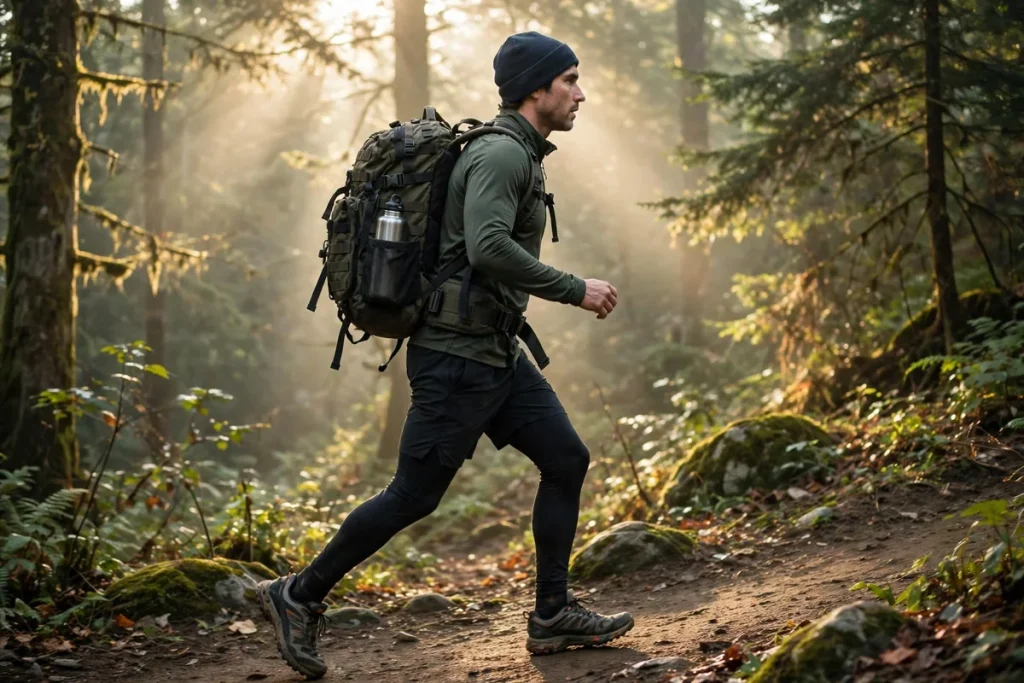
Rucking is brisk walking with a loaded pack, usually at 3–4 mph, with the weight carried on your back and hips. Running with a backpack is exactly what it sounds like: actually running while carrying weight. They look similar, but they load your body very differently.
When you run, each foot strike sends a force several times your body weight through your ankles, knees, hips, and lower back — and a heavy pack adds to every one of those impacts. That is why running with a heavy pack raises joint stress far more than rucking, and why weighted running is usually kept to short distances with light loads, if it is used at all.
The honest advice for most people: walk fast with the pack. You get most of the calorie burn (420–490 calories per hour at 155 lb, estimates) with far less joint stress. If you really want to run with a pack, keep it light — around 10% of body weight or less — stick to soft ground, keep the distance short, and only after building a solid base of weighted walking.
The benefits beyond calories
Calories are only part of the story. Rucking is a weight-bearing workout, so it builds strength endurance in your legs, hips, and core. It is cheap — any sturdy backpack and some weight will do — and it gets you outdoors, which makes it easier to stick with than a gym routine you dread.
How to start safely
Start lighter and shorter than you think you need to. Your fitness may be fine; it is your joints, feet, and skin that need time to adapt.
- Start at 10% of body weight — about 15 lb (7 kg) for a 155 lb person — for 20–30 minutes, two or three times a week.
- Progress gradually: add about 10% to your distance or your weight each week, but not both at once.
- Use a proper pack: a rucksack with a padded hip belt and a chest strap, weight packed high and close to your back.
- Pack the weight properly: use weight plates, sandbags, or books wrapped in a towel — loose, shifting weight throws you off balance.
- Stand tall: chest up, slight lean forward from the ankles, short steps, arms swinging naturally.
- Wear broken-in footwear: supportive walking shoes or light trail shoes, with blister-proof socks.
- Start flat: build your base on flat ground before adding hills, and save steep descents for later.
Safety: knees, back, and downhill
Most rucking injuries are overuse injuries: sore knees, an aching lower back, or blisters. All of them are easier to prevent than to fix.
- Knees: keep steps short, especially downhill, and avoid locking your knees on descents. On a steep hill, zigzag down or slow to a careful walk.
- Lower back: keep the load close to your spine and your hip belt snug so your hips carry the weight, not your shoulders. If you lean far forward to compensate, the pack is too heavy.
- Downhill caution: descents load your joints more than climbs do. Slow down, shorten your stride, and never run downhill with a pack.
- Feet: tape hotspots early, keep toenails trimmed, and stop to adjust a rubbing strap rather than limping on.
- Stop if you feel sharp pain: dull muscle soreness the next day is normal; sharp pain in a knee, shooting pain in your back, numbness, or a twisted ankle is not. Stop, unload, and rest. If pain persists for more than a few days, get it checked.
If you already have knee or back problems, a recent injury, or a heart condition — or if you are pregnant — check with a clinician before starting weighted walking.
The bottom line
Running with a backpack is best done as rucking: brisk walking with a loaded pack. For a 155 lb (70 kg) person, that burns an estimated 420–490 calories per hour — 6–7 METs × 70 kg — nearly double ordinary walking, with far less joint stress than running under load. Start at 10% of body weight for 20–30 minutes, progress slowly, and treat downhills with respect.
If rucking is part of a weight-loss plan, see our guide to how many steps it takes to lose a pound for the totals by body weight.
Frequently Asked Questions
How many calories does rucking burn per hour?
For a 155 lb (70 kg) person, rucking burns an estimated 420–490 calories per hour (6–7 METs × 70 kg). That compares with about 245 calories per hour walking (3.5 METs × 70 kg) and 630–700 running (9–10 METs × 70 kg). All figures are MET-based estimates, and your actual burn depends on pace, terrain, and pack weight.
Is running with a backpack bad for your knees?
Running with a heavy pack raises the impact forces on your knees, ankles, and lower back, so it carries more joint risk than rucking. Most people are better off walking briskly with the pack. If you want to run with a pack, keep it light (around 10% of body weight or less), use soft ground, and build up slowly.
How heavy should my rucking backpack be?
Start at about 10% of your body weight — roughly 15 lb (7 kg) for a 155 lb person — and build toward 15–20% over several weeks. At 70 kg, the estimated burn rises from about 420 calories per hour at 10% body weight to about 455 at 15% and 490 at 20%, using the MET method in this article.
How often should I ruck?
Two to three times a week is a good starting point, with rest days in between so your joints and muscles can adapt. Start with 20–30 minute sessions and add about 10% distance or weight per week, but not both at once.
Is rucking good for weight loss?
It can help, because it burns roughly twice as many calories as ordinary walking — about 420–490 calories per hour for a 155 lb person (estimates) — and it is easy to repeat several times a week. But weight loss still depends on your overall calorie balance, so pair rucking with sensible eating.