
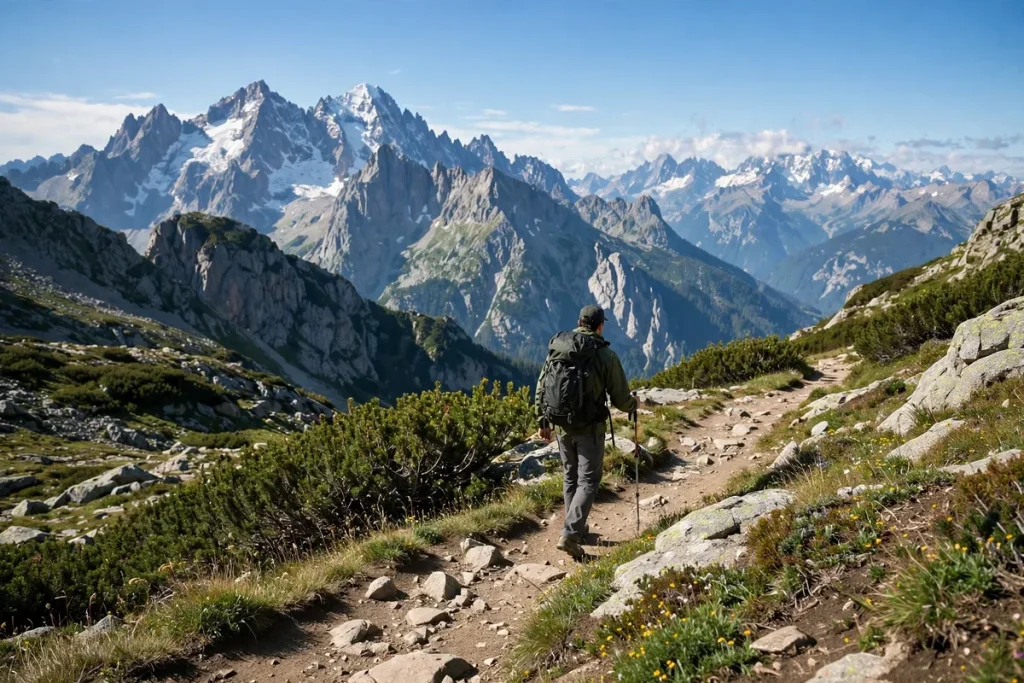
Use this hiking calorie calculator to estimate your burn from the four things that actually decide it — your weight, your pack, the climb and the ground under your boots. Most calculators ignore the pack and the slope; on a real trail those two can double the number.
Enter your details below and hit Calculate — your total burn and your hourly rate appear instantly.
Body weight:
Pack weight:
Hiking speed:
Trail grade: %
Terrain:
Duration: minutes
How This Calculator Works
This calculator runs on the Pandolf equation, developed from US Army research on how soldiers burn energy while carrying loads on foot. It is the standard scientific way to price walking with a load — a step beyond the flat-ground tables most calorie sites use — because it treats your hike as work against gravity and terrain, not just distance.
Here is what each of the four inputs does inside the equation:
- Body weight is the base cost. Most of the energy on a hike goes to moving you, so the equation starts with your weight and never leaves it. A heavier hiker burns more at the same pace — the same physics that makes a pickup thirstier than a sedan.
- Pack weight is the sneaky one. The pack term grows fast because the load is squared against your body weight — so each extra pound costs proportionally more the lighter you are. A 30 lb pack on a 120 lb hiker charges far more than the same pack on a 200 lb hiker.
- Trail grade is the silent budget-killer. Grade is multiplied against your speed and your total carried weight (body plus pack), which is why even a modest 5% climb can add roughly half again to your hourly burn without you going any faster.
- Terrain multiplies everything. A paved road is the baseline of 1.0; soft sand or off-trail brush carries a factor of 1.5 because every step costs more when the ground gives way beneath you or grabs at your boots.
The equation first computes your power output in watts, then converts it to calories for the time you enter. The number you get is a planning-grade estimate — useful for sizing up a route, packing food and comparing trails — not a laboratory measurement of your body on that day.
What the Slope Does
To feel how much the hill matters, take the same hiker — 154 lb, no pack, 3 mph on paved ground — and change nothing but the grade:
| Trail grade | Calories per hour |
|---|---|
| Flat (0%) | 252 |
| 5% grade | 393 |
| 10% grade | 534 |
Same legs, same speed — the hill alone more than doubles the burn.
Hiking vs Walking
On flat, smooth ground, hiking and brisk walking cost about the same per hour — your legs do not care what you call the outing. Hiking pulls ahead the moment the trail gets real: add a climb, a loaded pack and uneven ground, and the same hour can cost twice as much as a neighborhood stroll.
That is also what makes hiking such a forgiving exercise. You can dial the burn up or down by choosing flatter routes or lighter packs — no need to run or jump. If most of your miles are on flat paths, our walking calorie calculator covers that case, and the calories burned walking guide breaks down what different paces cost.
Frequently Asked Questions
How many calories does hiking burn per hour?
Roughly 250 to 550 for most hikers, depending on your weight, the slope, your pack and your pace. A flat walk sits near the low end; a steep climb with a loaded pack pushes the high end. The calculator above gives your number.
Does a heavier backpack burn more calories?
Yes — and the Pandolf pack term means the cost climbs faster than the pounds you add, because the load is squared against your body weight. Lightening your pack is one of the easiest ways to cut the effort of a hike.
Why do two calculators give different numbers?
Most generic calculators use flat-walking METs and ignore grade and pack weight entirely, so they undercount any real trail. This calculator prices the hill and the load, which is why its numbers can look higher — and more honest.
Is hiking good for weight loss?
Yes. It is joint-friendlier than running, easy to sustain for hours, and the burn scales with the hills you choose — you can turn the same trail system into an easy walk or a serious workout.
How accurate is the Pandolf equation?
It is a research-grade estimate built from military load-carriage studies — still an estimate. Fitness trackers vary too. Use it for planning hikes and comparing routes, not as lab truth for your body on a given day.
Now you know the number before you lace up. Run your planned route through the calculator, pack food to match, and let the hills do the work.