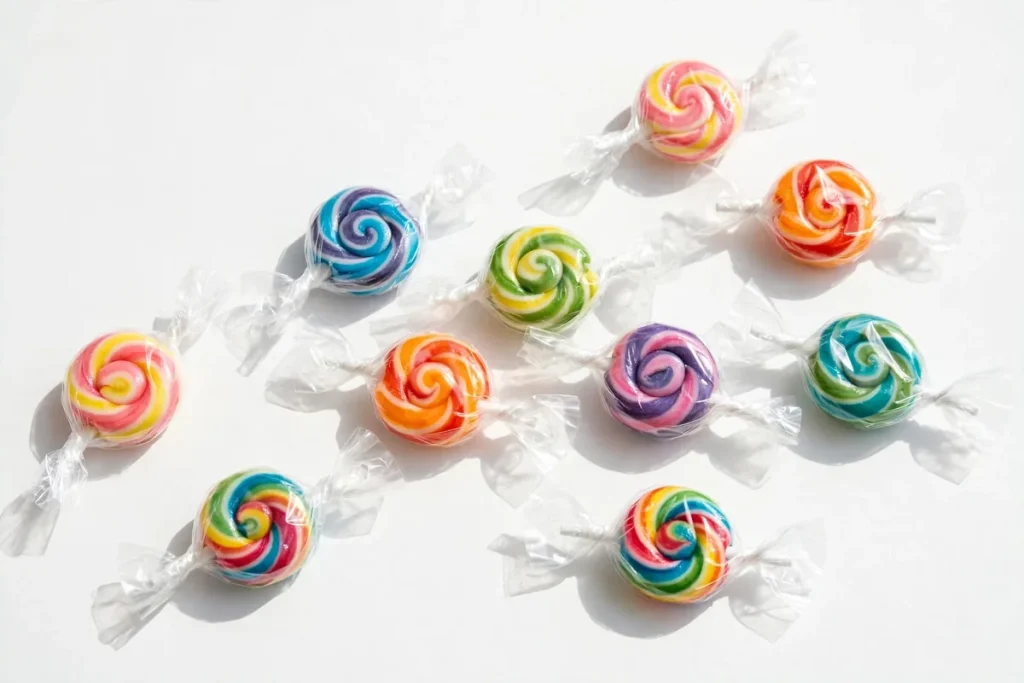

Dum dum calories are about 25 per pop. That is the whole answer in one line, and it is why Dum Dums keep showing up on lists of the lowest-calorie candies: a single mini lollipop is a complete little treat for roughly the calories of a single bite of most candy bars. But there is a catch hiding in plain sight on the label. The official serving is not one pop, it is two, and nobody who has ever reached into an office candy bowl has stopped at the serving size. So this article counts Dum Dums the honest way: per pop, per official serving, and by the handful, with the sugar math alongside.
A Dum Dum is Spangler’s mini lollipop, a small ball of hard candy on a paper stick that has been around since 1924. The Original Mix comes in 16 assorted flavors plus the famous mystery flavor, and the pops are free of the major allergens — no peanuts, tree nuts, milk, eggs, fish, shellfish, wheat, or gluten — which is a big part of why they are the default candy-bowl and parade candy across America. They are small on purpose. A standard lollipop is roughly twice the candy, and that size difference is the entire Dum Dum story.
That smallness cuts both ways, and this article keeps both sides in view. One pop is genuinely a light treat. Ten pops is a different story, and it is a story that happens quietly, because each pop is individually wrapped and feels like nothing. The numbers below come from the current label values, and every stacked total is labeled as computed from the per-pop figure, so you can check the math yourself.
Dum Dum Calories & Sugar
Start with the label. The official serving of Dum Dums is 2 pops (about 13 g), and that serving carries 50 calories and 9 g of sugar. Divide by two and you get the per-pop number the whole article runs on: about 25 calories and about 4.5 g of sugar per pop. Those are the current label values, and they are the reason the per-pop figure is written with an “about” — flavors vary a touch, but the pop is the pop. Some bulk packaging lists 3 pops (15 g) = 60 kcal — labels vary slightly by pack size; per pop stays about 20–25.
| Amount | Calories | Sugar |
|---|---|---|
| 1 pop | About 25 | About 4.5 g |
| Official serving (2 pops) | 50 | 9 g |
| 5 pops | 125 (computed) | About 22.5 g (computed) |
| 10 pops | 250 (computed) | About 45 g (computed) |
The sugar deserves its own line, because it is the part people underestimate. One pop’s 4.5 g of sugar is about 1.1 teaspoons — a small spoonful, easy to picture. Two pops, the official serving, is about 2.3 teaspoons. None of that is dramatic on its own. But sugar is sugar, and a Dum Dum is essentially flavored sugar on a stick: the ingredient list is sugar and corn syrup first, with citric acid, flavor, and color doing the rest. There is no protein, no fiber, and no fat to slow it down. That is not a scolding; it is just the plain description of what a hard candy is.
So the honest framing is this: a Dum Dum is a fine occasional treat precisely because it is small, and it is still pure sugar, so “small” is doing all the work. The moment the portion grows, the treat stops being small. That is where the next two sections come in.
How Dum Dums Compare
Put a Dum Dum next to the other candies in the bowl and it holds up well. A standard lollipop runs about 60 calories, roughly double a Dum Dum, because it is roughly double the candy. A Blow Pop, with its gum center, runs about 80. And the closest comparison, a Jolly Rancher hard candy piece, runs about 23 calories — a touch lighter than a Dum Dum, because it is a slightly smaller piece of candy without a stick. Those non-Dum-Dum figures are typical values, not label values, but the ranking is stable: Dum Dums sit at the light end of the lollipop world. See the full breakdown in our jolly rancher calories article.
| Candy | Calories each |
|---|---|
| Dum Dum | About 25 |
| Jolly Rancher hard candy piece | About 23 (typical) |
| Standard lollipop | About 60 (typical) |
| Blow Pop (with gum center) | About 80 (typical) |
The Jolly Rancher comparison deserves one honest footnote. A Jolly Rancher piece is lighter, but it is also smaller and stick-free, so people tend to eat them by the handful straight from the bag — and five Jolly Rancher pieces run about 115 calories, basically the same as four Dum Dums at 100. Per-piece rankings matter less than how many you eat, and that is true of every candy on this table.
The Blow Pop comparison is simpler. The gum center is the extra: you get a lollipop plus a piece of gum, and the calories show it. If you love the gum, that is a fair trade. If you just want a sweet taste, the plain mini pop gives you the flavor for less than half the calories.
The Portion-Control Case (and Its Limit)
Here is the real case for Dum Dums, and it is a good one. A mini lollipop is a complete treat with a built-in stopping point. You unwrap one, it lasts several minutes because hard candy dissolves slowly, and when it is gone, the treat is over. There is no open bag to keep reaching into, no half-eaten bar on the desk. For people who want a sweet taste after lunch, or something to hand out at Halloween without handing out a full-size candy bar, that built-in portion is genuinely useful. It is the smallest mainstream lollipop for a reason: the size is the feature.
The limit is just as real. Individually wrapped does not mean individually eaten. A handful from the office bowl is easily five pops, and five pops are 125 calories (computed) — no longer a tiny treat, just a regular candy serving wearing small clothes. Ten pops, the kind of handful that disappears during a long phone call or a movie, is 250 calories (computed) with about 45 g of sugar (computed). At that point the portion-control advantage has fully evaporated: you have eaten the equivalent of about four standard lollipops, one mini at a time.
The habit math makes the same point over a longer horizon. One pop a day for a year is about 9,125 calories (computed: 25 × 365), which works out to roughly 2.5 lb of body weight if nothing else changes. That is not a warning about a single daily pop — as habits go, one small lollipop a day is about as light as a candy habit gets. It is a warning about the handful-a-day version of the same habit, which triples the number without ever feeling like a bigger treat.
If you like Dum Dums and want to keep them small, a few habits help. Take one pop, not the bag, and put the bag away. Eat it slowly — hard candy rewards patience, and a pop that lasts ten minutes satisfies more than one crunched in thirty seconds. And keep count honestly: the wrappers pile up, which is actually a useful thing, because the pile is the portion record. When the pile reaches five, you have had 125 calories, whether it felt like it or not.
One more honest note: Dum Dums are allergy-friendly and simple — sugar, corn syrup, citric acid, malic acid, salt, artificial flavor, and color — but simple here means sugar, not nutrition. There is nothing in a Dum Dum your body needs. That is fine for a treat. It just means the pop earns its place on flavor and portion, not on health.
Frequently Asked Questions
How many calories are in a Dum Dum?
About 25 calories per pop.
How many calories are in the official serving of Dum Dums?
50 calories. The official label serving is 2 pops (about 13 g).
How much sugar is in a Dum Dum?
About 4.5 g of sugar per pop, or 9 g in the official 2-pop serving — about 1.1 teaspoons per pop.
Are Dum Dums a low-calorie candy?
Per piece, yes — about 25 calories makes them one of the lightest lollipops. But they are still essentially sugar, so the calories stack with every extra pop.
Dum Dum or Jolly Rancher — which has fewer calories?
A Jolly Rancher piece is a touch lower, at about 23 calories, and the Dum Dum at about 25 is close behind. The gap is small, so how many you eat matters more than which one you pick.
So the short answer stays short: about 25 calories per pop, 50 for the official two-pop serving, and about 4.5 g of sugar in each pop. Dum Dums are one of the lightest candies you can eat, and the only way they stop being light is the way every small candy stops being light — one more, and then one more. Count the pops and the pop stays small.
A last practical note for the candy bowl at home or the office: Dum Dums are the rare candy where the small size is genuinely on your side, because one pop is a complete sweet moment rather than the start of a bag. Keep the bowl small, keep it out of arm’s reach, and let the wrapper count be the judge. Twenty-five calories is a treat; two hundred and fifty is a decision. The pop does not change — only the number does.