
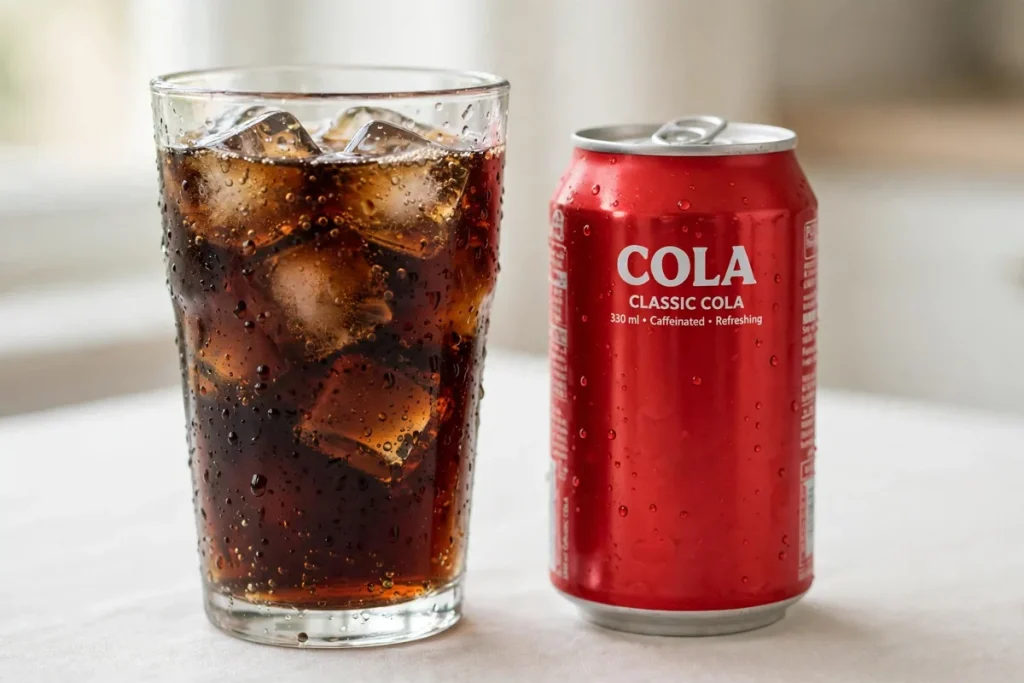

The nutrition label on Coca Cola is one of the shortest in the soda aisle, and that is exactly why it is worth reading carefully. A 12 oz can of Coca-Cola Original has 140 calories and 39 g of sugar, and every gram of that sugar is added sugar. There is no fat, no protein, and barely any sodium to complicate the picture: this is sweetened, caffeinated, flavored water, and the label says so plainly. In this guide we walk through the label line by line, every size from the 7.5 oz mini can to the 2-liter bottle, what 39 g of sugar actually looks like in teaspoons, and how Coke stacks up against Coke Zero, Diet Coke, and Mountain Dew. Every number below comes from Coca-Cola’s own official product nutrition, read live from coca-cola.com.
The Coca-Cola Label, Line by Line
Coca-Cola’s official label for a 12 oz can is refreshingly honest about what you are drinking. There are only a handful of lines, and none of them hide anything. Here it is, exactly as the company publishes it:
| Label line (12 oz can) | Amount |
|---|---|
| Calories | 140 |
| Total fat | 0 g |
| Sodium | 45 mg |
| Total carbohydrate | 39 g |
| Total sugars | 39 g |
| Includes added sugars | 39 g |
| Protein | 0 g |
| Caffeine | 34 mg |
The line that matters most is the added-sugars line. Many foods contain some natural sugar, which makes their labels harder to read. Coke has no such excuse: all 39 g are added, which means all 140 calories in the can come from sugar. The sodium, at 45 mg, is barely 2% of the 2,300 mg daily limit, so salt is simply not part of the Coke story. And with zero fat and zero protein, there is nothing in the can to slow the sugar down or keep you full.
Per 100 ml, the label works out to about 42 kcal and 10.6 g of sugar. The official panel for the 20 oz bottle tells the same story at a bigger scale: 240 calories, 65 g of carbohydrate, 65 g of sugars (all added), 75 mg of sodium, and 0 g of fat and protein. The ingredient list is short too: carbonated water, high fructose corn syrup, caramel color, phosphoric acid, natural flavors, and caffeine. That is the whole drink.
Calories by Size
Coke comes in more sizes than most people realize, and the calories scale almost perfectly with the ounces. Here is every common size, using the official per-serving values where Coca-Cola publishes them and calculated values elsewhere:
| Size | Calories | Sugar |
|---|---|---|
| Mini can, 7.5 oz | about 90 (calculated) | about 22 g (calculated) |
| Can, 12 oz | 140 (official) | 39 g (official) |
| Bottle, 16 oz | about 190 (calculated) | about 52 g (calculated) |
| Bottle, 20 oz | 240 (official) | 65 g (official) |
| Bottle, 1 liter | about 420 (calculated) | about 106 g (calculated) |
| Bottle, 2 liter (whole bottle) | about 840 (calculated) | about 212 g (calculated) |
Two traps hide in this table. The first is the 20 oz bottle: it is sold as a single drink, but at 240 calories it is nearly two cans in one container, and most people finish it in one sitting. The second is the 2-liter bottle. Its 840 calories look shocking, but that is the whole bottle — about six cans’ worth. A normal 12 oz glass poured from a 2-liter is still 140 calories, exactly the same as a can. The bottle is only a problem if you drink it like a single serving, which, to be fair, is easier than anyone admits at a party.
The mini can deserves a mention as the quiet hero of this table. At about 90 calories it saves roughly 50 calories against a regular can while keeping the full Coke taste and ritual. If you love real Coke and want to keep drinking it, the mini can is the simplest portion control Coca-Cola itself sells.
The Sugar: 39 Grams in Real Terms
Grams do not mean much until you can see them. A teaspoon of sugar weighs about 4 g, so the 39 g in a can of Coke is about 10 teaspoons of sugar, stirred into a single drink. Pour it into a glass and look at it: that is roughly a quarter of a cup of sugar, gone in the time it takes to eat a burger.
Now compare that with the daily added-sugar guidance most health authorities cite: about 25 g a day for women and 36 g for men. One can of Coke passes both figures on its own, before any food, dessert, or second drink enters the day. Two cans land at 78 g, which is about 20 teaspoons. None of this makes an occasional Coke a disaster — it is 140 calories, and a day of eating has room for treats — but it does explain why Coke belongs in the treat column rather than the thirst-quencher column. Water quenches thirst for zero calories; Coke is dessert that happens to be liquid.
One more honest note: the sugar in American Coke is high fructose corn syrup, while Coca-Cola Mexico uses cane sugar. Fans argue about the taste, but the nutrition is effectively identical — both are sugar, both land at the same calories per ounce, and neither is a healthier choice in any meaningful sense.
Coke vs Coke Zero vs Diet Coke
Coca-Cola Zero Sugar is the closest thing to a free version of the real drink. It has 0 calories and 0 g of sugar in every size, and Coca-Cola’s own product page describes it as a zero-sugar, zero-calorie soda. It is sweetened with a blend of aspartame and acesulfame potassium, chosen to mimic the original taste as closely as possible, and a 12 oz serving still carries about 34 mg of caffeine, the same as regular Coke. If the goal is keeping the Coke experience while dropping the sugar, Zero Sugar is the obvious pick.
Diet Coke is a different drink with its own fan base. It also has 0 calories, sweetened with aspartame, but it was never designed to taste like original Coke — it has a lighter, sharper flavor that its fans prefer and its critics do not. Diet Coke is also caffeinated. Between the two zero-calorie options, the choice is purely about taste: Zero Sugar if you want the closest match to a classic Coke, Diet Coke if you like its distinct lighter profile.
How Coke Compares to Other Sodas
Coke is not the sweetest soda on the shelf, which surprises people who assume it is. A 12 oz mountain dew calories check shows Mountain Dew at 170 calories and 46 g of sugar per can, so Coke runs 30 calories and 7 g of sugar lighter per can. That is a real difference, but it is a difference between two sugary drinks, not between a sugary drink and a light one. A can of Coke still carries more added sugar than the full daily guidance for most adults.
The fair way to rank sodas is by what is actually in the can: calories, sugar, and nothing else to redeem them. On that ranking, water and sparkling water sit at zero, zero-sugar sodas sit at zero with sweeteners instead, and every full-sugar soda — Coke included — lands in the same neighborhood of 140 to 170 calories per can. Coke’s advantage over the sweetest sodas is real but small; its advantage over water is nonexistent.
So what is the sensible way to drink Coke? Treat it like dessert: enjoy a can, or better a mini can, with a meal you are already enjoying, rather than sipping it all afternoon as a thirst drink. If you drink it daily, switching even half of those cans to Coke Zero Sugar removes about 490 calories and 273 g of sugar a week without giving up the ritual. And if you love the real thing, the label itself gives you the portion strategy: the smaller the container, the smaller the damage, and the mini can exists for exactly that reason.
Frequently Asked Questions
How many calories in a can of Coca-Cola?
A 12 oz can of Coca-Cola Original has 140 calories, all of them from sugar, according to Coca-Cola’s official nutrition.
How much sugar in a can of Coca-Cola?
39 grams, which is about 10 teaspoons of sugar. All 39 grams are added sugar.
How many calories in Coca-Cola Zero?
Zero. Coca-Cola Zero Sugar has 0 calories and 0 grams of sugar in every size.
How many calories in a 2-liter bottle of Coca-Cola?
About 840 calories for the whole bottle, calculated from the label. A normal 12 oz glass poured from it is still 140 calories.
Does Coke have caffeine?
Yes. A 12 oz can of Coca-Cola Original has 34 mg of caffeine, and Coca-Cola Zero Sugar has about the same per 12 oz.
The nutrition label on Coca Cola is short, honest, and easy to act on: 140 calories and 39 g of sugar per can, zero calories in the Zero Sugar version, and a mini can that cuts the damage nearly in half. Read the size before you drink it, and the label has already done most of the work for you.
One last label line worth a second look is the caffeine. At 34 mg per 12 oz can, Coke carries roughly a third of the caffeine in a typical brewed coffee, which is why an afternoon Coke rarely keeps anyone awake the way coffee does — but it is also why the caffeine adds up quietly if you drink several cans a day. Four cans land at 136 mg, past a full cup of coffee, with 560 calories of sugar alongside it.



Pingback: Calorie in Diet Coke — 0 Calories, Label Facts and Coke Zero Compared