If you have ever wondered about calories for olive garden breadsticks, here is the short answer: one breadstick has about 130 calories, according to Olive Garden’s own current nutrition document. The basket is the hard part, not the stick. One stick is a modest side, but the basket keeps coming back, and that is where the numbers quietly stack up.
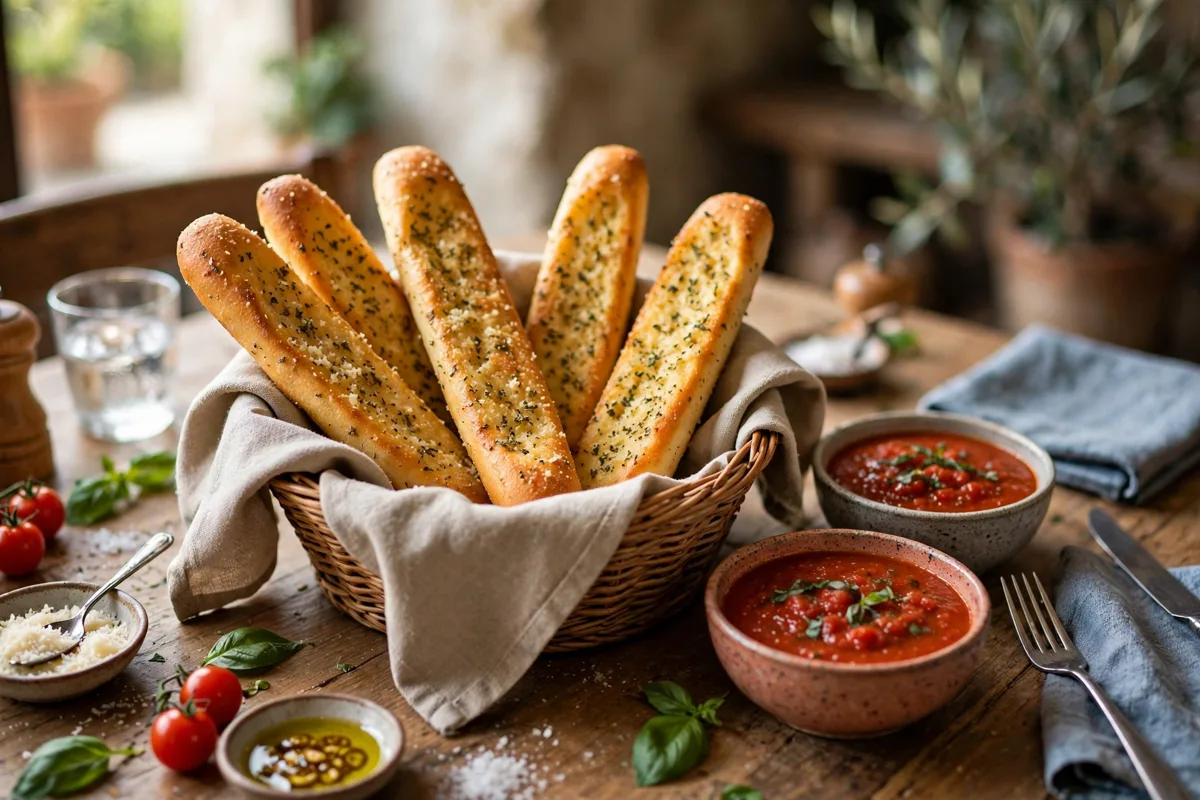
Every number in this article comes from Olive Garden’s official nutrition information, the nutrition document published on olivegarden.com and read live for this article. One honest wrinkle up front: the document lists the breadstick as plain, with no garlic topping, at 130 calories and 280 mg of sodium. The sticks that land on your table are brushed with garlic butter, and Olive Garden does not publish a separate garlic-topped figure, so treat 130 as the documented baseline. The served stick likely runs a touch higher, but the gap is small, and every calculation below uses the official 130-calorie figure so the math stays checkable.
That honesty matters because breadsticks are the rare restaurant freebie that people genuinely lose track of. They arrive before you have ordered, they are warm, and nobody counts them the way they count an entree. This guide counts them for you: one stick, the basket, the dips, and the sodium catch.
One Breadstick: Full Nutrition
Here is the full official panel for a single breadstick, exactly as Olive Garden’s nutrition document lists it. It is a simple food, and the table shows it: mostly carbohydrate, a little protein, almost no fat, and a noticeable amount of sodium.
| Nutrient | Per breadstick |
|---|---|
| Calories | 130 |
| Total fat | 1 g |
| Saturated fat | 0 g |
| Trans fat | 0 g |
| Cholesterol | 0 mg |
| Sodium | 280 mg |
| Total carbohydrate | 25 g |
| Dietary fiber | 1 g |
| Sugars | 2 g |
| Protein | 4 g |
In plain terms, a breadstick is refined white bread in stick form: 25 g of carbohydrate, 4 g of protein, and just 1 g of fat. That is why it feels light. It is not an empty food, exactly, but it is not a filling one either, with only 1 g of fiber. The number that deserves more attention than the calories is the sodium, at 280 mg per stick, which we will come back to below.
The Basket Math
One breadstick is 130 calories. The trouble is that nobody eats one breadstick at Olive Garden on purpose and stops. The basket arrives, it gets refilled, and the sticks disappear while you are reading the menu and talking. Here is what the count actually looks like, using the official per-stick figure, with sodium alongside because the two climb together.
| Breadsticks | Calories | Sodium |
|---|---|---|
| 1 stick | 130 | 280 mg |
| 2 sticks | 260 | 560 mg |
| 3 sticks | 390 | 840 mg |
| 6 sticks | 780 | 1,680 mg |
Three sticks, the number most people reach without thinking, cost 390 calories. That is roughly the size of a small meal, eaten before the real meal starts. Six sticks, which is easy across a long dinner with refills, cost 780 calories, more than many Olive Garden entrees add on their own. And remember, this is the per-person count that matters. A basket shared by a table of four is not four sticks each unless everyone stops at one, which almost nobody does.
The dine-in reality is worth stating plainly: with an entree, the basket is refilled, and the refills are the point. Olive Garden built its reputation partly on that basket. Enjoying it is fine. Counting it is what keeps a 130-calorie side from becoming a 780-calorie prelude.
Dipping Sauces
Breadsticks on their own are a modest side. Dipping sauces are where the basket can quietly double. Olive Garden’s nutrition document lists three dipping sauces, and the gap between the lightest and the richest is enormous. All three values below are the regular dipping-sauce servings from the official document, not the large cups, which roughly double each figure.
| Dipping sauce (regular serving) | Calories | Fat | Sodium |
|---|---|---|---|
| Marinara dipping sauce | 70 | 4.5 g | 640 mg |
| Five Cheese Marinara dipping sauce | 200 | 17 g | 650 mg |
| Alfredo dipping sauce | 440 | 43 g | 600 mg |
The gap between the lightest and the richest dip is 370 calories. Marinara, at 70 calories, barely changes the breadstick math: one stick plus a marinara dip is 200 calories. Five Cheese Marinara, at 200, is a real addition. Alfredo, at 440 calories with 43 g of fat, costs more than three breadsticks on its own. A stick dragged through alfredo is 570 calories, which is a small meal wearing a breadstick costume.
Note too that the dips are saltier than the sticks. A marinara dipping cup carries 640 mg of sodium, more than twice the breadstick itself, and the five cheese version carries 650 mg. So a stick with marinara is 200 calories but 920 mg of sodium, a combination that matters more than the calories for anyone watching salt. If you love a dip, marinara is the clear winner on both counts, and dipping lightly instead of dunking keeps the sauce where it belongs: as a flavor, not a second course.
The Sodium Catch
If calories are the breadstick’s friendly number, sodium is its catch. One stick carries 280 mg of sodium, about 12 percent of the 2,300 mg daily limit that nutrition labels use as a reference. That sounds manageable until the basket math kicks in: three sticks carry 840 mg, more than a third of the day, and five sticks carry 1,400 mg, well past half the daily limit, before a single bite of entree. Add a marinara dipping cup at 640 mg and a three-stick, one-dip snack is already at 1,480 mg of sodium.
This is the honest version of the sodium story. Older write-ups sometimes quoted a higher per-stick sodium figure, but Olive Garden’s current nutrition document lists 280 mg, and that is the figure used throughout this article. It is lower than the old number, but it is still a lot for a side that most people do not count at all. Anyone keeping an eye on blood pressure should treat the basket as a sodium event first and a calorie event second, and our guide to low sodium foods is a useful companion read for the rest of the meal.
Breadsticks vs Other Breads
How does a breadstick stack up against ordinary bread? A thick slice of sourdough runs about 120 calories, so a single Olive Garden breadstick at 130 calories sits just above it, nearly a tie. The difference is not the calories. It is the context: nobody is handed a bottomless basket of sourdough at the table, and sourdough does not arrive warm and free before dinner. Per bite, the breadstick is ordinary bread. Per visit, the basket is what makes it different.
Compared with the white sandwich bread most people keep at home, the story is similar. A breadstick is a little bigger and a little richer than a single slice, and it carries more sodium per piece at 280 mg. The takeaway is not that breadsticks are uniquely bad. It is that they are uniquely easy to overeat, because they are served warm, free, and refilled. For the full sourdough comparison, see our sourdough bread calories guide.
How to Keep It in Check
The basket is not the enemy. It is warm bread, served free, at a restaurant built for lingering meals. The trick is deciding before it lands. Pick your number in advance, two sticks is a generous choice at 260 calories, and treat anything beyond it as a conscious second helping rather than background snacking. When the refill arrives, it is easier to wave it off if you have already decided.
Dip lightly rather than dunking. A thin smear of marinara gives you the flavor for a fraction of the sauce cup, and marinara at 70 calories is the dip that keeps the whole basket honest. If alfredo is the temptation, remember the math: one stick with alfredo is 570 calories, so enjoy it as the indulgence it is, not as a free extra.
Finally, pair the basket with the lighter half of the menu instead of a third stick. Olive Garden’s salad and soups are the natural partners for breadsticks, and they fill the same warm, savory gap with far more volume per calorie. One stick, a salad, and a soup is a genuinely satisfying lunch. Four sticks and a refill is a meal you did not mean to eat, and the difference between the two is nothing but a decision made before the basket arrives.
So the bottom line is simple: one Olive Garden breadstick is 130 calories and 280 mg of sodium, from Olive Garden’s own official nutrition document. Two sticks are 260 calories. Three are 390. The basket is only a problem when nobody is counting, and now you are.
Frequently Asked Questions
How many calories in one Olive Garden breadstick?
About 130 calories, according to Olive Garden’s official nutrition document, which lists the breadstick without garlic topping. The basket sticks you are served are brushed with garlic butter, so the served stick may run a touch higher.
How many calories in 3 breadsticks?
About 390 calories, which is 3 times the official 130 calories per stick, before any dipping sauce.
Are the breadsticks really unlimited?
With a dine-in entree, servers bring the basket to your table and refill it, which is why Olive Garden’s breadsticks are famous as unlimited. The refill is the reason to decide your number before the basket lands.
How many calories does the marinara dip add?
About 70 calories for a regular marinara dipping sauce cup, with 640 mg of sodium. The alfredo dipping sauce is far richer at 440 calories.
How much sodium in one breadstick?
About 280 mg of sodium per breadstick, from Olive Garden’s official nutrition document. Three sticks carry 840 mg, and five sticks pass half of the 2,300 mg daily limit at 1,400 mg.