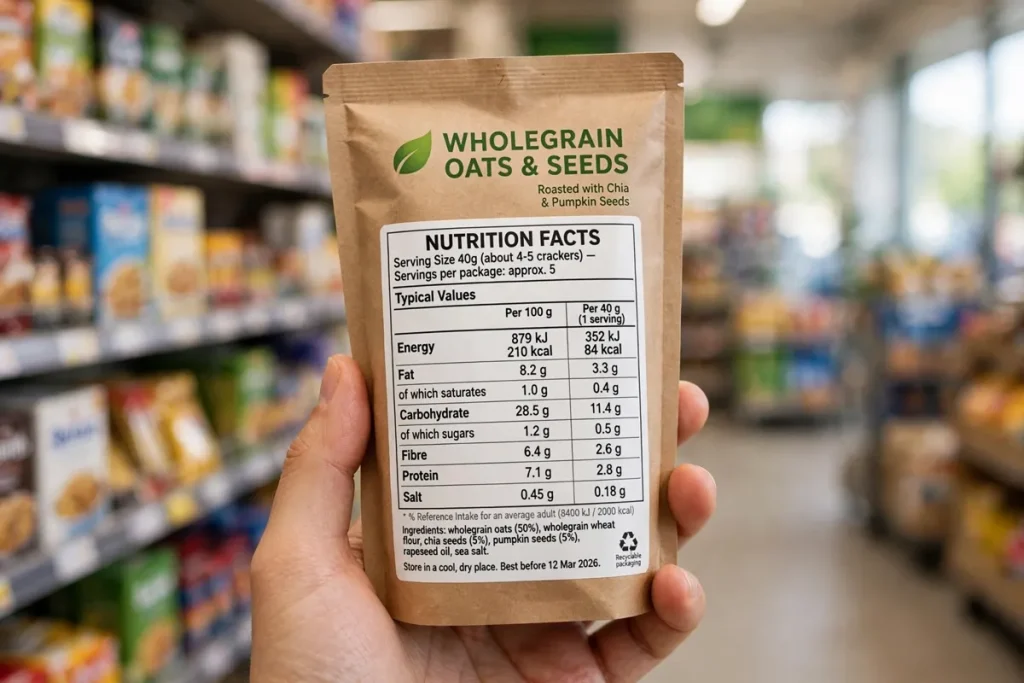

If you have ever flipped between a food label that says “calories,” an app that says “kcal,” and a European package that says “kJ,” you have probably wondered whether these are all the same thing — or whether one of them is secretly bigger than the others. The calorie vs kilocalorie question is one of the most common points of confusion in nutrition, and it trips up beginners and seasoned dieters alike.
The confusion is understandable, because the words look almost identical and are used almost interchangeably — sometimes correctly, sometimes not. A recipe blog writes “120 calories per serving,” a fitness tracker reports “450 kcal burned,” and a science article mentions “small calories,” and you are left wondering if you need a physics degree to plan lunch.
The Short Answer
Here is the short answer: on anything you eat, “Calories” and “kilocalories” are the SAME thing. One kilocalorie (kcal) equals 1,000 small calories (cal). So when a label says 250 Calories, it means 250 kcal — which is 250,000 small calories.
The small calorie is a physics unit: the energy needed to heat 1 gram of water by 1°C. The kilocalorie is the energy needed to heat 1 kilogram of water by 1°C — exactly 1,000 times more. Food energy is so large that only the kilo version is practical. Nobody wants to read “this sandwich has 450,000 calories” on a wrapper.
Why Two Names Exist
In the 1800s, scientists needed a small, precise unit of heat energy for physics and chemistry experiments, so they defined the calorie: the energy that raises one gram of water by one degree Celsius. It was perfect for laboratory work, where the amounts of energy being measured were tiny.
Then food science arrived, and researchers started measuring the energy in actual meals. The numbers were roughly a thousand times bigger than anything the little laboratory calorie was built for, so writers reached for the obvious fix: the kilocalorie — one thousand small calories — as the working unit for food. Suddenly the numbers were manageable again: a sandwich at 450 kcal instead of 450,000 cal.
Then came the shortcut. In everyday food writing, especially American food writing, “kilocalorie” was a mouthful, so it was shortened to “Calorie” with a capital C. The capital letter was supposed to be the signal: big C, big unit. A capital-C Calorie meant a kilocalorie; a small-c calorie meant the tiny physics unit.
The trouble is that in print, on screens, and inside apps, the capital letter often gets lost. Headlines write “calories,” apps write “cal,” and nobody can tell which unit is meant anymore. That one lost capital letter is the entire source of the confusion. Scientists, tired of the mess, mostly sidestep it by using kilojoules (kJ), the metric system’s standard unit of energy — which is why kJ shows up on labels across much of the world.
Calorie vs Kilocalorie: The One Table You Need
If you memorize nothing else from this article, memorize these four lines. They resolve every calorie vs kilocalorie question you will ever meet:
| Unit | Equals |
|---|---|
| 1 kcal | 1,000 cal |
| 1 food Calorie (capital C) | 1 kcal |
| 1 kcal | 4.184 kJ (round it to 4.2 for mental maths) |
| 1 kJ | about 0.24 kcal |
And here is the conversion table you will actually use when reading labels from other countries — kcal to kJ:
| kcal | kJ |
|---|---|
| 100 kcal | 418 kJ |
| 250 kcal | 1,046 kJ |
| 500 kcal | 2,092 kJ |
| 1,000 kcal | 4,184 kJ |
| 2,000 kcal | 8,368 kJ |
A quick note on that last row: the standard 2,000 kcal reference day appears as 8,400 kJ on EU labels — rounded for simplicity, since regulators prefer a clean number.
For everyday mental maths, keep it simple: to turn kcal into kJ, multiply by 4 (and add a little); to turn kJ into kcal, divide by 4 (and subtract a little). It is close enough for any real-world decision, from comparing two cereal boxes to logging an imported snack.
Labels Around the World
Travel abroad or pick up an imported snack, and the energy numbers can suddenly look wrong. They are not wrong — they are just labeled the local way. Here is how the big regions do it:
United States. Labels say “Calories,” and they mean kcal — the same unit you have always used. Kilojoules are usually absent entirely. An American label reading 250 Calories is 250 kcal, full stop. No conversion needed, no capital-letter detective work required.
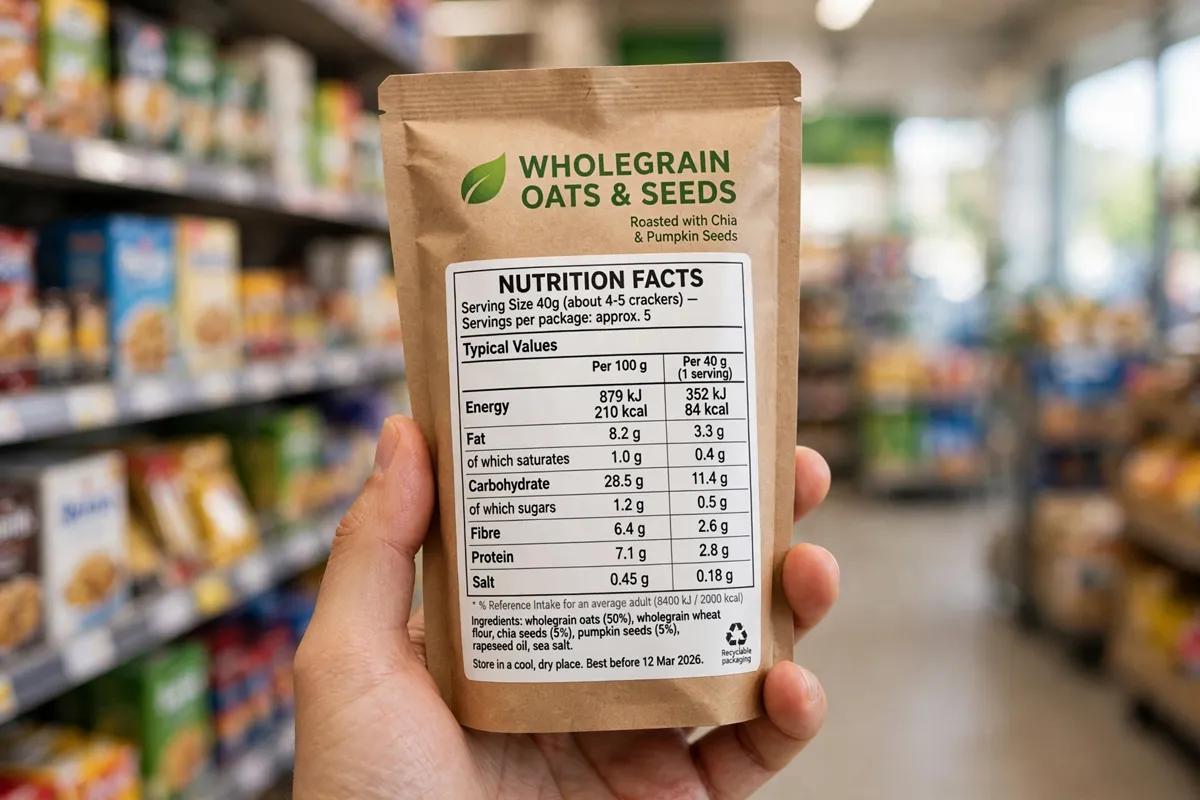
European Union. Here the kilojoule is the legal standard, so kJ is listed FIRST and kcal second. Our featured photo shows exactly this: a nutrition panel reading 879 kJ / 210 kcal per 100 g. A quick check that the label is honest: 210 × 4.184 = 878.64, which rounds to 879 kJ. Correct — both numbers describe the same energy.
United Kingdom. The kcal figure is the familiar number for most British shoppers, but kJ is printed alongside it in the EU style, so you get both — handy once you know they are two expressions of the same thing.
Australia and New Zealand. The kilojoule is the main unit, and this is where travellers get the biggest shock. A product that would say 200 Calories back home can read 836 kJ on an Australian shelf. The familiar “2,000 calorie diet” becomes an “8,700 kJ” average-adult day — the number looks enormous, but it is the same energy wearing different clothes.
Practical rule of thumb: if the number looks huge — in the thousands — you are reading kilojoules. Divide by 4.2 and you are back to the kcal number you know.
Once you have converted the number, treat it exactly like the calorie count you would see at home. A 210 kcal label from Berlin feeds the same body the same way a 210 Calorie label from Boston does — the unit changed on the package, not the food inside. That is the real payoff of the 4.2 rule: it turns every foreign label back into the numbers you already know how to use, whether you are logging a meal, comparing two snacks, or deciding if dessert fits your day.
Where Else the Confusion Bites
The calorie vs kilocalorie mix-up does not stay on food labels. It pops up in at least four everyday places:
- Fitness machines and watches. A treadmill that proudly reports you burned “300 calories” means 300 kcal — always, in food terms. The same goes for your smartwatch, your cycling app, and the cardio readout at the gym. Nobody in the fitness industry counts small calories; the numbers would be absurd.
- Science articles. Every so often you will read that a food “contains 45,000 calories.” The writer is using small calories — usually quoting a chemistry or physics source. That is 45 kcal: roughly an apple, not a feast. Divide by 1,000 and the mystery disappears.
- Recipes from other countries. A recipe from Australia, New Zealand, or much of Europe may list energy in kJ. Convert before you log the meal, or you will record a 2,000 kJ lunch as 2,000 kcal — more than four times too much — and wonder why your numbers never add up.
- Apps. Most calorie-counting apps count in kilocalories but display them as “cal” or “Cal.” The numbers are still kilocalories, so log them and compare them exactly as you would kcal. The label on the screen is sloppy; the arithmetic underneath is fine.
Does It Change How Much You Should Eat?
No — not by a single bite. Your daily target is the same number whether it is called calories or kcal. If your maintenance level is 2,200 kcal, it is 2,200 “Calories” on a US label and about 9,200 kJ on an Australian one. The unit changed; your body did not.
This is the point where the naming confusion actually costs people real progress. Someone reads that a diet plan allows “1,800 calories,” then opens an app counting “1,800 kcal,” and wonders whether they are supposed to eat a thousand times more or a thousand times less. Neither — the numbers are identical, the food is identical, and the result is identical. Once you see that, a whole category of diet anxiety evaporates.
If you do not know your own number yet, start with our guide to how many calories should I eat daily. It walks you through finding your maintenance calories step by step — and everything you have learned in this article still applies once you have that number in hand.
The Bottom Line
The difference between a calorie and a kilocalorie is a naming accident of history, not two kinds of energy. A small calorie heats a gram of water; a kilocalorie heats a kilogram; and a food “Calorie” is just the kilocalorie wearing a friendlier name. On anything you eat, read “Calories” as kcal — and you will always be right.
Is a calorie the same as a kilocalorie?
On food, yes. A food “Calorie” (capital C) is exactly 1 kilocalorie. In physics, 1 kcal = 1,000 small calories — the word is the same, the context decides the size.
How many kilojoules are in 1 kcal?
4.184 kJ — round it to 4.2 for quick maths. So 500 kcal is about 2,092 kJ, and a 2,000 kcal day is about 8,368 kJ.
Why do European labels show kJ first?
Because the kilojoule is the EU’s standard energy unit. The kcal figure is printed second — both numbers describe the same energy, so use whichever you count in.
My treadmill says I burned 300 calories — is that kcal?
Yes. Exercise machines, watches and apps all report kilocalories; they just write “cal” or “Calories” for short. 300 on the treadmill = 300 kcal of food energy.
How many calories are in a kilojoule?
About 0.24 kcal. Divide any kJ figure by roughly 4.2 to turn it into the kcal number you are used to.