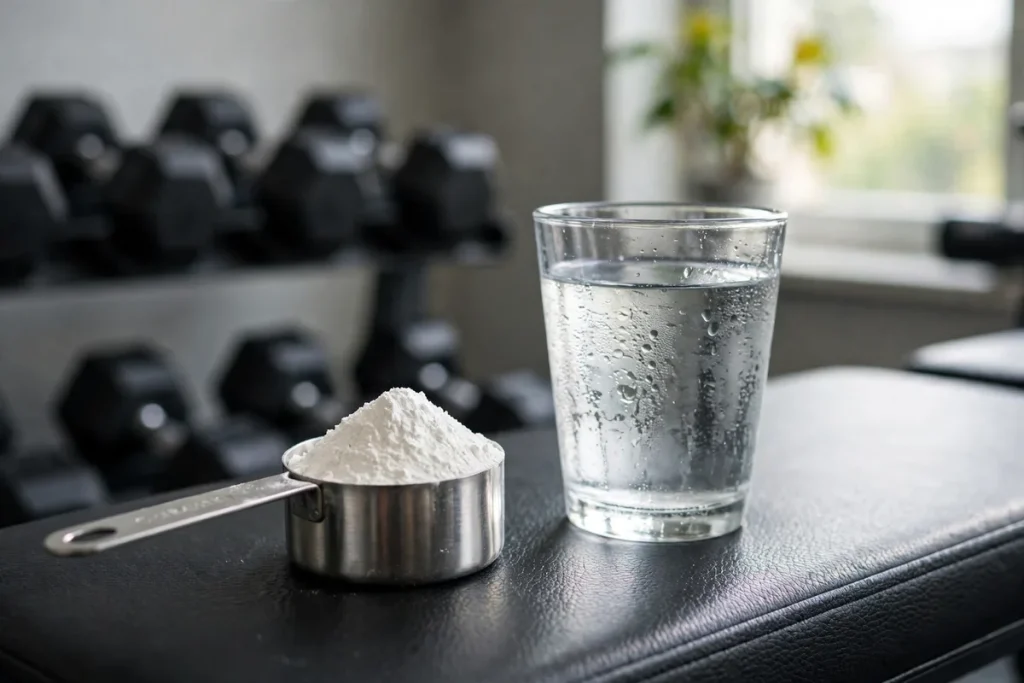

Quick answer: does creatine have calories? Effectively, no. Pure creatine monohydrate powder has so few that labels list about 0-10 kcal per 5 g serving — and most list zero. That is because creatine is not burned for fuel the way food is: it is stored in your muscles, where it helps recycle quick energy for short, hard efforts like lifting and sprinting.
The calories people worry about sneak in through flavored and sugar-loaded creatine products — gummies and “transport” formulas can carry more calories than a cookie. Below: the numbers by product type, the fasting question, what the early 1-2 kg on the scale really is, and the simple dosage that works.
Calories by Product Type
Not all creatine products are the same product. The powder itself is nearly calorie-free; what brands add around it decides the damage. Typical label values:
| Product | Serving | Calories (about) |
| Unflavored creatine monohydrate powder | 5 g | 0-10 kcal |
| Flavored creatine powder | 5-8 g | 10-35 kcal (sweeteners and flavors) |
| Creatine gummies | 2-4 gummies | 30-100 kcal (mostly sugar) |
| Creatine “transport” / cell-volumizer formulas | 1 big scoop | 120-180 kcal (30-40 g of dextrose or sugar doing the damage) |
| Ready-to-drink creatine | 1 bottle | 10-30 kcal |
Why does the same powder show 0 kcal on one tub and 10 on another? Label rounding. Manufacturers may list anything under about 5 kcal per serving as zero, and some brands round a flavored serving up instead. Either way, the creatine itself contributes almost nothing — the gap between 0 and 35 kcal in the flavored row is the flavor system, not the creatine.
The pattern is simple: the closer a product is to plain powder, the closer it is to zero. A transport formula is not really a creatine product with calories — it is a sugar drink with creatine in it, built on an outdated idea that you need a big insulin spike to absorb creatine (you don’t; normal meals handle it). If you track calories, unflavored monohydrate stirred into water or a shake is the entire answer: about as close to free as a supplement gets.
What Creatine Actually Is
Creatine is a compound your body makes in small amounts and stores mostly in muscle — about 95% of it lives there. Its job is energy recycling. During a heavy lift or a short sprint, your muscles burn through their fastest fuel, ATP, within seconds. Stored creatine (as phosphocreatine) donates a piece of itself to rebuild that ATP on the spot, buying you another rep or two before fatigue wins. That is why it pairs naturally with strength training — and tracking progress with a tool like our bench press max calculator is how you see the extra reps turn into bigger numbers.
Creatine is among the most researched supplements in sports science, with hundreds of studies over several decades — and two plain facts are worth stating clearly. First, it is not a steroid and not a hormone; it is closer to a nutrient. Second, you already eat it: meat and fish provide roughly 1 g of creatine a day on a typical diet, and your liver and kidneys make about another gram. A supplement simply tops the tank up from about two-thirds full to full.
That explains who notices creatine most: people who eat little or no meat — vegetarians and vegans — start with lower muscle stores, so they tend to feel the biggest effect. Heavy meat-eaters start nearer to full and may notice less. Either way, expect a modest effect: a rep or two more on your top sets, compounding over months — not a transformation.
Does Creatine Break a Fast?
The honest answer depends on why you fast. For unflavored powder at 0-10 kcal, the practical answer is no: that is too little energy to meaningfully interrupt a fast done for calorie control, appetite management or general metabolic health. It contains no sugar and no meaningful protein — nothing that asks your body to switch into fed mode in any real sense. Most people who fast for weight management take it without a second thought.
The strict answer: some fasting purists avoid everything except water on principle, because their goal is a completely clean fast — and by that rule anything else “breaks” it. If that is your framework, creatine simply waits until your eating window; timing within the day does not matter (more below).
Either way, the flavored and sweetened versions are a different story. Gummies at 30-100 kcal and transport formulas at 120-180 kcal genuinely break a fast, full stop — that is a snack, not a supplement scoop. When in doubt, plain powder in water is the version that removes the question entirely.
Will Creatine Make You Gain Weight?
On the scale, yes — briefly, and in the best possible place. When you start creatine, your muscles store more of it, and creatine draws water into the muscle cells along with it. Most people see the scale rise about 1-2 kg (2-4 lb) in the first 1-2 weeks. That is water inside your muscles — they may even look slightly fuller — not fat around your waist.
Fat runs on a different ledger. Creatine carries almost no calories, so it cannot create fat by itself; fat gain still requires eating more calories than you burn, day after day. If growing is actually your goal, that surplus is a separate, deliberate plan — our lean bulk guide walks through running one slowly and on purpose. What creatine does is help you train a little harder inside whatever plan you are already on: it supports muscle gain on a surplus and helps protect performance on a deficit.
Two practical notes. The water levels off after the first couple of weeks — a one-time step up, not endless creep. And if you stop taking creatine, the extra water quietly leaves over a few weeks and the scale drifts back down; nothing is permanent except the muscle you built while training on it.
How Much and When
The standard dose is 3-5 g of creatine monohydrate once a day — one small scoop or a heaped teaspoon. That is the dose nearly all the research uses, and more does not work better once your muscles are saturated; extra just gets excreted. There is an optional faster route: a loading week of about 20 g a day, split into four 5 g servings, fills your stores in under a week. Skip the loading and plain daily use gets you to the same place in about 3-4 weeks. Same destination — your choice of road.
Timing is flexible — consistency beats the clock. Take it whenever you will actually remember it: with breakfast, after training, in an evening shake. It dissolves best in warm liquid and is effectively tasteless in a shake; like protein powder, it disappears into oats, Greek yogurt or a smoothie without changing the flavor. If plain water is your vehicle, stir well and drink it promptly — monohydrate settles to the bottom of the glass if it sits.
Missed a day? Nothing resets — your stores drain over weeks, not hours, so there is no need to double up or to “cycle” off; cycling is an early-days myth, and long-term daily use at normal doses is the studied pattern. One buying note: monohydrate is the researched, cheapest form by far. Fancier versions (HCL, buffered, liquid) cost more without better evidence.
Myths and Who Should Be Careful
Kidney damage. The biggest myth, so first: in healthy people taking normal doses, studies consistently find no harm to kidney function — and creatine has been followed for years in some trials. Damaged kidneys are a different situation (see the caution below), but the supplement does not appear to damage healthy ones.
Hair loss. This one traces back to a single small 2009 study in rugby players, which found creatine raised a testosterone-related hormone marker (DHT). The study never measured hair loss, the hormone finding has not been confirmed since, and no study has shown creatine making hair fall out. Honest verdict: not impossible, but the evidence is weak.
Cramping and dehydration. The locker-room warning is not supported at normal doses. Studies of athletes training in the heat find no extra cramping in creatine users who drink normally. The sensible rule is the same as for any hard training: drink to thirst, a little more in the heat.
Bloating. When people feel bloated on creatine, it is usually the loading phase (a week of large doses pulling water in fast) or a sugar-loaded formula confusing the picture. Starting at plain 3-5 g a day skips most of it. A few people notice mild stomach discomfort at first; taking the dose with food usually settles that within days.
Who should talk to a clinician first: anyone with kidney disease, anyone pregnant or breastfeeding, and teenagers. Not because harm has been shown — but because those are the groups with the least safety data, and least data means a conversation first. One warning for everyone: creatine can raise creatinine readings on routine blood tests without any kidney damage at all, simply because more creatine in the body means more of its breakdown product in the blood. Tell your doctor you take it, so a harmless lab flag does not start an unnecessary investigation. This article is general information, not medical advice.
Frequently Asked Questions
Does creatine have calories?
Pure creatine monohydrate powder effectively has none — labels list about 0-10 kcal per 5 g serving. The calories in creatine products come from what is added to them: flavor systems, sweeteners and, in gummies and transport formulas, real sugar. Plain powder in water is the near-zero option.
How many calories are in creatine gummies?
About 30-100 kcal per serving of 2-4 gummies, and nearly all of it is sugar — the gummy format needs sugar to exist. That can cost as much as a small candy snack every day, which is why powder wins for anyone watching calories.
Does creatine break a fast?
Unflavored powder, practically no — at 0-10 kcal it does not meaningfully affect a fast done for calorie or appetite reasons. Sweetened versions do break it, because they carry real sugar. Strict purists who avoid everything but water will skip it; match the rule to your reason for fasting.
Can creatine make you fat?
No. Creatine carries almost no calories, so it cannot add fat by itself. Expect the scale to rise about 1-2 kg (2-4 lb) in the first 1-2 weeks — that is water pulled into your muscle cells, not fat. Fat gain still requires eating more calories than you burn.
Do I need to load creatine?
No. A loading week of about 20 g a day fills your stores in days, but a simple 3-5 g a day saturates your muscles in about 3-4 weeks. Loading is only a speed option, not a requirement — and skipping it avoids most loading-phase bloating.