
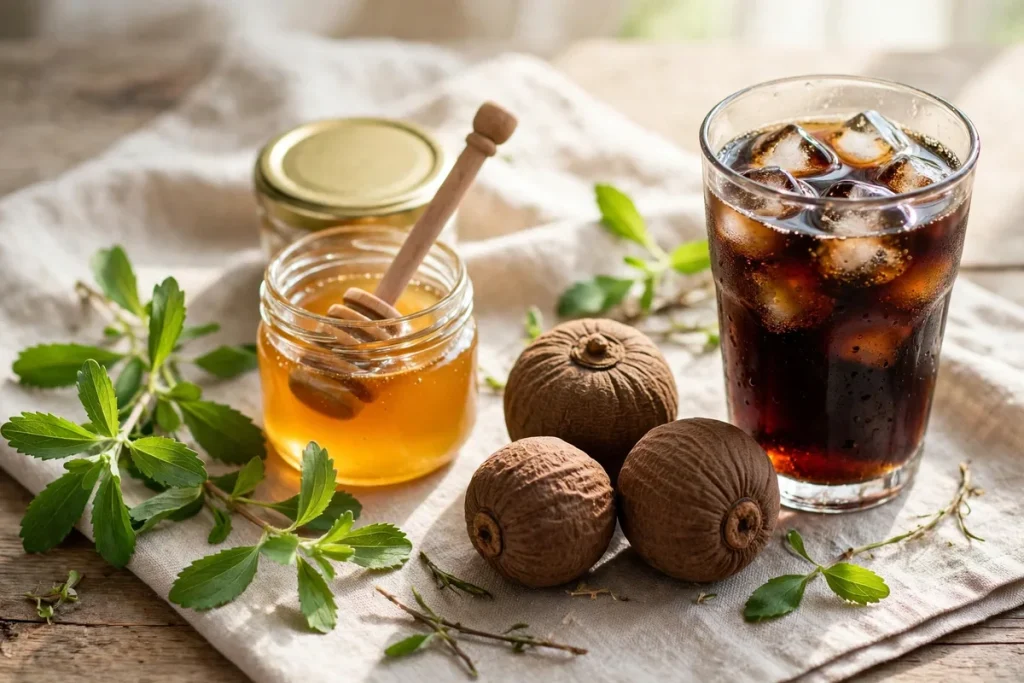

Quick answer: the healthiest sweetener, on the measures that matter most, is a tie between stevia and monk fruit — zero calories, no effect on blood sugar, and a long history of use. At the other end, honey, agave and maple syrup sit barely above plain table sugar, whatever their labels promise. Everything else falls somewhere in between, and this guide ranks all of them honestly.
One honest frame before the ranking: no sweetener is a health food. Sweeteners do not add nutrition worth chasing; the best ones simply do the least metabolic damage while making food taste sweet. So “healthiest” here means three practical things — few or no calories, little or no rise in blood sugar, and a safety record that holds up at the amounts real people actually use. Taste and usefulness matter too, because a sweetener you hate is one you will abandon by Friday.
The Ranking
Here is the full ranking, from the least metabolic downside to the baseline everything is trying to replace. Calories are per teaspoon, because that is the unit people actually spoon into coffee and tea. The notes give you the honest catch for each one — there is always a catch, whether it is taste, price, your stomach, or your dog.
| Sweetener | Calories per tsp (about) | The honest note |
|---|---|---|
| Stevia (leaf extract) | 0 | Plant-derived, no glucose effect; some people taste a bitter or licorice-like edge. |
| Monk fruit extract | 0 | A similar profile to stevia; usually blended with erythritol to give it bulk. |
| Allulose | ~2 | About 0.4 kcal per gram, so a teaspoon lands around 2 kcal. Tastes and bakes closest to sugar; newer and pricier. |
| Erythritol | ~1 | A sugar alcohol, mostly unabsorbed; cooling taste; large amounts can upset stomachs. A 2023 study linked high blood erythritol levels to heart events in already-sick patients — that is association, not proof that eating it causes harm; moderation is the sane read. |
| Xylitol | ~10 | A sugar alcohol with a genuine dental benefit — it is used in sugar-free gum for a reason. KEEP AWAY FROM DOGS: xylitol is highly toxic to them. |
| Sucralose | 0 | Artificial, heat-stable and very sweet; long approved and widely used in drinks and baking blends. |
| Aspartame | ~0 per serving | It has 4 kcal per gram but is used in milligrams, so a serving is effectively zero. The most studied sweetener of all: in 2023 IARC called it possibly carcinogenic (category 2B, the same tier as pickled vegetables), while JECFA kept the safe daily limit unchanged — normal diet-soda amounts sit far below that limit. |
| Honey | ~21 | Trace nutrients too small to matter; to your blood sugar it is sugar. See how many calories in a teaspoon of sugar for the full spoon math. |
| Agave / maple syrup | ~17-21 | Marketed as natural. Agave is higher in fructose than table sugar; maple brings a little flavor and mineral content. Treat both as sugar. |
| Table sugar | ~16 | The baseline everything else replaces — cheap, reliable, and pure added sugar. |
The zero-calorie leaders. Stevia and monk fruit sit on top because they clear every bar at once: no calories, no blood-sugar response, and decades of use. Their weakness is flavor, not safety. Stevia can read bitter or licorice-like to some palates, especially in larger amounts, and monk fruit is rarely sold pure — it is usually blended with erythritol so it measures like sugar. If you sweeten coffee or tea daily, these two are the default answer, and trying a couple of brands is worth it, because the extracts genuinely taste different from each other.
The interesting middle. Allulose is the newcomer with the best résumé: it is a naturally occurring rare sugar that behaves like sugar in a recipe — browning, bulk and all — at roughly a tenth of the calories, with minimal blood-sugar impact. Its downsides are price and availability. Erythritol, the old sugar-alcohol workhorse, is nearly free of calories because most of it passes through unabsorbed; that same property is why a large serving can mean a rumbly stomach, and why the 2023 blood-level study deserves a calm read rather than panic — it measured erythritol in the blood of already-sick patients, much of which the body makes itself, and did not prove that eating it causes harm. Xylitol earns its place for a different reason: it actively helps teeth. Just store it like the dog hazard it is.
The lab-made pair. Sucralose and aspartame are the artificial sweeteners most people actually consume, mostly through drinks. Sucralose is heat-stable, which is why it shows up in baking blends and protein products. Aspartame carries the loudest headlines and the deepest research file — the 2023 IARC classification put it in category 2B, “possibly carcinogenic”, a tier it shares with pickled vegetables and aloe vera extract, based on hazard rather than real-world risk at normal doses. In the same week, JECFA reviewed the same evidence and left its acceptable daily intake unchanged. A person would need to drink diet soda far beyond normal habits, every day, to approach that limit.
The natural syrups, honestly. Honey, agave and maple syrup lose this ranking not because they are dangerous, but because the body treats them as sugar while the marketing treats them as medicine. Honey’s antioxidants and enzymes are present in traces too small to change anything at a spoonful a day — and a teaspoon of honey actually carries more calories than a teaspoon of sugar, about 21 vs 16, because it is denser. Agave’s low glycemic reputation comes from being very high in fructose, which is not the advantage it sounds like. Enjoy these for flavor, in spoon-measured amounts, and they are fine. Just do not let the word “natural” upgrade them in your head.
What’s the Sweetener in Coke Zero?
Coke Zero Sugar is sweetened with a blend of two artificial sweeteners: aspartame and acesulfame potassium, usually listed as Ace-K. Together they sweeten the drink to roughly the level of the original Coca-Cola while adding 0 g of sugar and roughly 0-1 kcal per can — the can is, for tracking purposes, free. Neither sweetener appears on the front of the can, which is why this question gets asked so often; both are there on the ingredients list.
Diet Coke is a different recipe: it uses aspartame alone, in a different flavor base, which is exactly why the two drinks taste noticeably different despite both being “diet colas”. The blend in Coke Zero is deliberate formulation, not redundancy — aspartame and Ace-K mask each other’s off-notes, so the combination tastes smoother and closer to sugar than either does on its own. Many drink makers use the same trick.
Two practical questions follow. Does Coke Zero break a fast? With no calories and no sugar, it does not meaningfully interrupt a fast done for calorie or appetite reasons. Does it spike insulin? For most people, no meaningful insulin response is expected from a drink with no calories and no carbohydrate — sweet taste alone has not been shown to move insulin in a way that matters. Appetite is the fuzzier part: studies on whether diet drinks make people hungrier afterward are mixed, with results going both ways. The drink itself adds nothing to your calorie count; what you eat alongside it is your own story. If you are stocking a kitchen around this way of drinking, our sugar-free grocery list covers the drinks aisle in full.
Which One Should You Use?
For coffee and tea: stevia or monk fruit drops. They dissolve instantly, need no bulk, and a bottle lasts for months. If the taste edge bothers you, a half-and-half approach — half your usual sugar, half stevia — is a painless bridge that most people stop noticing within a week or two.
For baking: allulose, or an erythritol-based 1:1 blend. Baking is where pure stevia and monk fruit fail, because sugar does structural work in a recipe — it holds moisture, builds texture and browns. Allulose does most of that work at a fraction of the calories; erythritol blends measure cup-for-cup like sugar, though erythritol can recrystallize as things cool and leaves a slight cooling sensation. Expect about 90% of the result, not a perfect replica.
For cooking sauces: honestly, a pinch of real sugar, measured. A teaspoon of sugar is 16 kcal spread across a whole pan of sauce — the teaspoon-of-sugar numbers show how small that really is — and it balances acidity in a way substitute-sweetened sauces often fail to match. Spending 16 known calories beats serving a sauce nobody enjoys.
The deeper rule. The best sweetener strategy is not a product at all: it is gradually wanting less sweet. Taste buds recalibrate. Cut the sweetness in your coffee by a quarter and hold it there for two weeks, and the old amount will start to taste syrupy — the same food, a new baseline. That shift quietly covers everything: less sugar in drinks, desserts that satisfy at smaller portions, and no dependence on any substitute. Use the ranking above to pick your bridge, then let your palate do the long-term work.
Safety in One Paragraph
Regulators including the FDA and EFSA set acceptable daily intakes for approved sweeteners with large safety margins built in — typically a hundredfold below the highest dose that showed no effect in studies — and typical real-world use lands far below those limits, which is why the overall evidence supports these sweeteners as safe at normal amounts. That said, individual tolerance is a perfectly fair personal reason to avoid any of them: sugar alcohols genuinely upset some stomachs, some people are sensitive to particular tastes or aftertastes, and a few people find certain sweeteners trigger their migraines. For children and during pregnancy, the sensible line is moderation and food-first — sweeteners are not needed, occasional use within the limits is not a known concern, and specifics belong in a conversation with your own clinician rather than a website, including this one.
Frequently Asked Questions
What is the healthiest sweetener?
Stevia and monk fruit share the top spot: zero calories, no blood-sugar effect, plant-derived, and with a long history of use. Allulose is the closest challenger if you need something that bakes like sugar.
What sweetener is in Coke Zero?
A blend of aspartame and acesulfame potassium (Ace-K). The two mask each other’s aftertaste, which is why Coke Zero tastes smoother — and different — from Diet Coke, which uses aspartame alone.
Is honey healthier than sugar?
Barely on paper, and not meaningfully in the body. Honey’s trace nutrients are too small to matter at spoonful amounts, its blood-sugar effect is sugar-like, and it even has more calories per teaspoon — about 21 vs 16 for sugar.
Are artificial sweeteners safe?
Within the daily limits set by regulators such as the FDA and EFSA — which typical use stays far below — the evidence supports safety. The 2023 aspartame headlines did not change those limits; JECFA reviewed the evidence and kept its acceptable intake unchanged.
Which sweetener is best for baking?
Allulose, or an erythritol blend made for 1:1 replacement. Sugar does structural work in baking — bulk, moisture and browning — and pure stevia or monk fruit cannot provide it on their own.


Pingback: Is MiO Bad for You? Ingredients, Sweeteners & The Honest Verdict