
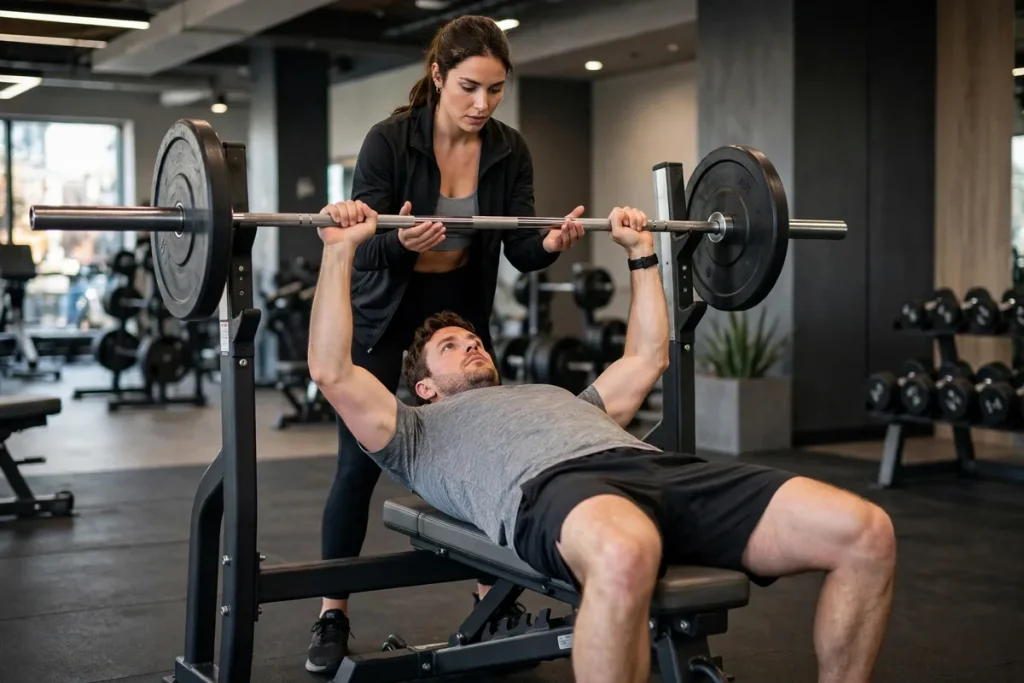
Your one-rep max (1RM) is the most weight you can bench press for a single clean rep — and you do not need to attempt it to know it. Enter a weight you lifted and how many reps you completed below, and this calculator estimates your 1RM with the Epley formula, then lays out your training weights at every percentage from 95% down to 60%. The same math works for the squat and deadlift too, so one tool covers your whole barbell program.
Weight lifted
Reps completed (1-15)
How Much Does the Bar Weigh?
Every bench press total includes the bar — always. A standard Olympic barbell weighs 45 lb (20 kg), and it counts toward your total whether you think about it or not. When someone says they bench 225, they mean the bar plus four 45 lb plates in total — not 225 lb of plates.
Not every bar is a standard Olympic bar, though. A women’s Olympic bar weighs 35 lb (15 kg) and has a thinner grip that suits smaller hands. The short, 1-inch bars sold with home gym sets usually run about 15-25 lb, and they vary from set to set — weigh yours on a bathroom scale if you train at home and want honest numbers. A Smith machine bar is counterbalanced, so it often effectively weighs only 15-25 lb even though the bar itself is heavier; most machines print the effective starting weight on a label on the frame, so check before you log the lift.
The rule for your total is simple: total lifted = bar + plates on BOTH sides. Because one side is easy to undercount, here are the classic gym loads built on a 45 lb bar:
| Total weight | Bar | Plates per side |
|---|---|---|
| 95 lb | 45 lb | one 25 |
| 135 lb | 45 lb | one 45 |
| 185 lb | 45 lb | 45 + 25 |
| 225 lb | 45 lb | 45 + 45 |
| 275 lb | 45 lb | 45 + 45 + 25 |
| 315 lb | 45 lb | 45 + 45 + 45 (three plates) |
If you train in kilos, the same logic applies with a 20 kg bar: the bar is never free weight you get to ignore. It is the first 45 lb (or 20 kg) of every single lift you log.
How Accurate Is a 1RM Estimate?
The Epley formula used here — weight × (1 + reps ÷ 30) — is the most widely used one-rep max estimator in strength training, and for the right inputs it is genuinely good. Estimates calculated from hard sets of 2-10 reps typically land within roughly ±5% of a lifter’s true tested max.
The estimate drifts as the reps climb. Beyond about 10-12 reps, muscular endurance and pain tolerance start to matter more than pure strength, and the formulas tend to overshoot: a set of 15 usually predicts a higher max than the lifter can actually press. Treat a high-rep estimate as an optimistic guide, and whenever you can, feed the calculator a set from the 3-8 rep range instead.
A worked example makes the limit concrete. Bench 185 lb for 8 clean reps and Epley estimates a max of about 234 lb. Bench the same 185 lb for 12 reps and the estimate jumps to about 259 lb — yet most lifters who can grind out 12 reps at 185 cannot actually press 259 lb for one. That gap is why many coaches program from a training max set at 90-95% of the estimate: it builds the formula’s optimism into your working weights and leaves room for good days and bad days.
It also pays to refresh your input regularly. Test a hard but clean set every few weeks, run the new numbers, and your percentage table updates with your strength. And remember that the rebuilding happens between sessions, not during them: food and sleep do the repair work, and most lifters progress best with a solid daily protein target — work yours out with our protein calculator.
Test Your Max Safely (or Don’t)
Here is the good news first: you never need a true one-rep max to train well. Percentage-based programs run perfectly happily off an estimate, and most experienced lifters build strength for months at a time without a single all-out attempt. The calculator above exists precisely so the gym math never forces your hand.
If you do decide to test, treat it like a skill, not a dare. Warm up in small jumps — the empty bar, then roughly 50%, 70%, 85% and 92-95% of your expected max for a few crisp reps each — and rest several minutes before the heaviest attempts. Always use a spotter, or set safety arms just below chest height, and never test a max alone with a loaded bar over your face and throat. Stop at a technical max: the heaviest rep you can finish with clean form. A grinding rep your spotter had to rescue is not a number worth programming from, and it is certainly not worth an injury. If you are still new to lifting, skip max testing for your first few months entirely and build the base first — our beginner workout plan is a sensible place to start.
The Same Calculator for Deadlift and Squat
Although this page wears a bench press name tag, the Epley math is lift-agnostic — it only ever sees a weight and a rep count. Enter a deadlift set (say, 315 lb for 6 reps) or a squat set in exactly the same way and you will get that lift’s estimated max and percentage table. That is true of every formula-based deadlift calculator and squat calculator online: underneath, they all run the same equations you will find here.
One caution: leverage and technique differ between lifts, and the deadlift in particular often performs differently across rep ranges than the bench. Use each lift’s own recent sets as its input rather than borrowing numbers from one lift to predict another.
Two technique notes will keep your estimates honest. For the squat, only count sets that reach at least parallel — a half squat inflates the input and produces a max you cannot hit at proper depth. For the deadlift, avoid bounced touch-and-go reps when you test a set; dead-stop reps, reset between each one, give the formula a cleaner input and produce an estimate that tracks your real pulling strength far better across the weeks.
Frequently Asked Questions
How do I calculate my bench press max without maxing out?
Lift a challenging weight for reps, then apply the Epley formula: weight × (1 + reps ÷ 30). For example, 225 lb for 5 reps gives 225 × 1.167, which is about 263 lb. Enter your set in the calculator above and it does the math instantly.
How much does a bench press bar weigh?
A standard Olympic barbell weighs 45 lb (20 kg), and it always counts toward your total. A women’s Olympic bar is 35 lb (15 kg), and home gym bars are lighter and vary by set.
Is the estimate accurate?
Within about ±5% when it is calculated from a hard set of 2-10 reps. Estimates from sets above 10-12 reps are less reliable, because endurance starts to outweigh strength.
What is a good bench press max?
As a rough guide, pressing 1× your body weight is a solid intermediate milestone for men, and about 0.65-0.75× body weight for women. Progress against your own previous numbers matters more than any chart.
Can I use this as a deadlift calculator?
Yes. The formula does not care which lift you performed — enter a deadlift or squat weight and reps, and you get that lift’s estimated max and training percentages.