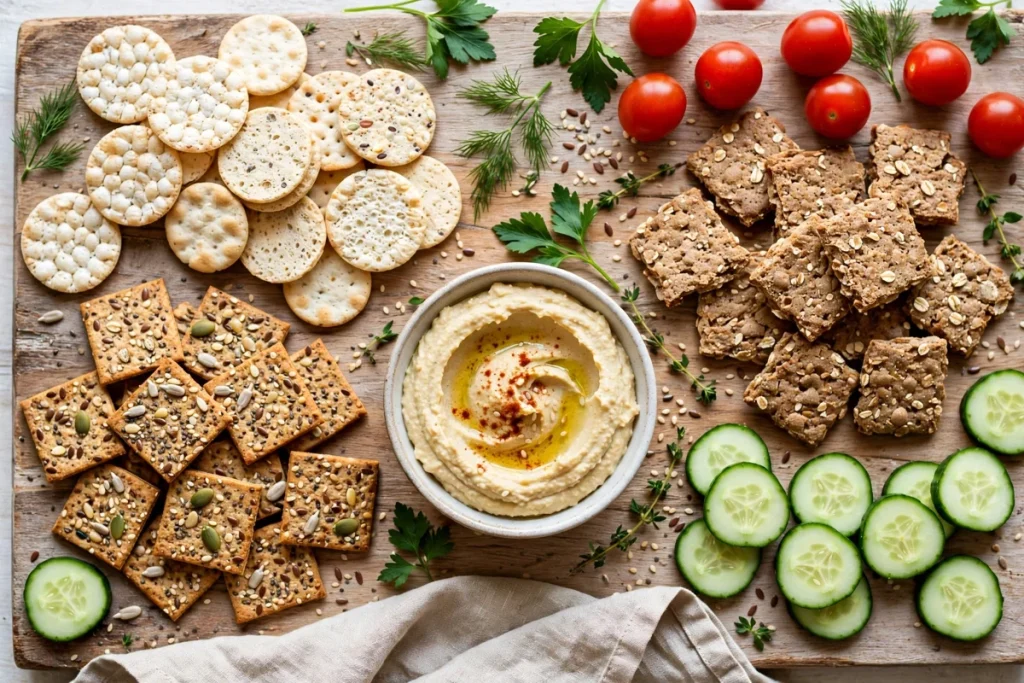

Vegan crackers have quietly moved from the health-food aisle to the mainstream snack shelf. They promise the same crunch as regular crackers without any animal-derived ingredients, but their calories vary more than most shoppers expect. A seeded whole-grain cracker can be a genuinely filling snack, while a light rice cracker can disappear in a handful of bites and leave you hungry again within the hour. This guide breaks down how many calories vegan crackers really contain, how to tell whether a cracker is truly vegan, which brands and types are worth buying, and what to pair them with for a snack that actually keeps you full.
Quick answer: Most vegan crackers run about 120–140 calories per 1 oz (28 g) serving — roughly a small handful, or anywhere from 6 to 17 crackers depending on how thick and dense they are. Seeded and nut-based crackers tend to sit at the higher end of that range, while thin water-style crackers sit at the lower end. The exact number always depends on the brand and the serving size printed on the pack, so check the label rather than guessing from the cracker count alone.
How to tell a cracker is truly vegan
Not every cracker without meat or eggs in the name is vegan. Crackers are one of the easiest places for hidden animal ingredients to show up, because dairy and honey are cheap ways to add flavor and browning. The good news is that a 30-second label check usually settles it. These are the ingredients to look for:
- Whey and milk powder: the two most common hidden dairy ingredients in crackers. If either appears in the ingredients, the cracker is not vegan.
- Cheese and butter: obvious in flavored varieties such as cheese crackers, but butter can also appear in plain-looking butter-style crackers.
- Honey: shows up in some “natural,” graham-style, and honey wheat crackers. It is easy to miss because it sounds wholesome.
- Egg: less common, but some enriched and glazed crackers use egg wash or egg whites.
- Casein and lactose: both are milk-derived, so either one rules a cracker out.
Then there is the line that confuses almost everyone: “may contain milk.” That note is a cross-contact warning for allergy purposes. It means the cracker is made on shared equipment with milk products, not that milk is an ingredient. A cracker can be made without any animal ingredients and still carry this note. Strict vegans sometimes avoid these products, but for most people eating plant-based, the ingredient list is what matters most. Also check the allergen statement at the end of the ingredients: if it says “Contains: milk,” the cracker is not vegan, whatever the front of the pack claims. And remember that flavors matter — a plain cracker can be fully vegan while its cheese or sour cream flavored sibling from the same brand is not, so check each variety separately.
The simplest shortcut is a certified vegan logo or a clear “vegan” statement on the pack. “Plant-based” on packaging usually means the same thing, but it is not regulated as strictly as a vegan certification, so the ingredient check still pays off.
Vegan cracker calories: brands and types
The table below uses calories from the brands’ current official product pages, checked in October 2026. Serving sizes differ from brand to brand, so compare the calories per serving rather than the number of crackers — a thick cracker and a thin one are not interchangeable.
| Cracker | Serving | Calories | Notes |
|---|---|---|---|
| Triscuit Original | 6 crackers (28 g) | 120 kcal | 100% whole grain wheat; 3 g fiber |
| Mary’s Gone Crackers Original | 12 crackers (30 g) | 140 kcal | Seeds and whole grains; 4 g protein, 3 g fiber |
| Simple Mills Fine Ground Sea Salt Almond Flour Crackers | 17 crackers (30 g) | 150 kcal | Almond flour, sunflower seeds, and flax seeds |
| Rice crackers (generic) | 28 g | About 130 kcal (estimate) | Light and crisp; usually low in fiber |
| Water crackers (generic) | 28 g | About 120 kcal (estimate) | Thin and plain; mostly refined flour |
| Seed crackers (generic) | 28 g | About 140 kcal (estimate) | Dense and filling; higher in healthy fats |
Brand figures come from each brand’s official product page. Generic types are standard reference estimates, because recipes vary from maker to maker. Two things stand out: first, the whole range is fairly narrow — most vegan crackers land within about 30 calories of each other per serving. Second, the cracker count is a poor guide to calories. Seventeen Simple Mills crackers and six Triscuit crackers both make a serving, but the servings weigh almost the same.
The healthiest vegan crackers, ranked
Calories alone do not make a cracker healthy. This ranking weighs fiber, protein, ingredient quality, and how filling each cracker is per calorie — the things that decide whether a snack keeps you going or just kills ten minutes.
- Seeded whole-grain crackers (such as Mary’s Gone Crackers Original). Seeds bring fiber, protein, and healthy fats in one bite — 4 g of protein and 3 g of fiber per serving — which makes these the most satisfying cracker on this list.
- 100% whole-grain wheat crackers (such as Triscuit Original). Just three ingredients — whole grain wheat, canola oil, and sea salt — with 3 g of fiber and the lowest calorie count of the three brands at 120 per serving.
- Almond flour crackers (such as Simple Mills Fine Ground Sea Salt). Nutrient-dense and gluten-free, with a good mix of seeds, but the nuts and seeds push calories to 150 per serving. Great for staying power; less ideal if calories are your main concern.
- Rice crackers. Light, crisp, and easy to like, but usually low in fiber and protein, so they are easy to overeat without noticing.
- Water crackers. The lightest option, but mostly refined flour, so they bring little fiber or protein. Fine as a vehicle for toppings, weak as a snack on their own.
The pattern is simple: the more whole grains, seeds, and nuts in the cracker, the more it fills you up. That is also why it is worth weighing out a serving now and then, especially with seeded and almond flour crackers, where a handful can quietly become two servings.
What to pair vegan crackers with
Crackers on their own are mostly crunch. The pairing is what turns them into a snack with staying power — but it is also where the calories can double, so it pays to know the numbers.
- Hummus — about 70 calories per 2 tablespoons (30 g). It adds protein and fiber, and it is the classic pairing for a reason. A serving of Triscuit (120 calories) with hummus comes to roughly 190 calories.
- Guacamole — about 60 calories per 2 tablespoons (30 g). Healthy fats and a creamy texture that works especially well with whole-grain and seed crackers. Crackers plus guacamole land around 180–200 calories.
- Peanut butter or almond butter — about 190 calories per 2 tablespoons (32 g). The most filling option by far, so pair it with a smaller portion of crackers rather than a full serving of both.
- Salsa or white bean dip — salsa runs about 10 calories per 2 tablespoons (30 g), and white bean dip is similar to hummus at roughly 70 calories. Both keep the snack light while adding flavor.
The practical tip is to pre-portion the dip instead of dipping straight from the tub. Two tablespoons of hummus is less than most people scoop in a sitting, and the dip — not the cracker — is usually what turns a 150-calorie snack into a 350-calorie one.
Vegan crackers vs. other crackers
Compared with a classic butter cracker, vegan crackers are usually similar in calories but often higher in fiber, especially the whole-grain and seeded kinds. That fiber is the real difference: it slows you down and keeps you full longer, even when the calorie counts look close on paper. For a direct comparison with one of the most popular butter-style crackers, see our guide to Ritz crackers calories, which breaks down that cracker’s calories per cracker, per sleeve, and the smartest swaps.
The bottom line
Most vegan crackers sit at 120–140 calories per 1 oz (28 g) serving, and the healthiest picks are the seeded whole-grain ones that bring fiber and protein along with the crunch. Check the ingredient list for whey, milk powder, honey, and cheese, treat “may contain milk” as an allergy warning rather than an ingredient, and pair your crackers with a measured portion of hummus or guacamole. Done that way, vegan crackers are an easy, genuinely satisfying snack — no label detective work required after the first shop.
Are all crackers vegan?
No. Many crackers contain whey, milk powder, cheese, butter, or honey. Always check the ingredient list, because a plain cracker can be vegan while a flavored variety from the same brand is not.
How many calories are in vegan crackers?
Most vegan crackers run about 120–140 calories per 1 oz (28 g) serving. Triscuit Original is 120 calories per 28 g, Mary’s Gone Crackers Original is 140 calories per 30 g, and Simple Mills Fine Ground Sea Salt Almond Flour Crackers are 150 calories per 30 g.
Are Triscuit Original crackers vegan?
Yes. According to Mondelez’s official SnackWorks product page, Triscuit Original crackers are made with just whole grain wheat, canola oil, and sea salt, and they are described as vegan snack crackers.
What is the healthiest vegan cracker?
Seeded whole-grain crackers rank first, because they combine fiber, protein, and healthy fats — Mary’s Gone Crackers Original, for example, has 4 g of protein and 3 g of fiber per serving. Whole-grain wheat crackers such as Triscuit Original come next.
What should I pair vegan crackers with?
Hummus (about 70 calories per 2 tablespoons), guacamole (about 60 calories per 2 tablespoons), or peanut butter or almond butter (about 190 calories per 2 tablespoons). Pre-portion the dip so the snack stays around 180–200 calories.