
Quick answer: twinkie calories come to 140 per cake. That is the number most people actually want, but it is not the number printed on the box. Hostess labels a serving as 2 cakes (77 g), which is 280 calories and 31 g of sugar — so if you eat the twin pack the way it is sold, you have eaten 280, not 140. Every number in this article comes from Hostess’s own official product nutrition, read from hostesscakes.com, and where a figure is worked out from the label (like the per-cake split), it says so. The sections below give you the by-count table, the sugar math against daily guidelines, the truth about the forever myth, and a head-to-head with CupCakes and Ding Dongs from the same official source.
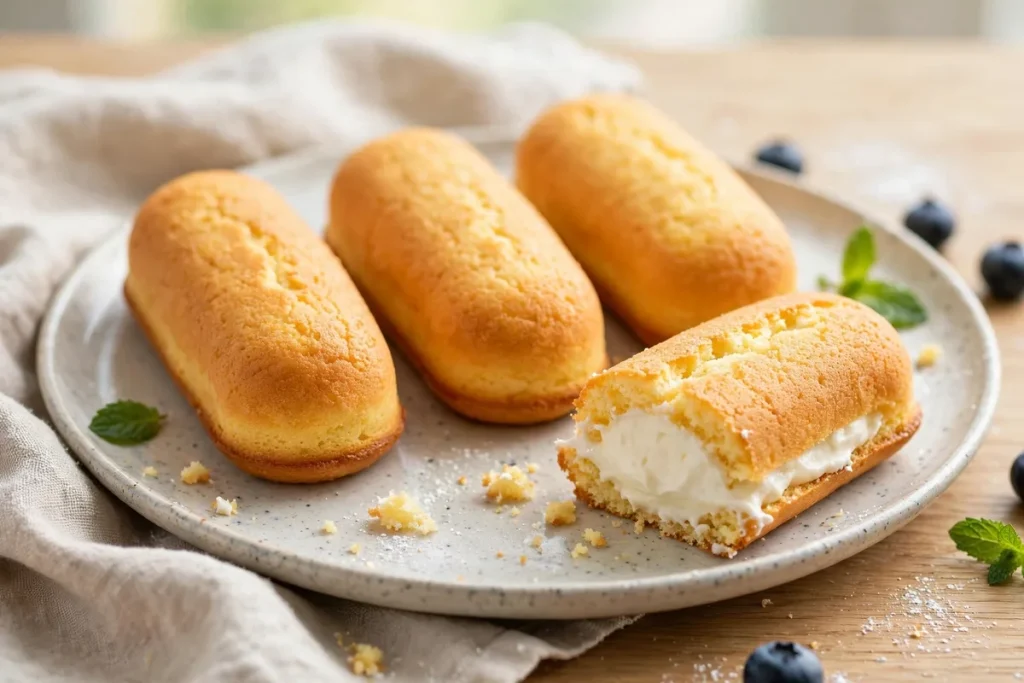
Twinkies are the golden sponge cake with the creamy filling, sold in 10-count and 16-count boxes and as a 2-count single serve. The cake is light, the filling is sweet, and the calories are almost entirely sugar and fat — there is no fiber and just 2 g of protein in a whole twin-pack serving. None of that makes a Twinkie a villain. It makes it a treat worth counting honestly, especially because the twin-pack habit doubles the damage before you have thought about it.
Twinkie Calories by Count
The table below is computed from the official label: one serving is 2 cakes at 280 calories and 31 g of sugar, so one cake is half of that, and a 10-cake box is five servings.
| Amount | Calories | Sugar |
| 1 cake | 140 | About 15.5 g |
| 2 cakes (one twin pack, the label serving) | 280 | 31 g |
| 10-cake box | 1,400 | 155 g |
For the full label picture, one serving (2 cakes) also carries 9 g of fat (3.5 g saturated, 0 g trans fat), 30 mg of cholesterol, 360 mg of sodium, 47 g of carbohydrate, 0 g of fiber and 2 g of protein. A 16-count box, the biggest box Hostess lists, works out to 2,240 calories and 248 g of sugar for the whole box — a number worth knowing before the box lives on your desk.
What Is Actually Inside
Start with the sugar, because it is the whole story. One cake carries about 15.5 g of sugar — roughly 4 teaspoons — and a twin pack carries 31 g, or about 8 teaspoons. Every gram of it is added sugar: the label lists 31 g of total sugars and 31 g of added sugars, which is 61% of the daily value in a single serving. Against the American Heart Association’s daily added-sugar guideline, one cake is about 62% of the 25 g figure for women and about 43% of the 36 g figure for men. A twin pack blows past the women’s guideline entirely (about 124%) and covers about 86% of the men’s.
The official ingredient list, in plain English, starts exactly where you would expect: sugar first, then enriched wheat flour, water, high fructose corn syrup, tallow (beef fat), dextrose and egg. After that comes the long tail of modern snack-cake engineering, all at 2% or less: soybean oil, whey, stabilizers and preservatives — sorbic acid and potassium sorbate are listed as being there to retain freshness — plus emulsifiers, gums and the colors Yellow 5 and Red 40. The allergen line is short and clear: the cakes contain egg, milk, soybean and wheat ingredients.
What is not in there matters too. There is no fiber, almost no protein, and no meaningful vitamins or minerals — calcium and iron barely register at 2% and 6% of daily value per serving. A Twinkie is not food that happens to be sweet. It is sugar, refined flour and fat, engineered to taste great and keep well. Enjoyed as a treat, that is fine. Eaten as a daily snack, it is 140 calories that will not keep you full for long.
The fat and salt are worth a line too. A twin-pack serving has 9 g of fat, of which 3.5 g is saturated, and 360 mg of sodium — 16% of the daily value. Neither is extreme on its own, but together with 47 g of carbohydrate and zero fiber, the serving is a fast hit of energy with almost nothing to slow it down. That is why a Twinkie rarely satisfies for long, and why the second cake in the pack is so easy to reach for.
Do Twinkies Really Last Forever?
No — and the myth is the most fun thing about Twinkies, so let us retire it properly. Hostess’s stated shelf life for Twinkies is 45 days, and Hostess’s own FAQ confirms that its products carry a Best By date printed on the packaging. Forty-five days is a very long life for a cake, but it is not forever, and a Twinkie left in a hot car or an open wrapper will still go stale and unpleasant long before any legend kicks in.
What is true is that Twinkies are built for shelf stability. Each cake is individually wrapped, the filling is a shelf-stable crème made with oils and stabilizers rather than fresh cream, preservatives like sorbic acid and potassium sorbate are in the recipe to retain freshness, and Hostess’s own storage note says to store the cakes at an ambient temperature in a clean, cool, dry place, away from direct sunlight. That is why a Twinkie survives a lunchbox, a glove box and a pantry shelf far longer than a bakery cake would. Shelf-stable is not the same as immortal.
The myth got a boost in 2012, when Hostess shut down and Twinkies briefly vanished from shelves — only to return in 2013 under new ownership. The cakes did not outlive civilization; the brand just changed hands, and the snack came back.
Twinkie vs Other Hostess Snack Cakes
From the same official Hostess source, here is how the classic snack cakes compare per cake. Note the serving sizes differ: Twinkies and Ding Dongs are labeled per 2 cakes, so their per-cake figures are the label serving halved, while a CupCake serving is a single cake.
| Snack cake | Label serving | Calories per cake | Sugar per cake |
| Twinkies | 2 cakes (77 g) | 140 | About 15.5 g |
| Hostess CupCakes (chocolate) | 1 cake (45 g) | 170 | 20 g |
| Ding Dongs | 2 cakes (72 g) | 155 | About 15.5 g |
The surprise is that the Twinkie is actually the lightest of the three. The chocolate CupCake is the heaviest at 170 calories per cake, thanks to chocolate cake plus fudgy icing and the same creamy center. The Ding Dong lands in the middle at 155 per cake — the chocolate coating adds a little over the plain golden sponge. If you love the Hostess lineup and want the smallest hit, the original Twinkie is, somewhat unfairly to its reputation, the best pick of the bunch.
One honest gap: Ho Hos are not listed among Hostess’s current everyday snacks on hostesscakes.com, so they are left out of this comparison rather than guessed at. If Hostess lists them again, the table will be updated.
The Portion Reality
One cake at 140 calories fits almost any calorie budget as an occasional treat — it is roughly the cost of a small cookie or a slice of bread with butter. The problem is never one cake. Twinkies are sold in pairs, the twin pack is the label serving, and the second cake is sitting right there, already unwrapped in your hand. The honest unit of Twinkie eating is 280 calories, and most people who buy a twin pack eat a twin pack.
Three habits keep it honest. First, if you buy the 2-count single serve, eat one cake and save the other for tomorrow — the wrapper makes that easy. Second, do not eat Twinkies hungry; pair the cake with something with protein or fiber first, so 140 calories is a dessert, not a meal replacement. Third, keep the box out of sight at work or home: a 10-count box on the desk is 1,400 calories of very easy decisions. If you want to see where a daily twin pack lands in your own numbers, run your total through a maintenance calories calculator — a 280-calorie daily habit is nearly 2,000 calories a week, which is more than half a pound of weight over a month if nothing else changes.
None of this is a scolding. Twinkies are a nostalgic, genuinely tasty snack, and a single cake is a small, countable pleasure. The trick is counting the pair, not the cake — and knowing that the box, not the cake, is where the calories pile up.
Frequently Asked Questions
How many calories are in a Twinkie?
One Twinkie has 140 calories. Hostess labels a serving as 2 cakes, which is 280 calories, so a twin pack is double the single-cake number.
How many calories are in a pack of two Twinkies?
280 calories, with 31 g of sugar. That twin pack is the official label serving.
How much sugar is in a Twinkie?
About 15.5 g of sugar per cake, and all of it is added sugar. A twin pack has 31 g, which is more than the American Heart Association’s 25 g daily added-sugar guideline for women.
Do Twinkies really last forever?
No. Hostess’s stated shelf life is 45 days, and every pack carries a Best By date. Twinkies are shelf-stable, not immortal.
Which has more calories, a Twinkie or a Hostess CupCake?
The CupCake. A chocolate Hostess CupCake has 170 calories per cake, compared with 140 for a Twinkie. A Ding Dong sits between them at 155 per cake.
So the honest answer to the question in the title: one Twinkie is 140 calories, a twin pack is 280, and a box is a commitment. Count the pair, enjoy the cake, and let the forever myth go — 45 days is impressive enough.