
Turkey breast calories are refreshingly low: roasted, skinless turkey breast runs about 147 calories per 100 g, with about 30 g of protein and only about 2 g of fat. That makes it one of the leanest meats you can put on a plate — leaner, in fact, than the chicken breast everyone holds up as the diet gold standard. But not every turkey breast counts the same: the skin adds roughly 40 calories per 100 g, and deli slices, while lighter on paper, carry a sodium load that changes the health story completely. This guide breaks down every version, so you can count the turkey in front of you, not a generic number.
One note before the numbers: all values here are typical USDA-based values. Brands and cures vary a little, so treat these as the honest middle of the range, not a laboratory promise for one specific package.
Turkey Breast Calories by Type
The type is where turkey breast counting usually goes wrong, because a roasted breast, a skin-on slice, and a deli slice are three different foods wearing the same name. The table below gives you every unit you are likely to meet.
| Type | Calories per 100 g |
|---|---|
| Roasted turkey breast, meat only (no skin) | About 147 |
| Roasted turkey breast, with skin | About 189 |
| Deli sliced turkey breast | About 100 |
| Roasted turkey dark meat | About 184 |
In serving terms, a 3 oz portion of roasted skinless breast (about 85 g, roughly a deck of cards) is about 125 calories, and a single ounce is about 42. Two slices of deli turkey (about 56 g) run about 55, and one thin slice (about 28 g) about 28. A 3 oz serving of roasted breast also carries roughly 25 g of protein, which is why it keeps you full far out of proportion to its calories.
What 100 g looks like on the plate helps more than any table. It is a palm-sized slice of breast, about as thick as your little finger is long, and it is the portion most nutrition labels quietly assume. Restaurant carvings and holiday servings are often double that, so a generous slice can be 250 to 300 calories before gravy — still modest for meat, but no longer the 147 headline.
The Skin Difference
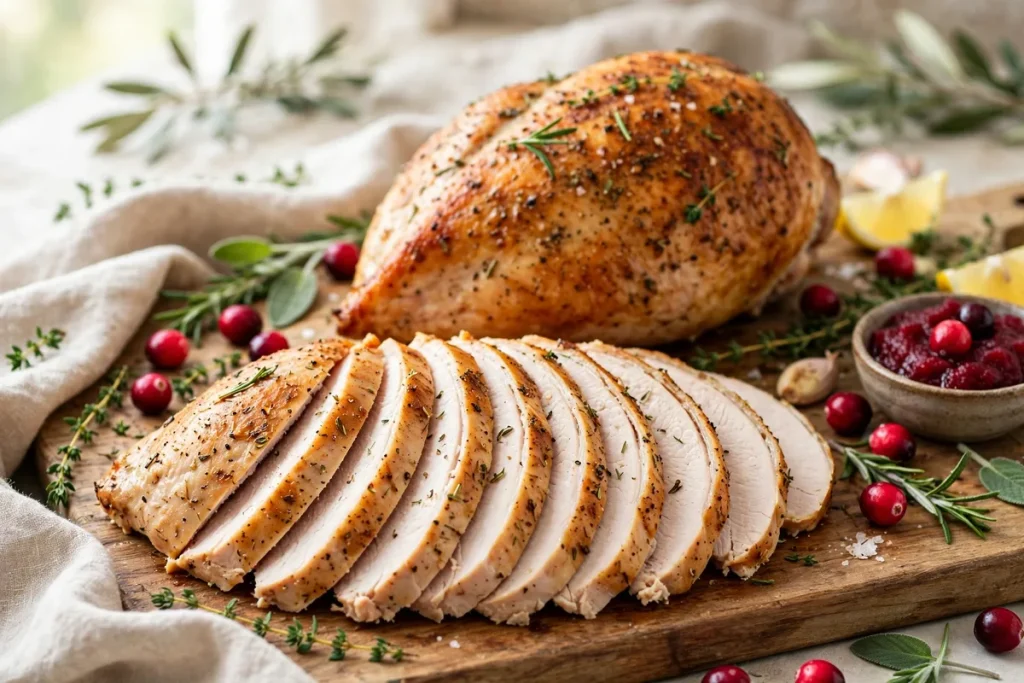
The skin is where roughly 40 calories per 100 g hide. Roasted breast with the skin on runs about 189 per 100 g against 147 without it, and the difference is almost entirely fat — the skin crisps in its own fat, and that fat stays on the meat when you eat it.
That does not make skin a villain. Crispy skin is one of the great pleasures of a roast, and at a holiday meal it is a small price. But for everyday eating, the honest move is to roast with the skin on — it keeps the meat moist — and take most of it off before you eat. You keep the juiciness and lose most of the 40.
One more skin note: the with-skin number counts the skin spread across the meat. If you eat a plate that is mostly crispy skin, you are eating far more than 189 per 100 g, because skin alone is mostly fat. The table number assumes a normal slice with its share of skin attached, not a pile of crackling.
Roasting tip worth knowing: a breast roasted skin-on and rested before carving stays noticeably juicier than one roasted bare, because the skin shields the meat from the oven’s dry heat. So the skin earns its place during cooking even if it does not earn a place on your plate afterwards. Let the bird rest for 15 minutes, carve, and then decide how much skin, if any, goes with each slice.
Roasted vs Deli Turkey
Deli turkey looks like the winner on paper: about 100 calories per 100 g beats roasted’s 147. The reason is processing — deli slices carry added water, which dilutes the calories per gram. You are, in part, paying for water weight, and the lighter number flatters a product that is not actually the leaner food.
The sodium tells the other half of the story. Deli sliced turkey runs about 900–1,100 mg of sodium per 100 g, while home-roasted turkey breast with no added salt sits well under 100 mg per 100 g. That is more than ten times the sodium for a product that looks lighter. Two slices of deli turkey can carry about 500–620 mg of sodium before the bread, the cheese, or the condiments enter the picture.
Deli turkey is also a processed meat, which puts it in a different health category from a freshly roasted breast, whatever the calorie label says. For an occasional sandwich it is fine; for daily eating, home-roasted wins — lower sodium, no processing, and protein you can trust. That is the honest version of the roasted-versus-deli debate: the calorie gap is small, but the sodium and processing gaps are not.
Practical middle ground: if deli slices are your weekday reality, look for low-sodium versions, keep the portion to two or three slices, and load the sandwich with vegetables so the salt has company. And read the label rather than the front of the pack: a product that says low sodium can still carry several hundred milligrams per serving, and serving sizes on deli packs are smaller than the sandwich you actually build.
One more deli habit worth building: slice your own. A home-roasted breast, carved thin across the grain, makes sandwiches all week, keeps in the fridge for three to four days, and costs a fraction of the deli counter per pound. It is the single easiest way to get deli convenience with roasted numbers.
Turkey Breast vs Chicken Breast
Here is the comparison most people get backwards. Cooked chicken breast runs 165 calories per 100 g; roasted turkey breast runs about 147. Turkey breast is the leaner of the two by about 18 calories per 100 g — roughly 11 percent lighter — with protein nearly identical at about 30 g per 100 g.
For the full picture on the other bird, see our guide to chicken breast calories, which covers 4 oz, 8 oz and every serving size. The short version: chicken breast is a superb lean protein, but if you are choosing purely on calories, turkey breast edges it.
Why does turkey win? The breast meat is simply a touch leaner — less fat per 100 g — while the protein holds steady at about 30 g. It is not a huge gap, and taste, price, and what you actually enjoy eating matter more than 18 calories. But the next time someone calls chicken breast the leanest meat, you know the correction.
When chicken still wins: it is usually cheaper, easier to find in small portions, and more forgiving when overcooked — a dry chicken breast is still edible, while a dry turkey breast is a chore. Turkey breast shines when you roast a whole breast for the week or want the leanest possible numbers. Choose the bird you will actually cook, and let the 18 calories be a tiebreaker, not a religion.
The bottom line: roasted, skinless turkey breast at about 147 per 100 g is one of the best calorie deals in the meat aisle, the skin costs about 40 per 100 g, and deli slices trade a lower calorie number for a much higher sodium one. Count the version in front of you, and turkey breast will rarely let your budget down.
Frequently Asked Questions
How many calories are in turkey breast?
About 147 calories per 100 g for roasted, skinless turkey breast, or about 125 for a 3 oz serving. With the skin on, the same breast runs about 189 per 100 g.
How many calories are in a slice of deli turkey?
About 28 calories for one thin slice (about 28 g), or about 55 for a two-slice serving (about 56 g). Watch the sodium, though: deli slices carry about 900–1,100 mg per 100 g.
Turkey breast or chicken breast – which has fewer calories?
Turkey breast, at about 147 calories per 100 g versus about 165 for cooked chicken breast, with protein nearly identical at about 30 g per 100 g.
Does turkey skin add a lot of calories?
About 40 calories per 100 g: roasted breast with skin runs about 189 per 100 g versus about 147 without it. Roast with the skin on for moisture, then take most of it off before eating.
Is deli turkey as healthy as roasted turkey breast?
Not quite. Deli slices are lower in calories per 100 g (about 100) but carry about 900–1,100 mg of sodium per 100 g, more than ten times home-roasted, and are a processed meat. Fine occasionally; home-roasted wins for daily eating.
A final counting tip that makes all of this easier: weigh your portion once. Most people overestimate a 3 oz serving by half, which turns 125 calories into nearly 190 without noticing. A cheap kitchen scale removes the guesswork, and after a week of weighing you will recognize a true 3 oz slice by eye. Pair that habit with the skin decision — skin on for the roast, skin off for the plate — and turkey breast becomes one of the easiest proteins to count accurately.