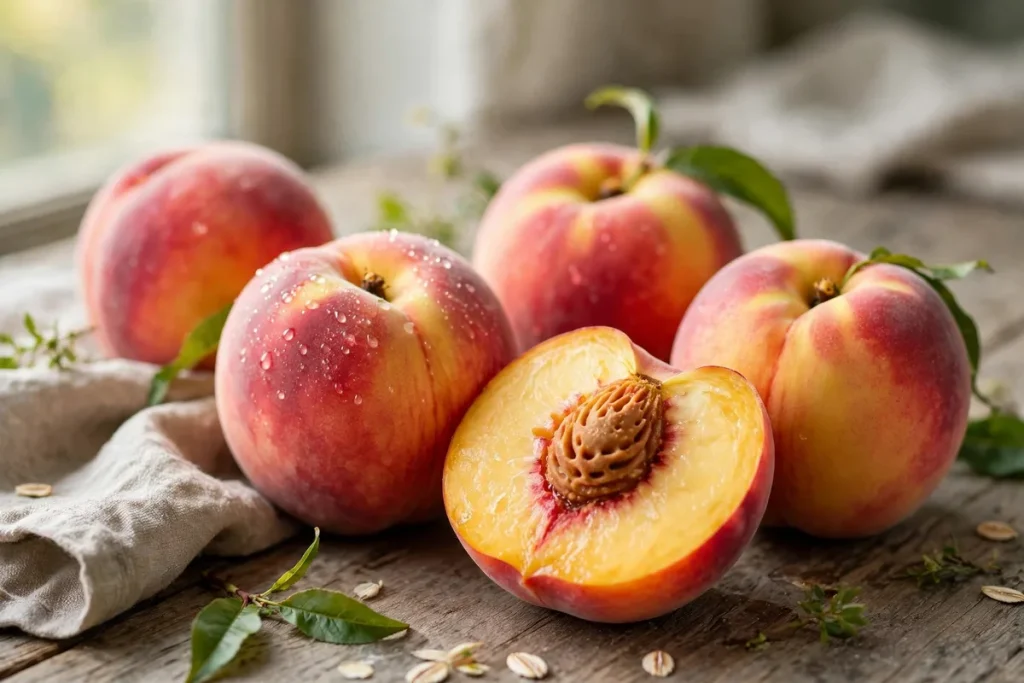

Quick answer: peach calories are refreshingly low — a medium peach (about 150 g) has about 59 calories. A small peach runs about 51, a large one about 68, and a cup of sliced peaches is about 60. For a fruit that tastes like summer dessert, that is a bargain: mostly water, gently sweet, and filling enough to count as a real snack rather than a tease.
Every number in this article is a USDA figure for raw peaches unless another form is named, so canned, dried and frozen versions get their own numbers below rather than borrowing the fresh ones. A fresh peach is about 89% water, which is the whole secret of its calorie count: you get a full, juicy, tennis-ball-sized piece of fruit for fewer calories than a single small cookie.
Peaches also sit in a friendly spot for everyday eating. They need no preparation, travel well in a bag, and work at breakfast, in salads and in desserts without any cooking skill. The rest of this guide breaks down the numbers by size, by nutrient and by form — because a peach in syrup is a different food from a peach off the tree, and the difference is worth knowing before you open the can.
Peach Calories by Size
Grocery peaches are not one size, and the calorie gap between a small and a large one is bigger than most people expect — about 17 calories, or roughly a third more. Use this table to find your peach, and remember that the weight, not the label, decides the number.
| Size | Weight | Calories |
|---|---|---|
| Small peach | 130 g | 51 kcal |
| Medium peach | 150 g | 59 kcal |
| Large peach | 175 g | 68 kcal |
| 1 cup sliced | 154 g | 60 kcal |
| Per 100 g | 100 g | 39 kcal |
The practical takeaway is simple: if you eat one peach a day, the size you grab is a 51-to-68 calorie decision, not a diet-breaking one. Weighing your usual peach once teaches you more than any table — most supermarket peaches land near the medium mark, so 59 is the number to carry in your head.
Peach Nutrition Facts
Beyond calories, a peach is a modest but genuine source of fiber, potassium and vitamin C, with almost no fat and no sodium worth mentioning. Here is the full picture per 100 g and per medium peach.
| Nutrient | Per 100 g | Per medium peach (150 g) |
|---|---|---|
| Calories | 39 kcal | 59 kcal |
| Protein | 0.9 g | about 1.4 g |
| Carbohydrates | 9.5 g | about 14 g |
| Sugars | 8.4 g | about 13 g |
| Fiber | 1.5 g | 2.3 g |
| Fat | 0.3 g | about 0.5 g |
| Potassium | 190 mg | about 285 mg |
| Vitamin C | 6.6 mg | about 10 mg |
| Water | about 89% | about 89% |
Two things stand out. First, the sugars in a peach are naturally occurring, packaged with water and fiber — a different experience from the same grams of sugar in a sweetened drink, because the fruit slows you down and fills you up. Second, the potassium is the quiet win: about 285 mg in a medium peach supports normal muscle function as part of an overall potassium-rich diet, no supplement required.
Fresh vs Canned vs Dried Peaches
This is where peach calories change character. Fresh peaches are the baseline. Canned peaches depend entirely on what they are packed in, and dried peaches concentrate everything — sugar included — by removing the water that made the fresh fruit so light.
| Form | Serving | Calories |
|---|---|---|
| Fresh, sliced | 1 cup | about 60 kcal |
| Canned in juice, drained | 1 cup | about 110 kcal |
| Canned in heavy syrup | 1 cup | about 190 kcal |
| Dried peaches | 100 g | 239 kcal |
| One dried half | 1 piece | about 31 kcal |
| Frozen unsweetened slices | 1 cup | roughly 60 kcal |
The syrup warning is the big one: a cup of peaches in heavy syrup runs about 190 calories against about 110 for the same cup packed in juice and drained — and most of that extra is added sugar from the syrup itself, not from the fruit. Draining helps, but it cannot undo a syrup pack; if you buy canned, juice-packed and drained is the honest choice, and the syrup left in the can belongs down the drain, not in your bowl.
Dried peaches deserve a different caution. At 239 calories per 100 g, they are about six times as calorie-dense as fresh peach, because the water is gone and everything else stayed. One dried half at about 31 calories sounds harmless, but dried fruit is easy to eat by the handful — five halves quietly pass 150 calories without ever feeling like a serving. Enjoy them, but count the halves.
Frozen peaches are the good-news exception: unsweetened frozen slices land at roughly 60 calories per cup, essentially the same as fresh, which makes them a smart out-of-season buy for smoothies and baking. Just check the bag says unsweetened — sweetened frozen fruit borrows the syrup trap.
Peach vs Nectarine and Other Stone Fruit
Peaches and nectarines are famously confused at the fruit stand, and the honest truth is that they are the same species — the nectarine is simply a smooth-skinned peach. The calorie difference is small enough to ignore in real life, but here it is beside the other stone fruits for completeness.
| Fruit | Calories per 100 g |
|---|---|
| Peach | 39 kcal |
| Nectarine | 44 kcal |
| Plum | 46 kcal |
| Apricot | 48 kcal |
Per 100 g, the peach is the lightest of the group at 39 calories, with the nectarine next at 44, then plum at 46 and apricot at 48. In a real serving the gap between a peach and a nectarine is about 8 calories — pick the one you like and the one that is ripe, not the one that wins a table. The nectarine’s small premium comes mostly from a touch more natural sugar per bite. For a wider orchard comparison, our apple calories guide breaks down Gala, Fuji, Honeycrisp and Granny Smith by the same per-100-g logic.
Are Peaches Good for Weight Loss?
Yes, with the usual honest caveats. A fresh peach has an energy density of only about 0.39 calories per gram, which puts it firmly among the foods you can eat a lot of for few calories. The combination that does the work is water plus fiber: about 89% water and 2.3 g of fiber per medium peach means the fruit fills your stomach and slows your eating, so a peach actually satisfies in a way that a 59-calorie snack bar often does not.
Peaches also play well with protein, which is what turns a snack into staying power. Sliced peach over Greek yogurt or cottage cheese, or a peach eaten alongside a handful of nuts, keeps you full far longer than the fruit alone — and that pairing is the difference between a snack that holds you until dinner and one that sends you back to the kitchen in twenty minutes.
The cautions are the ones already covered: syrup-packed cans and dried portions are where peach calories stop being light. A cup of syrup peaches at about 190 calories is a dessert, not a fruit serving, and dried halves are a food to count, not graze. Keep the fresh, juice-packed or frozen-unsweetened versions as your default, and peaches are an easy yes for weight loss. To see how a peach fits your own day, find your target with our maintenance calories calculator and treat fruit as part of the plan, not an extra on top of it.
How to Pick and Store Peaches
A good peach gives a little when you cup it and press gently near the stem — hard as a rock means underripe, while a peach that dents deeply is already past its best. Smell matters too: a ripe peach smells sweet and fragrant at the stem end, and the background skin should be golden or warm yellow rather than green. A red blush is about variety and sun, not ripeness, so do not judge by the red alone.
Underripe peaches ripen well at room temperature, faster in a loosely closed paper bag, which traps the natural ethylene gas. Once ripe, move them to the refrigerator, where they keep for a few more days — but eat them soon, because a perfect peach is a short-lived thing. For longer storage, slice and freeze them on a tray before bagging, and you have smoothie-ready fruit at roughly the same calories as fresh.
Frequently Asked Questions
How many calories are in one peach?
A medium peach (about 150 g) has about 59 calories. A small peach has about 51 and a large peach about 68.
How many calories are in 100 g of peach?
39 calories per 100 g of raw peach, with 0.9 g of protein, 9.5 g of carbs and 1.5 g of fiber.
Are peaches good for weight loss?
Yes. Fresh peaches are low in energy density at about 0.39 calories per gram, and their water and fiber help you feel full. Watch syrup-packed cans and dried portions, which are much higher in calories.
How many calories are in canned peaches?
About 110 calories per cup for peaches canned in juice and drained, and about 190 calories per cup for peaches in heavy syrup.
Which has fewer calories, a peach or a nectarine?
A peach, at 39 calories per 100 g compared with 44 for a nectarine. The difference is small, so choose whichever is ripe.
The bottom line: peach calories are low, honest and easy to use — about 59 for a medium fresh peach, about 60 a cup sliced, and a table full of small differences that matter less than the form you choose. Pick ripe ones, skip the syrup, count the dried halves, and the peach earns its place as an everyday fruit.