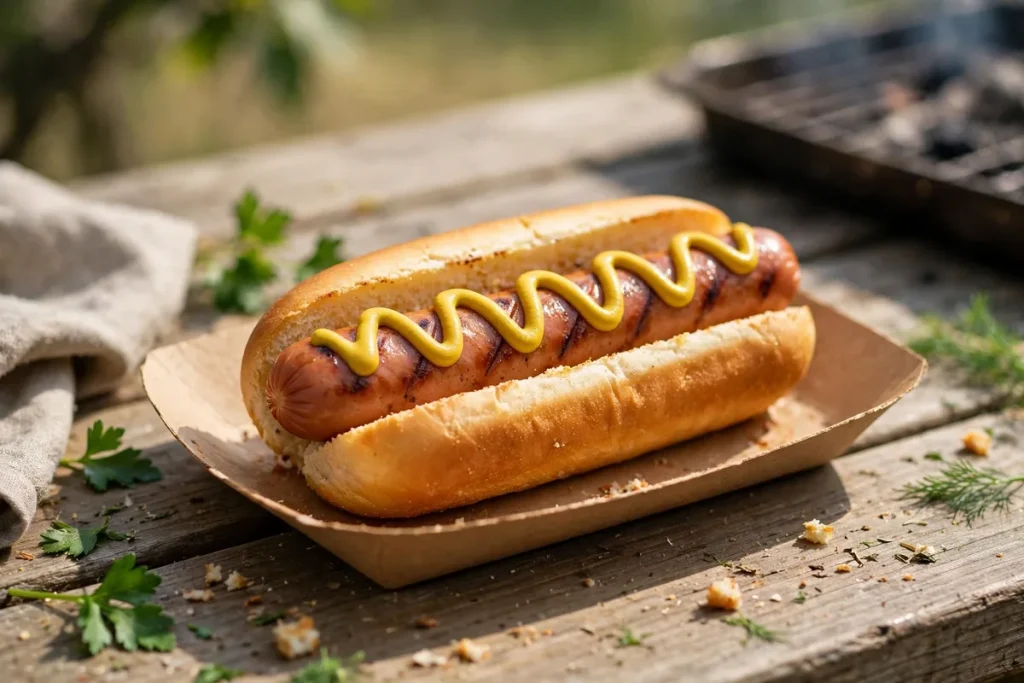

Quick answer: a standard hot dog frank on its own is about 140 calories — the bun adds about 130, so a plain hot dog lands at about 270 before a single topping. Frank calories are mostly fat calories (about 12 g of fat and only 5 g of protein in that frank), which is why the toppings and the build decide whether the meal stays light or quietly doubles.
Terminology first, because labels use three names for the same thing: a frank, a frankfurter and a wiener are the same slender, fully cooked sausage, traditionally a blend of beef and pork. The standard size used throughout this guide is about 45 g — the classic backyard frank, roughly eight to a pound. Ballpark franks run the same, cocktail franks are the miniature version, and jumbo franks are bigger in every direction, calories included.
How to use this page: the build-a-dog table below prices every component separately, so you can add up the exact hot dog you actually eat instead of a generic one. Then the nutrition section looks honestly at what is inside a frank beyond the calories, the bratwurst section untangles its bigger cousin, and the last section trims the cookout without ruining it.
The Build-a-Dog Table
A hot dog is an assembly, not a single food, so here is every part priced on its own. Pick your frank, add the bun, then add only the toppings you actually use:
| Component | Calories |
|---|---|
| Standard beef/pork frank (45 g) | 140 |
| Jumbo frank (57 g) | 180 |
| Turkey or chicken frank | About 100 |
| Hot dog bun | 130 |
| Ketchup (1 tbsp) | 17 |
| Yellow mustard (1 tbsp) | 10 |
| Sweet relish (1 tbsp) | 20 |
| Cheese slice | 55 |
| Chili topping (1/4 cup) | About 60 |
| Sauerkraut or onions (2 tbsp) | About 10 |
Worked totals for the builds people actually eat: a plain dog (standard frank and bun) is about 270 kcal. A cheese dog is about 325. A chili cheese dog is about 385. And the lightest honest build — a turkey frank with a regular bun, mustard and sauerkraut — comes in at about 240, which is less than a plain standard dog while tasting like more food, not less.
Two things stand out in the table. First, the bun is nearly half the plain dog — 130 of the 270 — so frank debates that ignore the bread miss half the story. Second, the condiment shelf splits cleanly in two: mustard, kraut and onions are nearly free at about 10 kcal, while cheese and chili are real food at 55-60 each. Ketchup and relish sit in between, and their cost is sugar more than size. Dress a dog with the cheap seats freely; count the cheese and chili like the ingredients they are.
Frank Nutrition, Honestly
Here is what one standard 45 g frank actually contains, beyond the headline number:
- Calories: 140 kcal
- Fat: 12 g, of which saturated fat is about 4.5 g
- Protein: 5 g
- Carbs: 1-2 g
- Sodium: about 460 mg
That sodium line deserves a pause: about 460 mg is roughly a fifth of a full day’s sodium in a single frank — before the salty bun, the cheese and whatever else lands on the plate. Combined with the preservatives that define processed meat, that is the real reason franks belong in the occasional column of anyone’s diet. It is worth saying plainly, because calorie sites rarely do: the calories are honestly not the worst thing about a hot dog. At 140, a frank costs about the same as a modest snack; it is the fat-heavy, protein-light split and the salt that make it a sometimes food rather than a staple.
The protein math makes the same point from the other direction. Five grams of protein for 140 kcal is a poor exchange rate — most unprocessed meats deliver that protein for well under half the calories, because they are not carrying 12 g of fat along for the ride. None of this makes a cookout hot dog a mistake. It makes it what it has always been: a treat to enjoy on purpose and count honestly, not a protein source to build a week around.
The Bratwurst Question
Search results love to merge these two, so let us separate them: a bratwurst is NOT a big frank. One brat link (about 85 g) runs about 290 calories — more than double a standard frank — because it is nearly twice the meat, ground coarser and mixed richer. The frank is a slim, smooth, emulsified sausage eaten at 45 g; the brat is a thick fresh sausage eaten at almost double the weight. In a bun, the brat is a 420-calorie commitment before a single topping, against the hot dog’s 270.
Both are cookout food, and both are fine as cookout food — just count them differently. The most common tracking error at a grill is logging a bratwurst as a hot dog and undercounting by about 150 kcal before toppings even enter the picture. The other fresh sausages on the grate — Italian links, kielbasa and their cousins — play in the brat’s league, not the frank’s: thick, rich and portioned large. When the sausage needs a knife-and-fork mindset, use brat math.
Two Dogs, and the Real Total
Nobody’s cookout serving is one hot dog, so run the honest multiples. Two plain dogs: about 540 kcal. Two cheese dogs: about 650. Two chili cheese dogs: about 770 — a full meal’s worth before a single side dish, chip or drink appears on the plate. None of these numbers is a scandal; cookouts are celebrations, and celebrations are allowed to look like it. The point of counting is simply that the total should be a decision, not a surprise discovered by a tracking app the next morning.
Making the Cookout Lighter
Nothing below removes any fun. Each swap keeps the shape of the meal — a grilled sausage in a bun with toppings — and just re-prices it:
- Switch the frank, not the ritual: turkey or chicken franks run about 100 kcal against the standard 140, saving about 40 each with the same grill marks and snap.
- Lean on the free toppings: mustard and sauerkraut deliver the sharp, tangy flavors that make a hot dog taste finished for about 10-20 kcal in total. Onions belong in the same nearly-free category.
- Cheese strategy: skip the cheese on the second dog, not the first. The first cheese dog is the experience; the second one’s cheese slice mostly goes unnoticed anyway, and that is 55 kcal back.
- Fill half the plate from the grill: the peppers, onions, corn and salads already sitting at every cookout are the volume that makes one good dog feel like a feast.
- Keep the bun honest: a regular bun at 130 is fine; the oversized bakery rolls that dwarf the frank can quietly double that line.
For the protein context, it helps to see how plain ground beef compares: in our ground beef calories guide, the lean grinds deliver roughly four times a frank’s protein at similar calories per serving, because unprocessed meat is not pre-mixed with extra fat. That is the whole frank story in one comparison — the calories were never outrageous; the composition is what asks for moderation.
Frequently Asked Questions
How many calories are in a hot dog?
About 270 kcal for a plain one — roughly 140 for a standard frank plus about 130 for the bun. Toppings move it from there: a cheese dog is about 325 and a chili cheese dog about 385.
How many calories are in a frank alone?
About 140 kcal for a standard 45 g beef or pork frank. A jumbo frank (57 g) is about 180, and a turkey or chicken frank is lighter at about 100.
How many calories are in a bratwurst?
About 290 kcal for one brat link (about 85 g) — more than double a standard frank, because it is nearly twice the meat and richer. In a bun, that is about 420 kcal before toppings.
Are hot dogs fattening?
The calories themselves are moderate — 270 for a plain dog. The bigger story is the sodium (about 460 mg per frank, roughly a fifth of a day) and the processing, plus a fat-heavy split of 12 g fat to just 5 g protein. Enjoy them as occasional food, counted honestly.
What is the lowest-calorie hot dog build?
A turkey frank in a regular bun with mustard and sauerkraut: about 240 kcal — less than a plain standard dog, because mustard and kraut add big flavor for only about 10-20 kcal combined.
The bottom line: a frank is 140 calories of mostly fat and salt wearing a 130-calorie bun, and everything after that is your own construction project. Build it deliberately — turkey frank or standard, free toppings or the full chili-cheese works — and there is nothing to feel ambushed by. That is all honest counting ever asks: the real number, known before the first bite, not after the second dog.
One last label habit worth having: weigh the promise against the package. Franks are sold by count, but the calories follow the grams — a pack of oversized franks can quietly be the jumbo row of the table at 180 each, while a pack of turkey franks at about 100 changes the whole build before you have made a single other swap. Thirty seconds with the nutrition panel in the store aisle is the cheapest calorie decision at the entire cookout.