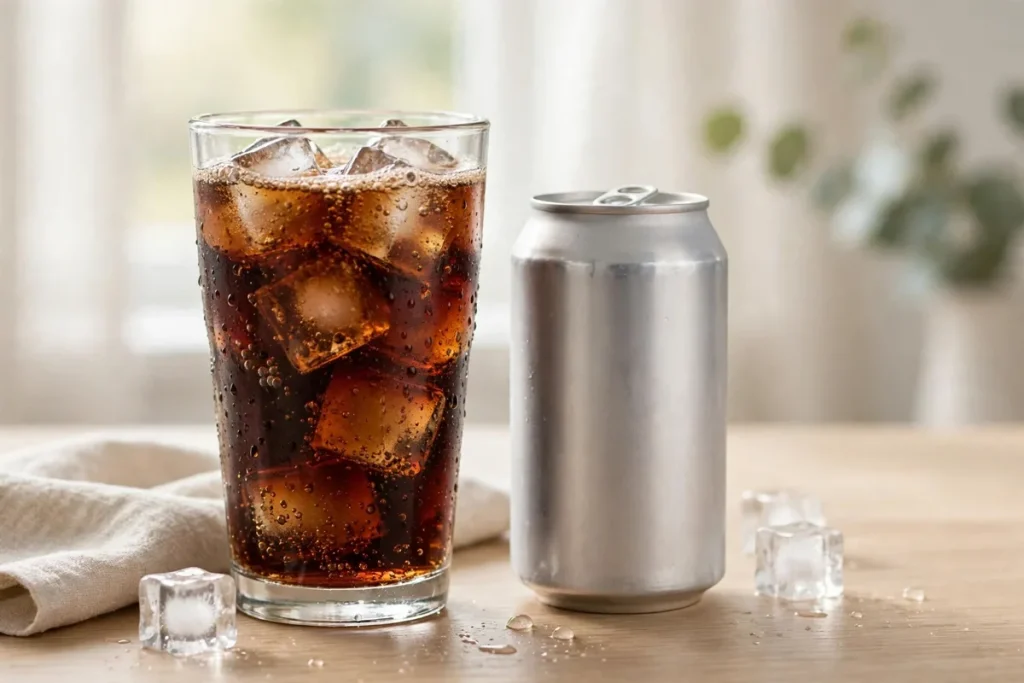

How many calories are in Diet Coke? None. Zero. That is the whole headline, and it is true in every size: the 12 fl oz can, the 20 fl oz bottle, and every other pack size all carry 0 calories on the label. Diet Coke gets its sweetness from aspartame instead of sugar, so there is nothing in the can for your body to turn into energy.
That zero is what makes Diet Coke such a popular swap. A regular Coca-Cola in the same 12 oz can carries 140 calories and 39 grams of sugar, so switching one daily can for Diet Coke removes 140 calories a day without changing anything else about the habit. This article reads the official label, line by line, compares Diet Coke with regular Coke and Coke Zero Sugar, and works out exactly what that daily swap adds up to.
All of the Diet Coke label facts below were read from Coca-Cola’s own official product page for Diet Coke, which lists the full Nutrition Facts panel for the 12 fl oz can. Where a figure comes from the label, this article says so; where it does not appear on that panel, this article does not invent it.
Diet Coke Label Facts
Here is the Diet Coke label, read straight from Coca-Cola’s official product page. The panel on that page covers the 12 fl oz can, and every figure below comes from it — nothing here is borrowed from a blog or an aggregator:
| Label fact | What the label says |
|---|---|
| 12 fl oz can — calories | 0 |
| 20 fl oz bottle — calories | 0 |
| Sodium (12 fl oz can) | 40 mg (2% of the Daily Value) |
| Caffeine (12 fl oz can) | 46 mg |
| Total sugars (12 fl oz can) | 0 g |
| Total fat / carbohydrate / protein (12 fl oz can) | All 0 g |
| Sweetener | Aspartame |
The first thing to notice is how empty that panel is. Zero calories, zero sugar, zero fat, zero carbohydrate, zero protein — the only numbers that are not zero are the sodium at 40 milligrams and the caffeine at 46 milligrams. That is the whole nutritional story of a can of Diet Coke: it is flavored, carbonated water with a sweetener, a little salt, and a moderate dose of caffeine.
The ingredient list on the official page reads: carbonated water, caramel color, aspartame, phosphoric acid, and potassium benzoate (to protect taste). Because the drink is sweetened with aspartame, the label also carries the standard note: “PHENYLKETONURICS: CONTAINS PHENYLALANINE.” That note matters to people with the rare condition phenylketonuria (PKU), who must limit phenylalanine; for everyone else it is simply part of the label.
One honest gap to note: the official panel published on Coca-Cola’s product page is for the 12 fl oz can. The 20 fl oz bottle is also 0 calories — that is the figure the brief gives for the bottle, and this article does not invent other bottle figures beyond it. If you drink from the bottle, the calorie count is still zero; only the can’s full panel is quoted here because that is what the official page shows.
Caffeine deserves its own line because it is the one active ingredient in the can. At 46 milligrams per 12 fl oz, a can of Diet Coke carries a little more caffeine than a typical cola and roughly half the caffeine of a small brewed coffee. There is also a caffeine-free version of Diet Coke for anyone who wants the taste without the stimulant — it carries the same 0 calories.
Diet Coke vs Regular Coke vs Coke Zero
Put the three colas side by side and the picture is simple: two of them cost nothing in calories, and one of them costs 140 per can. Regular Coca-Cola gets its calories entirely from sugar — 39 grams of it in a 12 oz can — which is why it is the outlier in the table. For the full regular-Coke numbers, see our Coca-Cola calories guide.
| Drink (12 fl oz can) | Calories | Total sugars | Caffeine |
|---|---|---|---|
| Diet Coke | 0 | 0 g | 46 mg |
| Regular Coca-Cola | 140 | 39 g | 34 mg |
| Coca-Cola Zero Sugar | 0 | 0 g | 34 mg |
Diet Coke and Coke Zero Sugar look identical in this table — both 0 calories, both 0 grams of sugar — but they are not the same drink. Diet Coke is the older recipe, with its own distinct flavor that fans describe as lighter and crisper, and it is sweetened with aspartame. Coca-Cola Zero Sugar was built to taste as close as possible to regular Coca-Cola, and it uses a different sweetener blend. So if you have tried one and did not like it, the other is still worth a taste: the numbers match, but the flavor does not.
Caffeine is the one place where the three drinks genuinely differ beyond sugar. Diet Coke, at 46 milligrams per can, is the most caffeinated of the three; regular Coke and Coke Zero Sugar both sit at 34 milligrams. That 12-milligram gap is small — about the difference between a weak and a strong cup of tea — but it is worth knowing if you drink several cans a day or you are sensitive to caffeine in the evening. A person drinking three cans of Diet Coke takes in about 138 milligrams of caffeine, roughly a cup and a half of coffee, while three cans of Coke Zero Sugar would be about 102 milligrams.
The practical takeaway is straightforward. If calories and sugar are what you are watching, Diet Coke and Coke Zero Sugar are interchangeable — both are zero on both counts. Choose between them on taste and on caffeine: Diet Coke if you like its classic flavor and do not mind the extra caffeine, Coke Zero Sugar if you want the closest thing to regular Coke with a little less buzz.
The 140-Calorie Swap
Here is where the zero turns into real arithmetic. A 12 oz can of regular Coca-Cola carries 140 calories, and a 12 oz can of Diet Coke carries 0. Swap one daily can, and the math is:
One day: 140 − 0 = 140 calories saved. One week: 140 × 7 = 980 calories saved. One month: 140 × 30 = about 4,200 calories saved.
That is simple subtraction, not a weight-loss promise. Bodies are not spreadsheets, and a saved 140 calories only matters if the rest of the day stays the same — swapping the drink while adding a snack wipes the saving out. But as a habit change, it is one of the easiest calorie cuts there is: same fizz, same ritual, same size can, 140 fewer calories a day, with no cooking, no measuring and no willpower required at mealtimes.
A word on the sweetener, because it is the question everyone asks. Diet Coke is sweetened with aspartame, and the safety of aspartame has been reviewed repeatedly by major food-safety regulators around the world, including the US Food and Drug Administration and the European Food Safety Authority, which consider it safe at normal intakes. Some people still prefer to limit sweeteners on principle, and that is a reasonable personal choice — but there is no need for scare language either way. The balanced view is this: Diet Coke has no sugar and no calories, which makes it a genuinely lighter choice than regular soda, while water remains the best everyday drink of all.
So the bottom line stays as simple as the label. A can of Diet Coke has 0 calories, 46 milligrams of caffeine, and a sweetener that regulators consider safe at the amounts people normally drink. If you enjoy it, the swap from regular Coke saves about 140 calories a day — and that is a number worth knowing, whatever else you choose to drink.
Frequently Asked Questions
How many calories in a can of Diet Coke?
0 calories. A 12 fl oz can of Diet Coke carries 0 calories on its official label, and so does the 20 fl oz bottle.
Does Diet Coke have caffeine?
Yes — 46 mg of caffeine per 12 fl oz can, a little more than regular Coca-Cola (34 mg) and roughly half a small brewed coffee.
Is Diet Coke the same as Coke Zero?
No. Both are 0 calories and 0 g sugar, but Diet Coke has its own classic flavor and is sweetened with aspartame, while Coca-Cola Zero Sugar is built to taste like regular Coke with a different sweetener blend and 34 mg of caffeine per can.
Does Diet Coke break a fast?
At 0 calories, most fasting approaches treat Diet Coke as not breaking a calorie fast — but purists who avoid all sweeteners during a fast would skip it, so it depends on the fasting style you follow.
Is Diet Coke bad for you?
It has no sugar and no calories, and major regulators consider its sweetener, aspartame, safe at normal intakes. It is a lighter choice than regular soda, though water is still the best everyday drink.