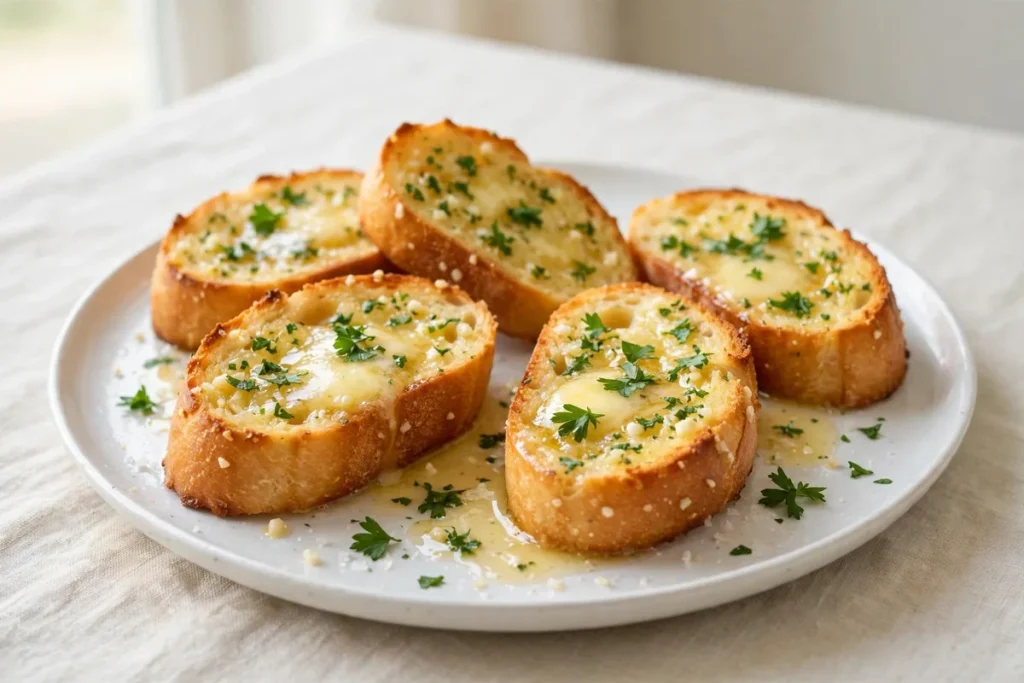

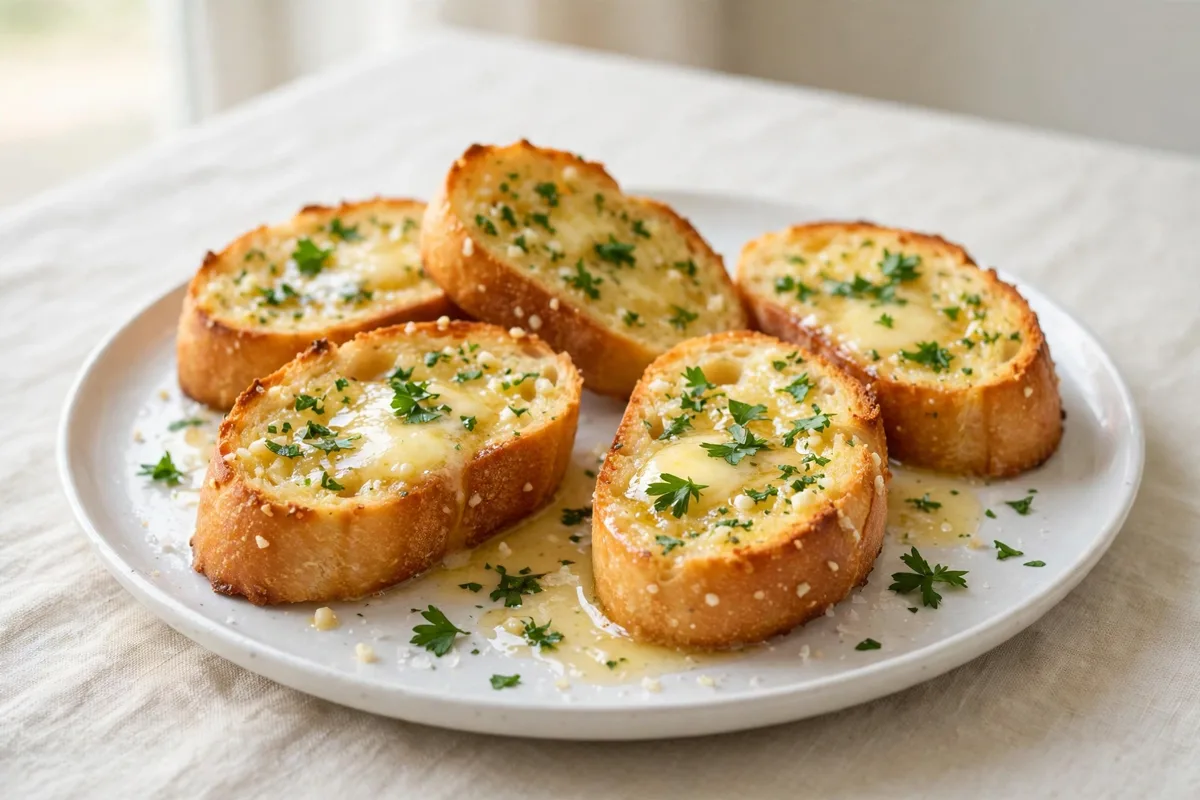
How many calories in a slice of garlic bread? About 150. That is the quick answer for a typical restaurant or frozen garlic bread slice — and the important part of the answer is what is behind that number. It is not the garlic. A clove of garlic has almost no calories at all. The calories come from the bread and, above all, from the butter spread across it.
Garlic bread is one of those foods that feels light because it is thin and crisp, but it is richer than it looks. A single slice sits somewhere between a slice of plain bread and a small pastry, and two slices — the amount most restaurants actually serve — land around 300 calories before you have touched the main course. This guide gives you the typical numbers per slice, shows exactly where those calories come from, and finishes with swaps that keep the flavor while cutting the cost.
One note before the numbers: garlic bread is a home and restaurant food with no single official label, so every figure here is stated plainly as a typical value. Slice sizes and butter amounts vary a lot from kitchen to kitchen, which is why the ranges below are wide — and why the per-slice figure is given as “about 150” rather than an exact count.
Garlic Bread Calories per Slice
Here are the typical values for garlic bread in its common forms. The plain-bread row is the starting point: everything else is that slice plus a spread, a topping, or both.
| Item | Calories (typical) | Notes |
|---|---|---|
| Plain bread slice (no spread) | 90–100 | White bread slice, before butter |
| One slice garlic bread | About 150 | Typical range 130–190 by size and butter |
| Two slices (common restaurant serving) | About 300 | 2 × 150 |
| Cheese garlic bread slice | About 200 | Garlic bread plus melted cheese |
| Olive-oil garlic bread slice | About 130 | Brushed with olive oil instead of butter |
| Per 100 g | About 330 | Garlic bread, typical |
The macros for a typical garlic bread slice run roughly: fat about 7 grams, carbohydrate about 18 grams, protein about 3 grams, and sodium about 250–300 milligrams. That sodium figure is worth noticing — a single slice carries roughly a tenth of a day’s sodium, and two slices push past a fifth, mostly from the salted butter and the bread itself.
The range matters more than the single number. A thin slice from a supermarket loaf, lightly buttered, can sit near 130 calories; a thick restaurant slice, dripping with garlic butter and served warm from the oven, can reach 190. If you are counting, assume the restaurant version is at the top of the range — it usually is.
It Is the Butter, Not the Garlic
Garlic gets the name, but butter does the damage — in the nicest possible way. A clove of garlic contains about 4 calories, and a whole head of garlic, all ten or twelve cloves, barely reaches 45. The amount of garlic actually on a slice of garlic bread — a teaspoon or so of minced garlic spread across the surface — contributes almost nothing to the total. If garlic bread were just bread and garlic, it would barely top 100 calories a slice.
The quick math shows where the rest comes from. Start with the plain bread slice at about 90–100 calories. Add a tablespoon of butter, which is about 100 calories on its own — and a generous restaurant spread can easily be a tablespoon per slice. That alone would push a slice to about 200, so the typical 150 figure reflects a more moderate spread of roughly half a tablespoon, about 50–80 calories of butter, plus the garlic, parsley and a pinch of salt. The spread is the lever: double the butter and you add about 50–80 calories per slice; skip it and you are back to plain bread.
Butter also explains why garlic bread is so high in fat for something that looks like bread. About half of a garlic bread slice’s calories come from fat — the butter’s fat plus the small amount already in the bread. That is not a reason to fear it, but it is the reason a thin, crisp slice can carry the calories of a much bigger-looking piece of food. And it explains the cheese version: melted cheese adds about 50 calories per slice, taking a standard slice from about 150 to about 200, because cheese brings its own fat and protein on top of the butter underneath.
One more thing worth knowing: garlic bread is rarely eaten alone. It arrives beside pasta, soup or a salad, and the two-slice serving of about 300 calories is the number that actually matters on the night. A basket of garlic bread passed around a table can quietly add up to a whole extra course before the main dish arrives — which is part of its charm, and part of why it is worth counting.
Lighter Garlic Bread Swaps
Garlic bread does not need to be an all-or-nothing food. Because the butter is the lever, small changes to the spread change the number more than any other tweak — and none of them ask you to give up the garlic flavor that makes it worth eating in the first place.
The easiest swap is olive oil. Brushing a slice with olive oil instead of butter gives you a slice of about 130 calories rather than about 150 — a saving of about 20 per slice, and the oil still carries the garlic beautifully, especially if you let minced garlic sit in the oil for a few minutes before brushing. The fat is still there, so this is a lighter version, not a light one, but the oil version also brings a different, fruitier flavor that works especially well with soups and tomato dishes.
The half-butter spread is the bigger win. Spread the butter on only half as thick — a thin scrape instead of a generous layer — and a slice drops from about 150 toward 120, because you have cut the 50–80 calorie spread roughly in half. At home, this is easy to control: soften the butter, mix in the garlic and parsley, and spread it thinly and evenly rather than in thick stripes. You still get butter on every bite, just less of it.
Changing the base helps too. A whole-wheat slice starts at roughly the same calories as a white slice, so it does not save much on its own — but its extra fiber makes one slice feel more satisfying, which makes stopping at one slice easier. And for the cheese version, the spec’s own advice holds: put the cheese only on top of one slice rather than loading every slice, and keep the cheese slice as the treat while the rest of the bread stays plain garlic. A cheese slice at about 200 is fine as a single; a whole basket of cheese slices at 200 each is where the numbers run away.
The simplest swap of all is portion. One slice at about 150, eaten slowly with the main course, is a very different proposition from the two-slice restaurant serving at about 300 — and from the four or five slices that disappear from a shared basket before anyone has counted. If you love garlic bread, have the one good slice, enjoy it properly, and leave the basket alone. That single choice saves more calories than any ingredient swap on this page.
Put together, the picture is a friendly one. Garlic bread is not a health food, but it is not a mystery either: about 150 calories a slice, about 300 for two, about 200 with cheese, about 130 with olive oil — and every one of those numbers is within your control the moment you pick up the butter knife.
Frequently Asked Questions
How many calories in a slice of garlic bread?
About 150 calories for a typical restaurant or frozen garlic bread slice (typical range 130–190 by slice size and butter amount).
How many calories in cheese garlic bread?
About 200 calories per slice — the standard garlic bread slice (about 150) plus about 50 calories of melted cheese.
How many calories in 2 slices of garlic bread?
About 300 calories — two typical slices at about 150 each, which is the common restaurant serving.
Is garlic bread healthy?
It is buttery white bread, so it is tasty but rich: about 150 calories and 250–300 mg of sodium per slice. Olive-oil and whole-wheat swaps, and stopping at one slice, make it a lighter choice.
Does garlic add calories to garlic bread?
Almost none. A clove of garlic has about 4 calories, and the small amount on a slice adds barely anything — the butter carries the calories, not the garlic.