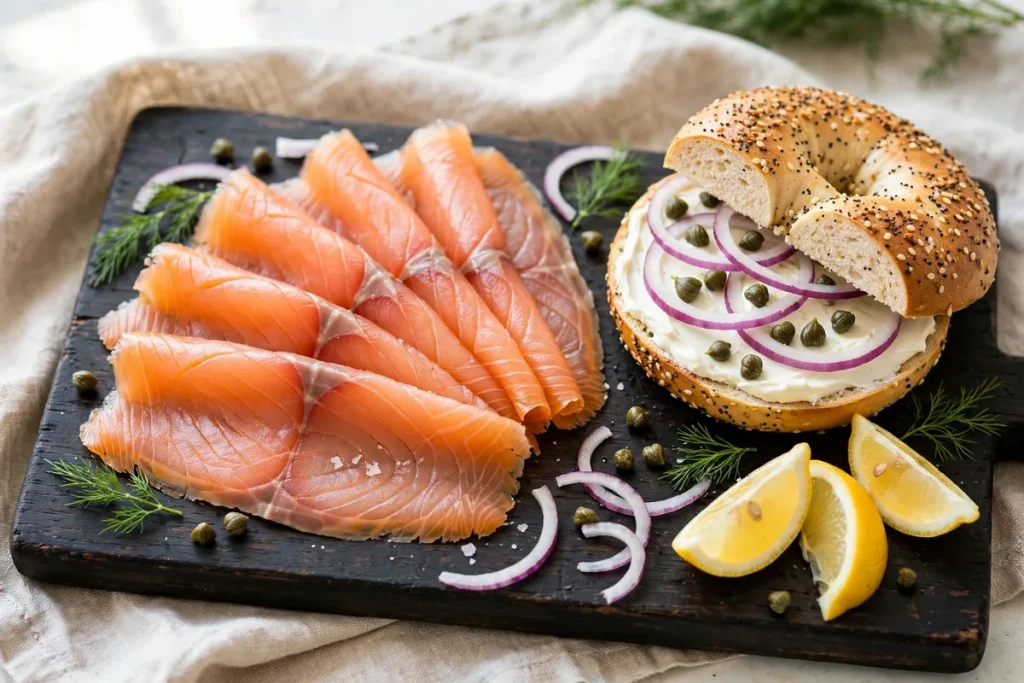

Smoked salmon calories come in lower than most people expect: about 70 calories for a typical 2 oz (57 g) serving, or about 117 calories per 100 g. That makes lox one of the lightest ways to eat salmon — but also one of the saltiest, with roughly ten times the sodium of fresh salmon. The calories are the good news; the salt is the catch, and this guide covers both honestly.
If you have only ever met smoked salmon on a bagel, the numbers can feel confusing. A few silky slices look like almost nothing, yet the packet lists a serving you would never weigh at home. Below, every figure is broken down by slice, ounce and serving, plus the full bagel math, so you can count a lox breakfast honestly instead of guessing.
One note before the numbers: all values here are typical USDA-based values for cold-smoked salmon (lox) unless a line says otherwise. Brands and cures vary a little, so treat these as the honest middle of the range, not a laboratory promise for one specific packet.
Smoked Salmon Calories by Serving
The serving is where smoked salmon counting usually goes wrong, because a packet serving and a bagel’s worth of slices are rarely the same thing. The table below gives you every unit you are likely to meet, so you can count whichever one is in front of you.
| Serving | Calories |
|---|---|
| One thin slice (about 15 g) | About 18 |
| One ounce (28 g) | About 33 |
| Typical package serving (2 oz / 57 g) | About 70 |
| Per 100 g | About 117 |
| Hot-smoked salmon (per 100 g) | About 140 |
The slice is the most useful unit at breakfast. Three thin slices — about what most people actually layer on a bagel — come to roughly 45 g and about 54 calories, which is barely more than the cream cheese underneath them. The 2 oz serving is the number printed on most packets, and it is a generous bagel portion rather than a skimpy one.
Hot-smoked salmon is the odd one out in the table. It is the flaky, fully cooked kind sold in chunks rather than slices, and it runs a little higher at about 140 calories per 100 g. If your packet says hot-smoked, use that row; everything else in this article is about cold-smoked lox.
Packet labels deserve one careful look, because serving sizes are not standardized. Some packets list a 1 oz serving (about 33 calories), which makes the packet look lighter than the 2 oz serving used here. The calories per 100 g never change — 117 for cold-smoked — so if the label confuses you, work from the per-100 g figure and your own scale.
Smoked vs Fresh Salmon
Here is the surprise that earns this section: smoked salmon is lighter per 100 g than fresh salmon, not heavier. Cold-smoked salmon runs about 117 calories per 100 g, while cooked fresh salmon runs about 206. Smoking does not add calories the way frying does — it is curing, not cooking — and the fish going into the smoker is typically leaner to begin with. Different fish and curing, not cooking concentration, is the simple explanation.
| Type | Calories per 100 g |
|---|---|
| Cold-smoked salmon (lox) | About 117 |
| Hot-smoked salmon | About 140 |
| Cooked fresh salmon | About 206 |
The protein story stays strong after smoking: cold-smoked salmon still delivers about 18 g of protein per 100 g, with only about 4 g of fat. That is why a lox breakfast feels far more substantial than its calorie count suggests — protein is doing the heavy lifting, not fat.
Omega-3s survive the smoker too. A typical serving carries about 0.5–1 g of EPA and DHA, the long-chain omega-3s that make oily fish worth eating in the first place. Smoking is a cold, gentle process — the fish is never cooked — so the fats that nutritionists praise in fresh salmon are still there in the smoked version.
For the full picture on the fresh fish, see our guide to salmon calories, which covers fillet sizes, nigiri and salmon types. The short version: fresh salmon is richer and more filling per bite, while smoked salmon is lighter and saltier. Neither is the wrong choice — they are just different tools for different meals.
Use follows the same split. Cold-smoked slices belong on bagels, in salads and folded through scrambled eggs, where their silky texture shines raw. Hot-smoked chunks flake into pasta, grain bowls and fish cakes, where their firmer, cooked texture holds up. Counting them the same way would be a mistake — they are different products that happen to share a name.
The Sodium Trade
Now the catch. Cold-smoked salmon carries about 1,000 mg of sodium per 100 g, and a typical 2 oz serving lands at about 570 mg. Fresh salmon, by comparison, carries only roughly 60–70 mg per 100 g. That is about 10–15 times more sodium for the smoked version — the price of a cure that is, at heart, salt.
| Item | Sodium |
|---|---|
| Fresh salmon, per 100 g | About 60–70 mg |
| Cold-smoked salmon, per 100 g | About 1,000 mg |
| Cold-smoked salmon, per 2 oz serving | About 570 mg |
| Common daily reference | 2,300 mg |
Put against the common 2,300 mg daily reference, one 2 oz serving of lox uses about a quarter of the day’s sodium before the bagel or the capers even enter the picture. Two generous servings — easy to reach if you pile the slices high — pass the halfway mark on their own.
Who should care? Anyone tracking sodium for blood pressure reasons should treat lox as a sometimes food and watch the portion, not ban it outright. The practical moves are simple: keep the serving near 2 oz, skip extra salty toppings, and balance the rest of the day toward lower-sodium foods. Rinsing the slices under water trims a little surface salt, but it cannot undo a cure — portion size is the lever that actually works. And one honest line: if you watch sodium for medical reasons, check with your doctor about how often cured fish fits your plan.
Pairing helps too. Tomato, cucumber, lettuce and red onion add bulk and crunch for almost no sodium, which means the plate feels generous even when the salmon portion stays modest. It is the same trick as the bagel swap below: keep what you love, shrink what costs.
The Lox Bagel, Counted
The classic lox bagel is where all of this comes together, and the math is kinder than the reputation suggests — until the extras pile on. Built the standard way, it looks like this:
| Component | Calories |
|---|---|
| Plain bagel | About 270 |
| Cream cheese, 2 tbsp | About 100 |
| Smoked salmon, 2 oz | About 70 |
| Total | About 440 |
So the headline number is about 440 calories for the full bagel with a proper schmear and a real portion of salmon, computed from the typical values above. The salmon itself is the smallest contributor — barely a sixth of the total. The bagel is the main event, and the cream cheese is second. If your bagel feels heavier than 440, the usual culprit is a bigger bagel or a thicker schmear, not the fish.
For the deeper dive on the bagel half of the equation, our bagel with cream cheese guide walks through the schmear scale from light to loaded. The pattern it shows holds here too: the spread, not the topping, decides the total.
The lighter version: go half bagel (about 135 calories) with the same cream cheese and salmon, and the same breakfast lands at about 305 calories — squarely in the 300–350 range and still recognizably a lox bagel. Prefer the whole bagel? Switching to whipped cream cheese (about 70 calories per 2 tablespoons) brings the full build to about 410. Either swap keeps the salmon exactly where it is, because the salmon was never the problem.
A few finishing touches barely move the needle: capers, red onion, lemon and dill add flavor for a handful of calories at most. Tomato slices add a little bulk for almost nothing. The extras that do cost are a second schmear of cream cheese or a second bagel half — keep those in check and the lox bagel stays one of the most satisfying breakfasts in its calorie range.
The bottom line is a pleasant surprise with one honest asterisk: smoked salmon is light, protein-rich and genuinely good eating at about 70 calories a serving — just remember that the salt comes along for the ride. Count the slices, watch the bagel, and lox fits comfortably into most weeks.
Frequently Asked Questions
How many calories are in smoked salmon?
About 117 calories per 100 g for cold-smoked salmon (lox), or about 70 calories for a typical 2 oz (57 g) serving.
How many calories are in a slice of smoked salmon?
About 18 calories for one thin slice (about 15 g). Three slices, a normal bagel portion, run about 54 calories.
Smoked salmon or fresh salmon – which has fewer calories?
Smoked salmon, at about 117 calories per 100 g versus about 206 for cooked fresh salmon. The trade is sodium: smoked runs about 10 to 15 times higher.
Is smoked salmon healthy?
Largely yes: it is high in protein, keeps its omega-3s, and is low in calories. The caveat is sodium, about 1,000 mg per 100 g, so keep portions near 2 oz if you track salt.
How many calories are in a bagel with smoked salmon and cream cheese?
About 440 calories for a plain bagel with 2 tablespoons of cream cheese and 2 oz of smoked salmon. A half-bagel version lands at about 305 calories.