
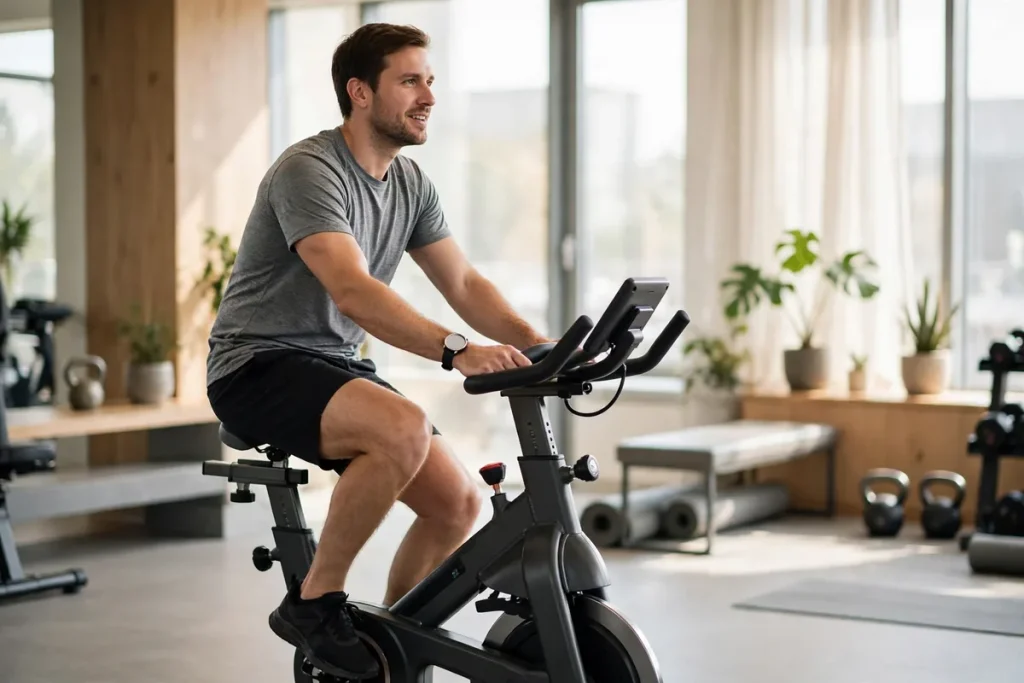

Your Zone 2 heart rate is 60-70% of your maximum heart rate — an easy, conversational intensity where you can still speak in full sentences. It does not feel like much of a workout. That is precisely the point, and it is why Zone 2 has become the base that endurance athletes — and increasingly everyone else — build their fitness on.
Below you will find your Zone 2 range by age, how to estimate your maximum, how to check your intensity with no watch at all, and how much of it to do each week.
One note first: this article is general information, not medical advice. If you have a heart condition, or you take medication that affects heart rate — beta blockers are the common example — your numbers can shift substantially, so check with your clinician before training by heart rate.
What Zone 2 Actually Is
Training intensity is usually divided into five zones, expressed as percentages of your maximum heart rate. Each zone feels distinctly different:
| Zone | % of max heart rate | How it feels |
|---|---|---|
| Zone 1 | Under 60% | Very easy — warm-ups and recovery walks; you could sing |
| Zone 2 | 60-70% | Easy — full sentences, relaxed breathing, sustainable for a long time |
| Zone 3 | 70-80% | Moderate — sentences get choppy; comfortably uncomfortable |
| Zone 4 | 80-90% | Hard — only a few words at a time; minutes, not hours |
| Zone 5 | 90-100% | Maximal — gasping; seconds to a couple of minutes at most |
Zone 2 is the top of easy: the fastest you can go while your breathing stays calm and conversation stays possible. Physiologists sometimes pin it to the effort just below where lactate starts building faster than you can clear it — but for everyday purposes, if it feels easy and you can talk, you are in it.
Why Zone 2 Matters
At low intensities, a larger share of the energy you burn comes from fat, simply because fat is a slow-burning fuel and Zone 2 is a slow-burning pace. That does not make it a magic fat-loss zone — total calories still rule — but it does mean long, easy sessions can burn a lot of energy without beating you up.
The deeper benefit is in your cells. Mitochondria are the tiny structures inside your muscles that turn fuel and oxygen into usable energy — your aerobic engine. Easy, high-volume training is the strongest everyday signal for your body to build more and better mitochondria, and a bigger engine raises everything: how fast you can go at the same heart rate, how quickly you recover, how steady your energy feels.
There is a health angle too: a strong aerobic base is consistently linked with better metabolic markers — steadier blood sugar, healthier blood pressure — in large population studies. Zone 2 alone will not transform those numbers in a week, but as the repeatable core of an active life, it is the kind of training most people can still be doing at 70.
And Zone 2 is gentle. The injury and burnout risk is low, it barely interferes with the rest of your training, and most people finish a session feeling better than they started. That is why it complements harder training instead of replacing it: the intervals and the lifting build the top end, and Zone 2 builds the base underneath.
Step 1 — Estimate Your Max Heart Rate
Everything starts from your maximum heart rate — the highest rate your heart can reach in an all-out effort. Testing it directly is miserable and unnecessary; estimate it instead. The classic formula is 220 − age. A 40-year-old gets an estimated max of 180 bpm.
A newer formula, from researcher Hirofumi Tanaka, usually lands closer: 208 − (0.7 × age). The same 40-year-old gets 208 − 28 = 180, while a 60-year-old gets 208 − 42 = 166, versus 160 from the classic formula — a small but real difference at older ages.
Whichever formula you use, treat the answer as a neighborhood, not an address. Individual maximums scatter about ±10 bpm around these estimates — two healthy 40-year-olds can honestly have maximums of 172 and 189. Use the estimate to build your first range, then refine it with the talk test below.
Step 2 — Your Zone 2 Range by Age
Applying 60-70% to the classic 220 − age estimate gives the standard Zone 2 ranges:
| Age | Estimated max (220 − age) | Zone 2 range (60-70%) |
|---|---|---|
| 20 | 200 bpm | 120-140 bpm |
| 30 | 190 bpm | 114-133 bpm |
| 40 | 180 bpm | 108-126 bpm |
| 50 | 170 bpm | 102-119 bpm |
| 60 | 160 bpm | 96-112 bpm |
Notice how the ranges slide down with age — that is the maximum falling, not your fitness. A fit 60-year-old working at 105 bpm may be at exactly the same relative effort as a fit 25-year-old at 135.
If your watch or an old test has shown you a real maximum that differs from the formula, use yours — a measured number beats any population average. And if your range surprises you by feeling too easy, that is normal at first; see the grey-zone section below.
No Watch? Use the Talk Test
Your breathing is a built-in heart-rate monitor. At Zone 2 you can speak in complete sentences, comfortably, without gasping between phrases — recite a paragraph, hold a conversation, or sing a chorus quietly. The moment your speech breaks into short phrases, you have crossed into Zone 3; single words mean Zone 4 or above.
Two more free gauges agree with the talk test. Perceived effort: Zone 2 feels like about 3-4 out of 10 — working, but unhurried. Breathing: you can still breathe through your nose for much of it. Many coaches trust the talk test over wrist-based numbers, because it auto-adjusts for heat, fatigue, caffeine and everything else that pushes heart rate around.
How Much Zone 2 Per Week
For beginners, start with 2-3 sessions of 30-45 minutes a week. That is enough to begin building the base, and it is recoverable from day one — you should finish each session feeling like you could have done more.
A common general target is roughly 90-150 minutes of Zone 2 per week in total, spread however your schedule likes. More is fine when recovery allows — endurance athletes log many hours — but the benefits come from consistency over months, not from one heroic Sunday. When you do build, add roughly 10% duration at a time.
Where does Zone 2 fit with everything else? Think of it as the floor of your week, not the whole building. One or two harder sessions and some strength training sit on top of it comfortably, because Zone 2 leaves you fresh enough to actually do them well.
And it does not demand special clothes, a gym or a recovery day afterward: a 40-minute easy walk after dinner, a relaxed spin while you watch a show, a lunchtime loop around the block — it all counts. Several short, truly easy sessions spread across the week beat saving it all for one long weekend effort, especially while you are building the habit.
Best Zone 2 Activities
The best Zone 2 activity is the one where you can hold a steady, controllable effort. Incline treadmill walking is the beginner favorite because the belt holds your pace honest — our treadmill pace chart converts speeds into the paces you will be working at. Stationary cycling is equally good and kind to your joints, which is why so much Zone 2 happens on a bike.
Rowing machines, ellipticals, easy swimming and outdoor cycling all work. Outdoor walking counts too — our guide to how long it takes to walk 5 miles shows how far those easy minutes actually take you. Easy jogging belongs on the list only if you are already fit enough to jog while chatting; for most beginners, jogging drifts straight out of Zone 2, and there is no shame at all in walking the hills.
A quick gear note: a chest strap reads more steadily than a wrist sensor when your arms swing or grip handlebars, but for steady Zone 2 work a modern watch is usually close enough — and the talk test above costs nothing and never needs charging.
The #1 Mistake: The Grey Zone
Almost everyone new to Zone 2 makes the same mistake: they drift into Zone 3 — too hard to be easy, too easy to be hard. It feels productively moderate, which is exactly the trap. Zone 3 costs real fatigue but delivers neither the base-building volume of Zone 2 nor the top-end stimulus of Zone 4, and grey day after grey day is how people stall and burn out.
The second trap is subtler: heart-rate drift. Across a long session your heart rate creeps upward even at a perfectly steady pace, thanks to heat, dehydration and accumulating fatigue. An hour-long walk that starts at 118 bpm can end near 132 without you speeding up at all. The rule is simple and slightly humbling: the zone wins, not the pace — slow down, walk the hill, let the ego go.
That willingness to go slower than feels impressive is, honestly, the whole skill of Zone 2. Your fitness adapts quietly in the background; a few months later, the same heart rate buys you a noticeably faster pace, and that is when it clicks.
Frequently Asked Questions
What heart rate is Zone 2?
60-70% of your maximum heart rate. Using 220 − age, that is about 120-140 bpm at age 20, 114-133 at 30, 108-126 at 40, 102-119 at 50 and 96-112 at 60. Your personal range may honestly sit a few beats either side of these.
Is Zone 2 good for fat loss?
It helps: at Zone 2 intensity a high share of the fuel you burn is fat, and because the effort is easy you can accumulate a lot of total calories over a week. But fat loss itself is decided by your overall calorie balance — Zone 2 is a good tool, not a loophole.
Can I do Zone 2 every day?
Generally yes — true Zone 2 is gentle enough for daily training, and many people do 30-60 easy minutes most days. Keep the discipline of staying genuinely easy, and take rest days whenever fatigue, soreness or life says so.
Why does my heart rate go above Zone 2 when I walk uphill?
Hills raise the workload at the same speed, so your heart rate climbs with the gradient. The fix is simple: slow down, shorten your stride, or ease off on the steep parts — pace serves the zone, not the other way round.
Is the 220-minus-age formula accurate?
Only roughly. Individual maximums vary by about ±10 bpm around the estimate, so treat your range as a starting band and refine it with the talk test: if you cannot speak in full sentences, you are above Zone 2 whatever the formula says.



Pingback: Is Swimming Good Exercise? Benefits, Calories Burned & Endurance Tips
Pingback: What Is a Good VO2 Max? Age & Sex Charts (And How to Test Yours)