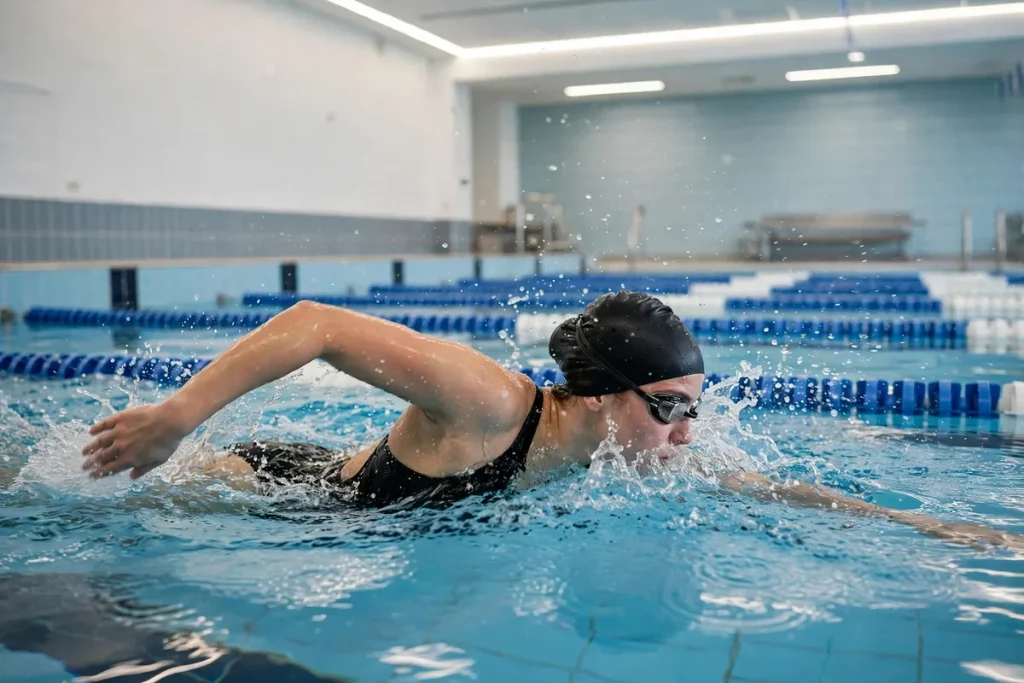

Is swimming good exercise? Yes — swimming is one of the best all-round exercises there is: it works your whole body, spares your joints, burns roughly 400-700 calories an hour, and builds serious heart-and-lung fitness.
The one genuine trade-off is that the water does the supporting for you, so swimming does not load your bones the way walking or running does — and it will not build visible muscle the way lifting does. Below is the honest case for the pool: the benefits, how many calories it burns, how many laps make a real workout, and how to build endurance from your first ten minutes.
This article is general fitness information, not medical advice. If you have a heart or lung condition, or you are coming back from an injury, check with your clinician before starting a swimming program.
Why Swimming Is Such Good Exercise
First, it is genuinely full-body. A freestyle stroke works your back, shoulders, arms, core and legs on every length; backstroke, breaststroke and butterfly rotate the emphasis further. Few other workouts recruit this much muscle at once.
Second, it is vigorous without the pounding. Water supports roughly 90% of your body weight, which makes swimming the rare exercise that can raise your heart rate into a training zone while treating your joints gently. That is why it is a favorite for people with knee or ankle issues, and for older adults who still want intensity.
Third, your heart and lungs get a serious workout. The horizontal position changes how blood circulates, and the forced, rhythmic breathing means you cannot slack off the way you can on an easy walk. Regular swimmers build strong aerobic bases — and that fitness carries over to everything else you do.
It is a mind workout too. The rhythmic breathing and stroke counting make swimming oddly meditative; many swimmers say it is the clearest-headed part of their day.
And the bone caveat, stated plainly: because the water holds you up, swimming does almost nothing for bone density. Walkers and runners load their skeletons with every step. If swimming is your main exercise, a couple of days of weight-bearing activity a week — walking or strength training — keeps that base covered.
One honest cost to factor in: pools are not as free as sidewalks. Membership or lane fees, travel time and pool hours are real constraints, and they are the main reason people stop swimming. If access is the barrier, no exercise is good enough to justify an unsustainable routine — pick the pool you will actually keep going to.
Which Stroke Should You Use?
For endurance, freestyle (front crawl) is the default: it is the fastest and most efficient stroke, and the one every plan in this article assumes. If you only learn one stroke well, make it this one.
Backstroke and breaststroke are excellent alternates. Backstroke keeps your face out of the water (breathing is easy) and is kind to the neck; breaststroke is slower and calmer, and many beginners find it the most comfortable stroke to learn. Rotating strokes across a session spreads the muscular load and gives tired shoulders a break.
Butterfly is the fourth stroke and the outlier: spectacular, exhausting, and a poor choice for building endurance. Admire it, race it if you like, but do not base your weekly volume on it.
Calories Burned Swimming
Per-hour calorie estimates by body weight and intensity. These are standard MET-based estimates — useful ranges, not laboratory measurements:
| Weight | Leisurely laps (1 hour) | Vigorous freestyle laps (1 hour) |
|---|---|---|
| 125 lb | ~420 kcal | ~590 kcal |
| 155 lb | ~520 kcal | ~735 kcal |
| 185 lb | ~620 kcal | ~880 kcal |
Treat every number as a range with your name on it. Efficient swimmers burn less at the same speed than beginners fighting the water do — good technique makes you faster and cheaper at the same time. Your effort, stroke and rest breaks all move the real number up or down. For context, an hour of moderate swimming sits in the same ballpark as an hour of steady jogging for most people, with far less impact.
To make it concrete: a 155 lb swimmer doing an easy half hour burns roughly 260 kcal — about the same as a small sandwich. Swum vigorously, that same half hour is closer to 370. Small numbers per session, big numbers per month.
How Many Laps Is a Good Workout?
Forget chasing a magic lap number — distance and time are what count. As a rough guide in a 25-meter or 25-yard pool (where one lap means one length of the pool):
Beginners: 10-20 lengths (250-500 m) is a real session. If you need a rest every length, take it — stopping at the wall is part of training.
Intermediate: 30-40 lengths, roughly 750-1,000 m in 30-40 minutes, is a solid workout.
Strong swimmers: 60+ lengths (1,500 m and up) per session.
A kickboard for leg sets and a pull buoy for arm sets add variety and let one half of your body recover while the other works — a neat trick for stretching a session out when you are tired but not done.
In open water, stop counting laps entirely and think in minutes: 20 easy minutes of continuous swimming is a real workout, and 40-45 minutes puts you firmly in intermediate territory.
How to Increase Your Swimming Endurance
Endurance in the pool is mostly skill plus patience. The practical ladder:
1. Technique first. In swimming, efficiency beats effort. A streamlined body position and a calm breathing pattern (many swimmers breathe every three strokes) do more for your endurance than extra muscle. A lesson or two — or simple drills like catch-up freestyle and side-kicking — pays back faster than extra laps ever will.
2. Build gradually. Add roughly 10% distance per week — the same rule runners use. The water hides fatigue well, so a cap keeps you honest.
3. Use intervals. Swim short repeats with rest: for example 8 × 25 m with 20-30 seconds rest, progressing to 4 × 50 m, and eventually continuous swims. Intervals build endurance faster than swimming until exhaustion every time, and they keep sessions interesting.
4. Swim 2-3 times a week. Consistency matters more than heroics. Two regular sessions beat one monthly marathon, because water feel — that sense of balance and glide — fades quickly when you are away.
5. Mix strokes. Alternating freestyle with backstroke or breaststroke spreads the load across muscle groups and keeps long sessions from getting stale.
6. Keep it mostly easy. The bulk of endurance swimming should feel like Zone 2 — conversational, controlled effort where you could keep chatting. Save the hard repeats for a small slice of each week.
One more honesty note: almost every beginner runs out of breath before their muscles give out. That is a technique and breathing problem, not a fitness verdict — and it is exactly why step one is technique.
A little dryland helps too. Core strength holds your body flat in the water, and body position is most of the efficiency battle; a few minutes of planks and dead bugs a few times a week is plenty.
A Simple 4-Week Starter Plan
Assume a 25 m pool, 2-3 sessions a week, and full permission to rest at the wall. If any week feels hard, repeat it instead of pushing on — the plan waits for you.
| Week | The target |
|---|---|
| Week 1 | 2 swims, 10-15 minutes of easy lengths with rests as needed |
| Week 2 | 2-3 swims, 15-20 minutes of short intervals (25 m repeats) |
| Week 3 | 3 swims, 20-25 minutes with longer sets (50 m repeats) |
| Week 4 | 3 swims, 25-30 minutes, including one continuous 10-minute block |
After week four, you own a routine. From here, keep the same skeleton and add distance: a few extra lengths per session, a fourth day when life allows, or longer continuous blocks. Endurance now compounds — the second month grows faster than the first did.
How Often Should You Swim?
Two to three times a week is the sweet spot for most people — enough to keep your water feel and build fitness, easy to fit around work. Swimming is gentle enough that daily easy sessions are fine once you are conditioned, but beginners should take at least one rest day between harder sessions while their shoulders and technique catch up.
If you also lift or run, swimming slots in as the low-impact day: it adds training volume without adding pounding, which is exactly what aging knees ordered.
Getting Started at the Pool
You need less gear than you think: a swimsuit, goggles that seal, and a towel. A cap keeps hair out of the way and the pool filters happy — optional, but appreciated. Learn the lane etiquette before your first session: swim on one side of the lane (usually the right), circle-swim when you share, and let faster swimmers pass at the wall.
Start in the shallow end, make sure you can float and tread water comfortably, and keep the first sessions short — the pool will still be there tomorrow.
Swimming vs Running
Neither wins outright — they cover different weaknesses:
| Swimming | Running | |
|---|---|---|
| Joint impact | Very low | High — the main injury source |
| Calorie burn | Strong (400-700/hr) | Slightly higher at matched effort for most |
| Bone loading | Almost none | Yes — bones adapt and strengthen |
| Access | Needs a pool | Just shoes and a door |
| Muscle built | Upper body and core emphasis | Legs, glutes and calves |
The tiebreaker is the boring one: the best exercise is the one you will repeat for years. Many people do both — swim for the low-impact volume, run or lift for the bones. If you are building a weekly routine from scratch, start from the site’s beginner workout plan and slot your swims in alongside it.
Runners who add a weekly swim often find it is the best recovery session they do: it moves blood through tired legs with zero impact. Swimmers who add a weekly run or lift get the bone loading the pool cannot give. The two sports are genuinely complementary.
Safety Notes
Swimming is safe when you respect it. Never swim alone in open water, and know your limits in any water: cold, currents and fatigue are the three real hazards. Rest at the wall without embarrassment — strong swimmers do it constantly. In pools, swim where a lifeguard can see you, learn to float and tread water before venturing deep, and tell someone your plan if you swim at quiet hours. And if you have a heart or lung condition, or you are returning from an injury, check with your clinician first; swimming’s gentleness makes it tempting to overdo early.
Frequently Asked Questions
Is swimming good exercise for weight loss?
Yes. An hour of swimming burns roughly 400-700 calories depending on your weight and effort, and the low joint impact makes it easy to repeat often. But weight loss is still decided by your total calorie balance — swimming is an excellent tool for the spending side of that equation.
How many laps should I swim for a good workout?
For most people, 20-40 lengths of a 25 m pool is a solid session; beginners should start at 10-20 lengths and build up. Time and distance matter more than the lap count — aim for 20-40 minutes of actual swimming.
How can I increase my swimming endurance?
Technique first, then add about 10% distance per week, swim intervals (such as 8 × 25 m with short rests), get in the water 2-3 times a week, and keep most of it at an easy, conversational effort.
Is swimming better than running?
Neither is strictly better. Swimming wins for joints and full-body muscle use; running wins for bone loading and convenience, and usually burns slightly more at matched effort. The one you will keep doing beats either on paper.
Why am I so hungry after swimming?
Cool water plus full-body work often raises appetite more than land exercise does. Plan a protein-rich meal after your swim rather than fighting it — the hunger is real, and it is manageable.