A medium red onion, about 110 grams as purchased, has about 44 calories. Per 100 grams, red onion gives you 40 calories with 9.3 grams of carbs and 1.7 grams of fibre. That combination of big flavour, very few calories, and a useful amount of fibre makes the red onion one of the highest flavour-per-calorie ingredients in the kitchen. You can slice a whole medium onion into a salad or over a grain bowl and barely move the calorie needle.
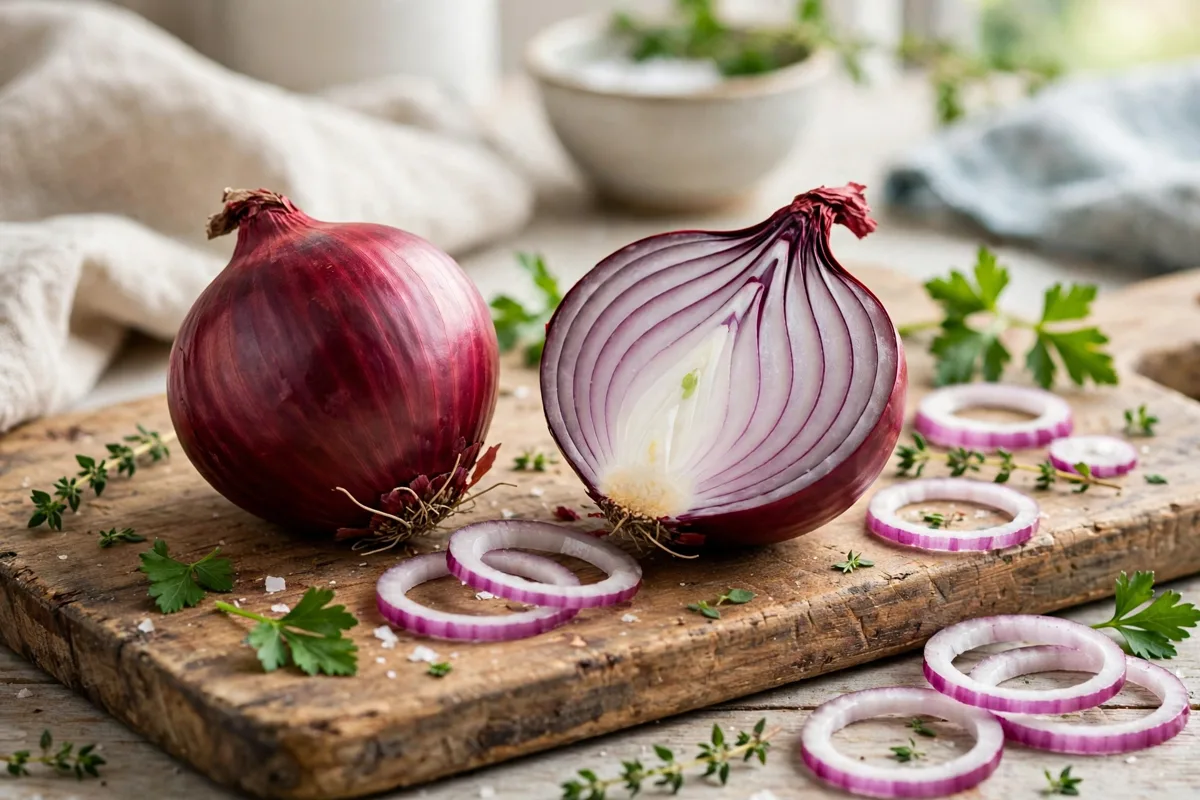
This guide breaks down red onion calories in every practical form: per onion, per cup, per slice, and per 100 grams, plus the full nutrition picture and how red onions compare with yellow and white onions. It also covers what cooking and pickling do to the numbers, because the way you prepare an onion matters far more than which onion you pick.
All figures below are based on USDA values for raw red onions. Calories are rounded to the nearest whole number, and weights are given as the edible portion you would actually eat. A medium onion here means a typical grocery-store red onion of about 110 grams, and the cup figures are for sliced onion unless stated otherwise.
Red Onion Calories by Serving Size
Most recipes ask for a slice, a tablespoon, a half cup, or a whole onion, so here are the calories for each in a quick table. A single slice is almost negligible, and even a full cup of sliced red onion lands under 50 calories:
| Portion | Calories |
|---|---|
| 1 tablespoon chopped (10 g) | about 4 |
| 1 slice (14 g) | about 6 |
| 1/2 cup sliced (57 g) | about 23 |
| 1 medium onion (110 g) | about 44 |
| 1 cup sliced (115 g) | about 46 |
| 100 g | 40 |
One detail worth noting: the calories scale almost perfectly with weight, because the calorie density of raw onion is so low and consistent. If your onion is a little bigger or smaller than the ones in the table, just scale by weight at 40 calories per 100 grams and you will be within a calorie or two of the true figure.
Red Onion Nutrition per 100 g
Here is the full nutrition breakdown for 100 grams of raw red onion. It is mostly water with a modest amount of carbohydrates, a little fibre, and very little fat or protein:
| Nutrient (per 100 g, raw) | Amount |
|---|---|
| Calories | 40 |
| Protein | 1.1 g |
| Carbs | 9.3 g |
| Sugars | 4.2 g |
| Fibre | 1.7 g |
| Fat | 0.1 g |
| Water | about 89 g |
The sugars figure deserves a note. Those 4.2 grams are intrinsic sugars — the onion’s own natural sugars, not added sugar of any kind. They are the reason raw red onion tastes faintly sweet under its sharpness, and the reason onions caramelise so well in a hot pan. At about 4 grams per 100 grams, the sugar content is roughly the same as a carrot, so in normal portions it is a non-issue for most people.
The 1.7 grams of fibre is a quieter win. Onion fibre is mostly soluble, including fructans — prebiotic fibres that feed beneficial gut bacteria. You will not get a fibre-rich meal from onions alone, but they contribute steadily to your daily total in almost every cuisine, because they show up in the base of so many dishes.
Red vs Yellow vs White Onions
When it comes to calories, the three main onion colours are practically identical: about 40 to 42 calories per 100 grams for red, yellow, and white onions alike. The fibre and water contents are close enough that no calorie tracker needs to distinguish them. The one outlier in the allium family is the shallot, which is richer at about 72 calories per 100 grams — but shallots are smaller and usually used in smaller amounts, so that difference rarely matters either.
Red onions carry anthocyanins, the purple pigments responsible for their colour. Anthocyanins are antioxidants, and they are absent in white onions. Red onions also tend to be richer in quercetin, a flavonoid antioxidant — red onions are among the top dietary sources of it. Just as important is how red onions get eaten: they are the onion most often served raw, on salads, in sandwiches, in salsas, and pickled. Eaten raw, their bite is milder than other onions’ and their antioxidants are fully preserved, since heat degrades some of them.
Yellow onions are the cooking default for good reason. They have a deeper, rounder flavour that intensifies beautifully when cooked — which is why almost every soup, stew, and sauce recipe simply says “onion” and assumes you will reach for yellow. Nutritionally they are the same as red and white, but because they are almost always cooked, you absorb slightly fewer of their raw-state antioxidants. In exchange, you get the best flavour return of the three in hot dishes.
White onions are the sharpest and crispest of the three when raw. They have the most assertive bite, which makes them the favourite for fresh salsas and Mexican dishes where a sharp onion edge is the point. They contain no anthocyanins. Their calorie and fibre numbers are, again, effectively identical to red and yellow.
Nutrition verdict: choose by dish, not by calories. Pick red for salads, sandwiches, and pickling, where its mild bite and raw-state antioxidants shine. Pick yellow as your everyday cooking onion. Pick white when you want a crisp, sharp raw onion. The calorie difference between them is a rounding error.
What Cooking Does to Onion Calories
Cooking changes onions dramatically in texture and flavour — but the onion itself stays low-calorie. What changes the dish is the oil. As water leaves the onion in the pan, its flavour concentrates and its natural sugars become more prominent, which is why a softened onion tastes so much sweeter than a raw one. No sugar is added by cooking: the sweetness was always there, just hidden behind the raw onion’s pungency and diluted by its water content.
The arithmetic of the pan is simple and worth memorising. One teaspoon of cooking oil adds about 40 calories to the dish, and one tablespoon adds about 120 calories. Saute a whole sliced onion in a teaspoon of oil and you are adding roughly 40 calories to the onion’s 46 — a modest, honest cost. Fry it in two tablespoons of butter and you have added 240 calories to a vegetable that started with 46.
Caramelised onions deserve their own warning label, though. Long, slow cooking converts and concentrates the onion’s sugars, so caramelised onions taste far sweeter than raw — and a cup of caramelised onion packs far more actual onion into the cup than a cup of raw slices, because the slices collapse down. Add the oil used for the long cook, and a cup of caramelised onion prepared with a tablespoon of oil lands around 150 to 190 calories total, mostly from the oil and the concentrated onion. That is still a reasonable number for what it does to a dish, but it is not a raw-onion number. If you want the soft, sweet result with minimal calories, try dry-sweating sliced onions in a non-stick pan with a splash of water instead of oil — it keeps the figures near the raw ones.
Pickled red onions are the happy middle ground. A quick pickle in vinegar with little or no sugar keeps them at roughly 40 to 50 calories per 100 grams, depending on the brine’s sugar content. They keep the raw crunch, add a bright acidic note that flatters tacos, salads, and grain bowls, and cost almost nothing calorically. Just check sweet commercial pickles, where a sugary brine can push the number noticeably higher.
Why Dieters Love Onions
The case for onions in weight management comes down to flavour-per-calorie economics. A whole medium onion — 44 calories — can carry an entire salad, lift a sandwich from bland to craveable, or form the aromatic base of a stir-fry. Very few ingredients deliver that much sensory payoff per calorie. Where diet food often fails is not on nutrition but on satisfaction, and onions are one of the cheapest fixes for that problem: they add savoury depth, sweetness when cooked, and sharp freshness when raw, all for a trivial calorie cost.
Beyond the calories, onions bring two genuine nutritional bonuses. First, their prebiotic fibres — mainly fructans — feed the beneficial bacteria in your gut, the same class of compounds that make garlic, leeks, and asparagus good for digestive health. Second, their quercetin content is unusually high for a vegetable; red onions are a top dietary source of this antioxidant flavonoid, which research associates with healthy inflammatory responses.
The honest limits matter too. Onions are a supporting actor, not a meal: they bring almost no protein, so they cannot carry satiety on their own. And raw onion in quantity bothers some stomachs — the same fructans that feed gut bacteria can ferment uncomfortably in sensitive people — while bothering all nearby noses. Think of onions as a seasoning vegetable: one of the best tools in a calorie-conscious kitchen, but still a seasoning.
Do Onions Count Towards Your Vegetable Servings?
Yes. In the 5-a-day style counting explained in How Many Servings of Vegetables Per Day?, about 80 grams of onion counts as one portion of vegetables. That means a medium onion, once chopped, is roughly one and a third portions on its own.
In practice, most people eat onion differently from how they eat broccoli or carrots: as a base ingredient spread across dishes rather than as a side. You may not sit down to a plate of onions, but the onion in your morning omelette, your lunchtime salad, and your evening stir-fry quietly adds up. It all counts towards your daily total, and because onions are so low in calories, they are one of the easiest vegetables to eat more of.
Onion-heavy cooking fits almost any calorie budget — set yours on the Maintenance Calories Calculator, then build your meals around flavourful, low-calorie bases like this one.
How many calories are in a red onion?
About 44 in a whole medium onion (110 g), 40 per 100 g, about 46 in a cup of slices and only about 6 in a single slice.
Are red onions healthier than white onions?
Slightly, on one axis: the purple pigment (anthocyanins) and higher quercetin give red onions an antioxidant edge, and they are often eaten raw, which preserves more of it. Calories and fibre are effectively the same.
Do red onions have a lot of sugar?
About 4.2 g per 100 g — the onion’s own natural sugars, roughly the same as a carrot. It is not added sugar, and in normal portions it is a non-issue for most people.
How many calories are in caramelised onions?
The onion stays low; the oil decides. A cup of caramelised onion cooked in a tablespoon of oil lands around 150–190 calories total, mostly from the oil and the concentrated onion. Dry-sweating them in a non-stick pan keeps it near the raw figures.
Are red onions good for weight loss?
Yes — few foods deliver this much flavour for 40 calories per 100 g. They make salads, eggs, sandwiches and stir-fries satisfying without moving the calorie needle.